 Videos
 Photos


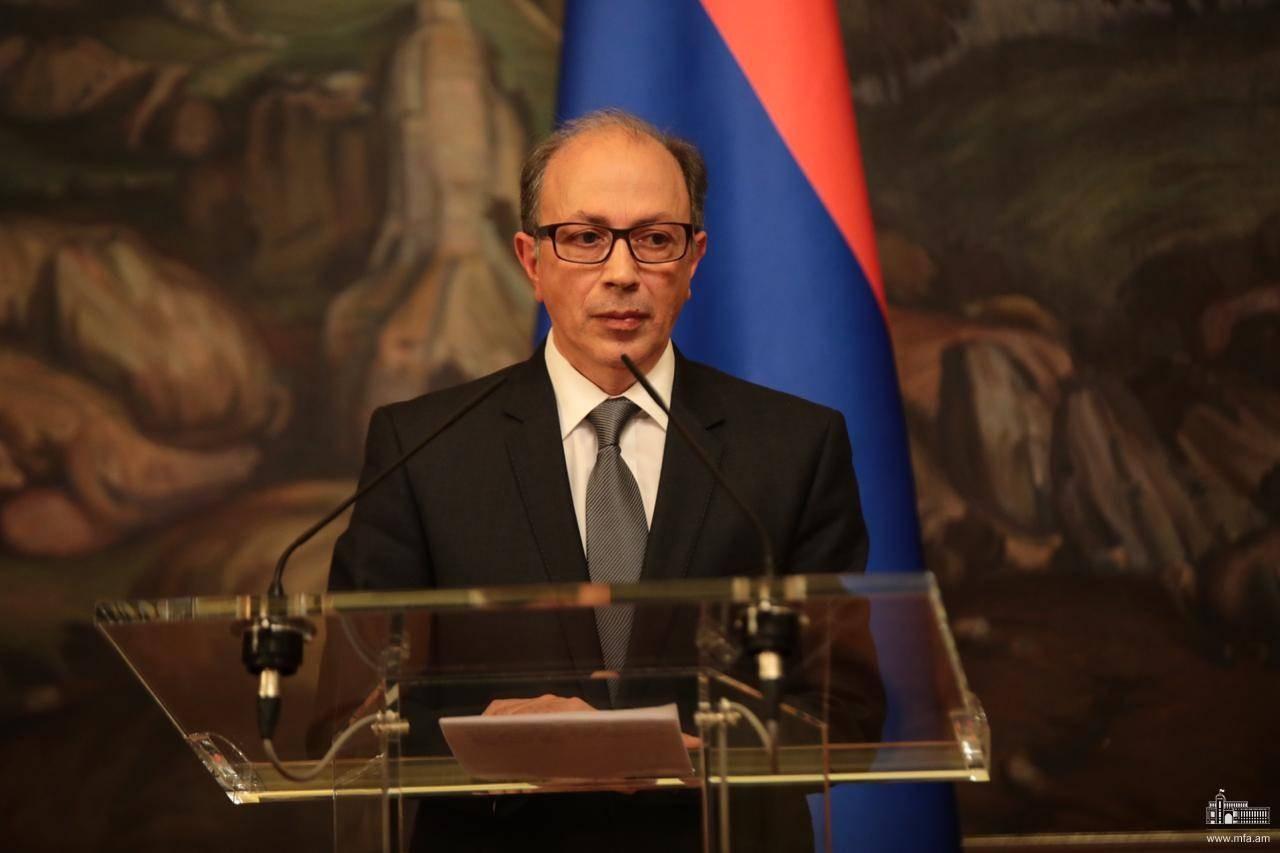
Armenian Foreign Minister in Moscow: "Self-Determination of Artsakh People Is At the Core of Nagorno-Karabakh Conflict".
Armenian Foreign Minister Ara Ayvazyan, now in Moscow on a working visit, made the following remarks for journalists following talks with Russian Foreign Minister Sergey Lavrov. Ayvazyan then responded to journalists’ questions.
First, I would like to thank the Russian side, represented by the Foreign Minister Sergey Lavrov, for the warm welcome and constructive, meaningful dialogue.
Notably my first visit as Minister of Foreign Affairs of Armenia is being paid to Moscow, which clearly speaks of the exceptional nature of relations between Armenia and Russia, moreover, I am sure that today's negotiations will give a new impetus for further strengthening and developing our allied relations.
Sergey Lavrov and I have already had the opportunity to meet in Yerevan, we have also constantly been in touch on various issues, and today's visit is a logical continuation of the already established tradition of relations between our countries and Foreign Ministries.
Today we have discussed in detail a wide range of international and regional issues, primarily, of course, the issue of regional peace and security. Naturally, the discussion mainly focused on the situation developed in our region over the past months and in the light of the joint statement adopted on November 9 of this year.
Russia played a key role in the cessation of the Turkish-Azerbaijani aggression unleashed against the people of Artsakh which lasted for more than six weeks. On November 9, due to the personal mediation of President Vladimir Putin, it became possible to agree upon and adopt a joint trilateral statement setting the establishment of a ceasefire on the ground and the deployment of a Russian peacekeeping mission in Nagorno-Karabakh.
The presence of the Russian peacekeepers creates conditions for the restoration of calm and stability in the region and serves as a guarantee against provocations from Azerbaijan, its regional sponsor and foreign terrorist fighters recruited by them.
The cessation of hostilities provides an opportunity for the resumption of discussions, within the framework of the OSCE Minsk Group Co-Chairmanship, on the restoration of the peace process.
We also discussed a wide range of issues regarding the extremely difficult humanitarian situation in Nagorno-Karabakh resulting from the deliberate targeting and methodical shelling of peaceful settlements and vital civilian infrastructure by the Azerbaijani armed forces. We are grateful for your prompt and effective participation in resolving humanitarian issues. In this context, we consider it important to engage specialized international organizations to solve humanitarian issues on the ground.
In the context of humanitarian issues, the priority is the immediate and unconditional exchange of the prisoners of war and captives, as well as the return of the bodies of those killed without delay. We expressed our readiness to conduct an exchange on the principle of “all for all” and expect that the Azerbaijani side will not pose impediments towards this process.
At the same time, the Azerbaijani side does not stop the inhuman treatment of the Armenian prisoners of war and civilians held as hostages. The Armenian prisoners of war, civilians who did not have enough time to leave their houses, are severely tortured and beheaded alive, in exactly the same way as ISIS treated hostages in the Middle East.
The manifestations of vandalism and desecration towards the Armenian monuments and religious sites - churches and monasteries in Artsakh are outrageous.
During this aggression and the following period, we and the international community have witnessed a new wave of manifestations of Armenophobic policy, which has been inflicted in the Azerbaijani society by the military-political leadership of Baku for decades.
In fact, Turkey, being the main provocateur and sponsor of the Azerbaijani aggression against the people of Artsakh, continues to pursue its devastating policy in the region. This makes the international community use all possible levers to force Turkey to refrain from any action that could further escalate tensions. Turkey should withdraw its armed forces and its sponsored terrorist groups from the Nagorno-Karabakh conflict zone and the South Caucasus in general. There are no clear signals about the withdrawal of foreign terrorist fighters so far. On the contrary, there is reliable information about Azerbaijan's plans to expand the geography of the spread of terrorist fighters and mercenaries and resettle them in the occupied areas of Artsakh.
During today’s negotiations I once again stressed the imperative of restoring the rights of the 150,000 people of Artsakh and implementation of those rights in their historical homeland.
With regards to the efforts towards the settlement of the Nagorno-Karabakh conflict, I would like to emphasize very clearly that the issue of self-determination of the people of Artsakh is at the core of the Nagorno-Karabakh conflict. Armenia stands and will continue to stand for the recognition of the right to self-determination and the security of the people of Artsakh.
The lasting and sustainable settlement of the Nagorno-Karabakh conflict should be achieved through the negotiations under the auspices of the OSCE Minsk Group Co-Chairs, which is the only format enjoying international mandate for the Nagorno-Karabakh peace process.
I once again express my gratitude for the warm welcome, Mr Sergey Lavrov. Thank You.
See Q&A section HERE
Comments (3)
Write a comment