 Videos
 Photos


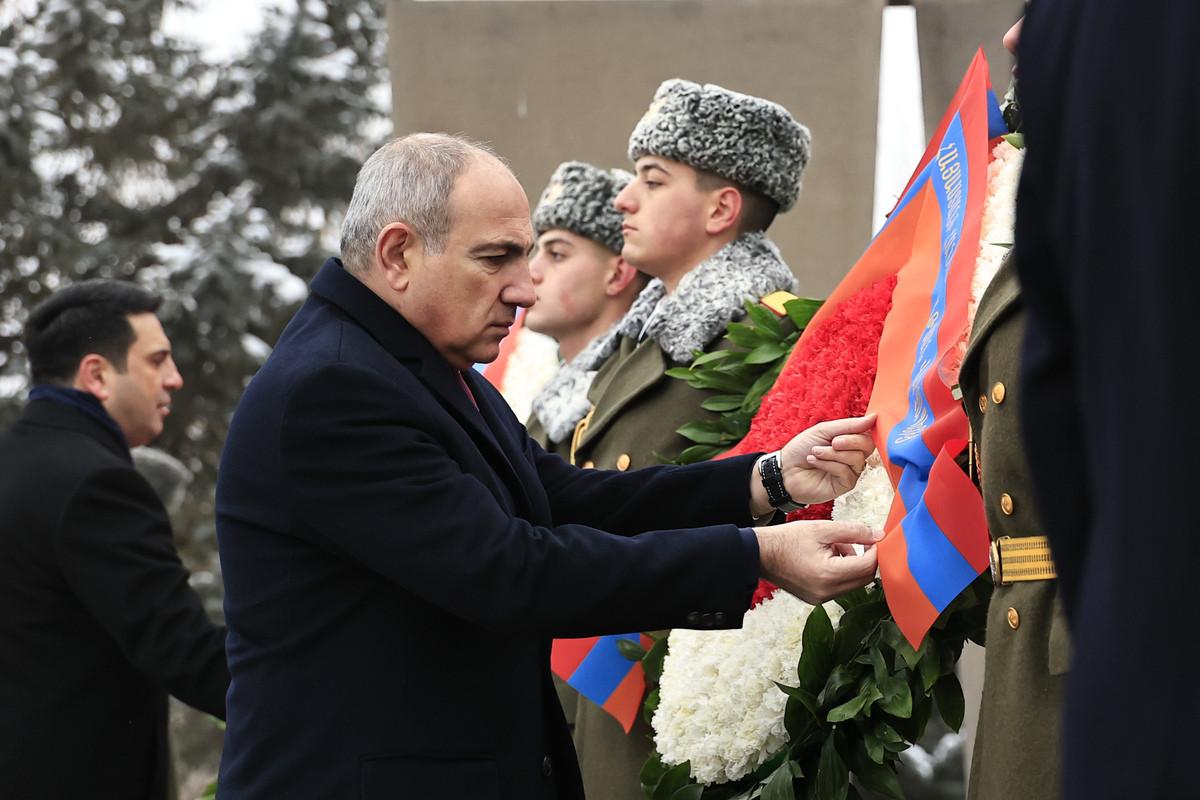
Pashinyan Says Armenia's Partners Refused to Sell It Weapons Prior to 2020 Artsakh War
Armenian PM Nikol Pashinyan, in his address today marking the 34th anniversary of the formation of the Army of the Republic of Armenia, claimed that the country’s international partners with the potential to sell weapons and equipment to Armenia refused to do so both prior to and after the disastrous 2020 Artsakh War.
Pashinyan says these unnamed international partners were afraid that such weapons might be deployed outside of Armenia or that the weapons’ technology would be made available to the Moscow-backed CSTO military alliance. He notes the years 2018-2022 when weapon sales were refused.
Pashinyan also blames CSTO for not delivering hundreds of millions of dollars in weapons and equipment to Armenia even though Yerevan had paid for them.
The Armenian prime minister says the above created “an existential threat to the Republic of Armenia” that was overcome when Armenia and Azerbaijan, in 2022, recognized each other's territorial integrity and sovereignty based on the Alma-Ata Declaration of 1991, and the freezing of Armenia's membership in the CSTO.
Pashinyan added that the issue of Azerbaijan’s continued occupation of Republic of Armenia’s territory will be resolved when the borders of the two countries are delimited.
As of late 2025/early 2026, independent analyses indicate that at least 241 square kilometers (approximately 93 square miles) of internationally recognized Armenian sovereign territory is under Azerbaijani control.
This figure does not include the disputed Nagorno-Karabakh region, over which Azerbaijan regained full control in 2023. The current figure refers to Azerbaijani incursions made into Armenia proper, primarily during military operations in 2021 and 2022.
Pashinyan claims that his administration has made huge investments and reforms to bolster Armenia’s defense capabilities.
Pashinyan concluded his remarks by reiterating that peace has been established between Armenia and Azerbaijan and that there is no more reliable guarantee of security than peace.
Nevertheless, Pashinyan says the development of the army will continue, because the army is one of the most important institutions of the state, and it is extremely important to have a strong defense capable army to withstand the conditional threats of the future, in cases where diplomacy will not be able to do so.
Comments (1)
Write a comment