 Videos
 Photos


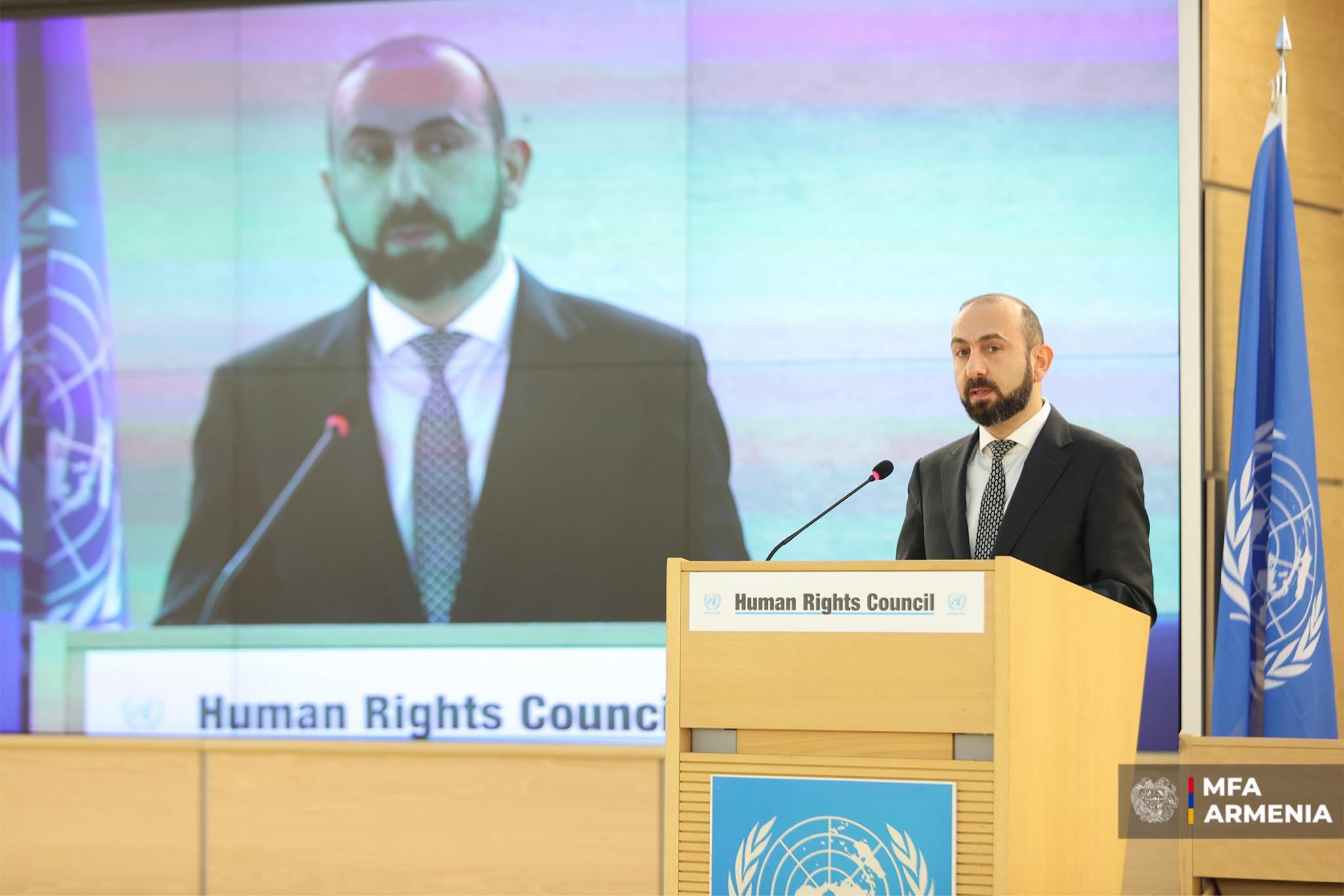
Democracy on the Rise in Armenia, Says Foreign Minister Mirzoyan
Armenian Foreign Minister Ararat Mirzoyan, on February 23, in Geneva, delivered the following remarks at the high-level segment of the UN Human Rights Council. (Transcript provided by Armenia’s Ministry of Foreign Affairs)
Let me first extend my heartfelt congratulations to the President and the members of the Bureau of the Human Rights Council on their election. I would also like to take this opportunity to convey appreciation to the High Commissioner for Human Rights and his Office.
For Armenia, our vision and intentions are unequivocally premised on the conviction that the human rights pillar of the United Nations must be further strengthened and adequately resourced to ensure prevention, accountability, and non-recurrence of violations and abuses of international human rights and humanitarian law.
Mounting conflicts and humanitarian emergencies, as well as systemic inequality and their irreversible global impact, warrant nothing less. Armenia stands ready to ensure that the ongoing UN80 initiative and the forthcoming review process of the Human Rights Council will serve as an important opportunity for honest reflection and concrete action to strengthen the Human Rights Council and its mechanisms as cornerstones of the UN human rights architecture.
Like many other democracies these days, our society is also facing a huge wave of hybrid threats, including disinformation, manipulation and foreign interference. Those are targeted, systemic, hostile campaigns designed to achieve specific goals, including undermining trust of our citizens in democratic institutions and the effective enjoyment of human rights. Confronting these challenges has become a daily activity through continuous strengthening of the democratic resilience.
Years of sound reforms, higher levels of rule of law and human-rights-based policies, as well as transparent and accountable institutions have produced tangible development outcomes, also reflected in internationally recognized indices. In the Freedom in the World 2025 report of Freedom House Armenia received a 54 out of 100, with significant scores for political rights and civil liberties.
Quite remarkably, in 2025 Armenia ranked 34th on the Reporters Without Borders World Press Freedom Index, marking a significant improvement from 43rd place of the previous year.
According to the World Economic Forum’s Global Gender Gap Report 2025, Armenia ranks among the top countries in women’s educational attainment and has seen steady increases in women’s representation in all spheres of political life.
In line with Armenia’s commitment to consolidating implementation of its human rights obligations, last year Armenia established its National Mechanism on Implementation, Reporting and Follow up, and launched its supportive digital tool – the Armenia’s Institutional Network for Monitoring and Reporting (AI-NEMRA), which serves as a centralized system bringing together recommendations issued by international and regional human rights mechanisms.
Armenia’s engagement, however, is not confined to domestic implementation. We seek to contribute substantively to the strengthening of global safeguards against the gravest violations of international law. In this context, at the present session of the Human Rights Council, Armenia will once again table the resolution on the Prevention of Genocide. The progressive development of this resolution has reflected emerging challenges at the intersection of international human rights law, international humanitarian law and international criminal law and has consolidated international consensus on the means to address them. Support by all member states to this important resolution will be a much-needed signal of our shared obligation to end the scourge of genocide.
After decades of violent conflict and humanitarian emergencies, Armenia together with Azerbaijan took decisive actions towards establishing long-term peace in our region. Last year’s Peace Summit in Washington not only established peace between the two countries but also paved the way for trade, connectivity and people-to-people contacts. To take this path beyond the agreements between governments, we are also planting the seeds of genuine dialogue and trust between our societies, including affected populations.
Though the painful humanitarian consequences of the conflict are still to be resolved and the wounds of the distant and recent past linger on, we have chosen the difficult path of reconciliation. This is indeed a difficult endeavor with 19 Armenian detainees still being held in Baku, and need for clarification of the fates of missing persons and cases of enforced disappearances, and amid dissemination of distorted historical narratives. Nevertheless, Armenia remains firmly committed to pursuing this path to its future-oriented conclusion with the understanding that further institutionalization of peace will foster a more conducive environment for addressing the consequences of the conflict.
In conclusion, I would like to underline that despite the immense pressure on multilateral institutions, we should remain voices of principled optimism and express our strong conviction that the human rights system and the United Nations will emerge from this process with reinvigorated capacities to fulfill their global mandate.
Write a comment