 Videos
 Photos


Iran War Hasn't Yet Impacted Armenia's Trade Flows; Transport Costs Have Increased
Eleven percent of Armenia’s total imports worth US$13 billion in 2025 and six percent of its total exports ($8.4 billion) passed through the country’s southern Meghri checkpoint bordering Iran.
Thus, the escalation of military operations in the region or the disruption of transport infrastructure passing through Iran can disrupt Armenia's trade flows and cause significant economic risks.
The Yerevan-based Armenian Center for Socio-Economic Studies (ACSES) published a paper this month studying how military operations in Iran can affect Armenia's trade flows.
Gas, iron bars, Chinese cars: Imports through the territory of Iran
The ACSES reports that not only Iranian goods enter Armenia through the Armenian-Iranian border, but also those from third countries, mostly China, and to a lesser extent, the United Arab Emirates (UAE).
See: Potential Effects of the Middle East War on Armenia-Iran Trade, Few Iranians Crossing Into Armenia to Flee War
According to the study, in 2025, the list of goods imported into Armenia through the territory of Iran is headed by gas, worth $101 million. Since 2009, Armenia has been cooperating with Iran on the principle of electricity exchange: Armenia provides electricity and gets natural gas in return. Armenia gives Iran 3 kWh of electricity for 1 cubic meter of gas. The terms of the program are periodically extended.
$68 million worth of iron rods (toothed rebar) came in second. Chinese manufactured passenger cars worth $57 were third on the list. In 2025, 3,578 cars were imported into Armenia through the Meghri checkpoint.
Petroleum bitumen, oil products, steel rolls, tires, cement, tobacco raw materials, etc. are also imported into Armenia via the Meghri checkpoint. Tomatoes, butter, citrus fruits, and vegetables are also imported in smaller volumes.
According to the ACSES, in 2025, 89.1% of iron bars, almost all petroleum bitumen, 88.4% of cement, and 97.7% of calcined molybdenum concentrate imported to Armenia transited the Meghri border crossing.
If trade across the Armenian-Iranian border is suspended or flows are reduced, Armenia will be forced to look for alternative routes to maintain communication with the outside world to avoid deficits or inflation.
“In-depth interviews conducted with transport companies show that as of early April, no disruptions in supplies and exports have been recorded. However, there is a certain increase in transportation costs, especially in cases where the routes pass through zones of active military operations,” the ACSES report states.
Cigarettes, electricity: 6% of Armenia's exports in 2025 passed through the Meghri checkpoint
Only 17% of the goods exported from Armenia across the Armenian-Iranian border are sent directly to Iran. The destination of most of the Armenian goods passing through Iran is not Iran, but third countries, mainly Iraq, and to a certain extent also the UAE.
Cigarettes are mainly exported from Armenia to Iraq through Iran. Cigarettes also dominate Armenian exports to the UAE. In 2025, Armenia exported or re-exported cigarettes worth $338 million across the Armenian-Iranian border.
As for the goods intended specifically for Iran, electricity is of key importance ($75 million). As mentioned above, this is being implemented within the framework of the “Gas for Electricity” program.
On April 8, the U.S. and Iran reached an agreement on a two-week ceasefire.
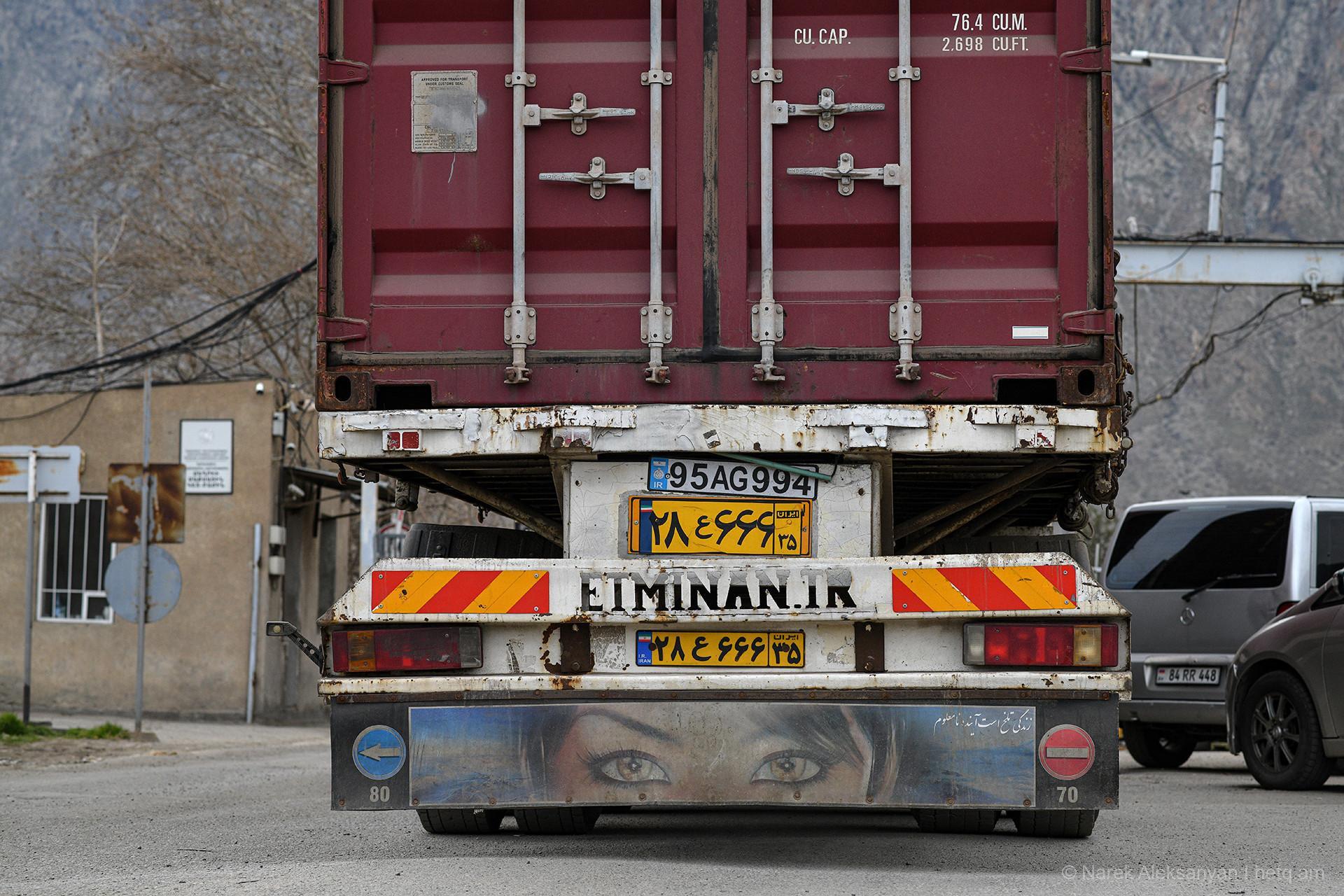
Top photo: Cargo truck on the Armenian-Iranian border (Narek Aleksanyan, hetq.am)
Write a comment