 Videos
 Photos


Environmental Issues Take a Back Seat in Armenia’s Election Campaign
In November 2026, Armenia will host the UN World Summit on Biodiversity, COP-17.
Hundreds of heads of state, thousands of international delegates, and environmentalists will arrive in Yerevan to discuss the ecological future of the planet in Armenia. While official Yerevan is trying to show the world its interest in global environmental issues, nature conservation is in last place in the election programs of the forces seeking to win seats in the country’s next parliament. What are the political forces promising this time to solve Armenia’s environmental problems?
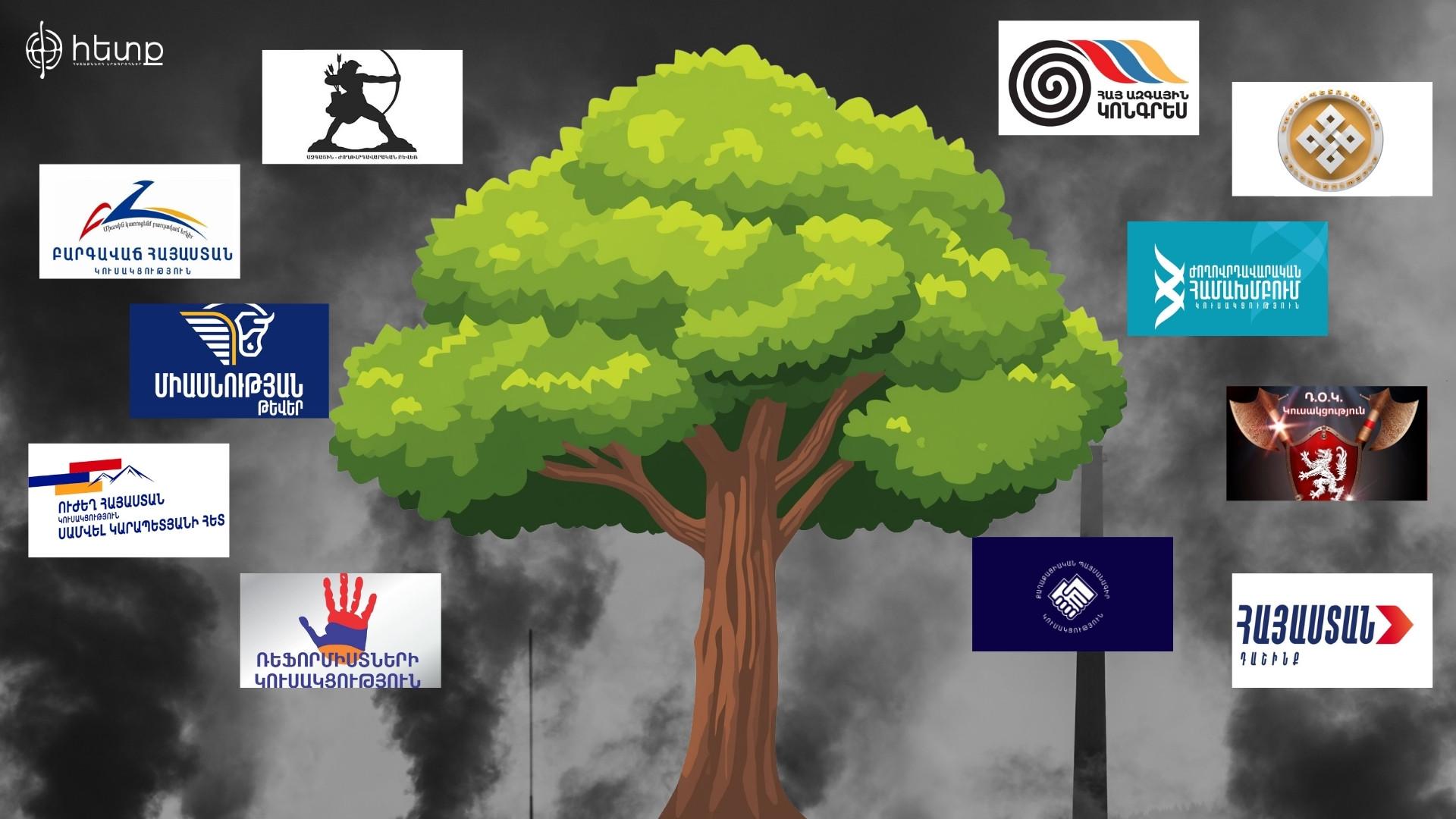
Eighteen political forces are participating in the 2026 parliamentary elections. The election programs of ten political forces have been published on the Central Election Commission website, and some forces have presented their programs or political priorities on their own websites. The For the Republic, Shonorhapetakan, Kocharyan National Revival and National Awakening and Christian-Democratic parties do not have election programs.
Not everyone is interested in environmental protection. The programs of the Reformists, National Democratic Pole, New Force Reformist Party, Bright Armenia, and I Am Against Everyone do not refer to ecology at all.
Civil Contract Party
The ruling Civil Contract (CC) party knows the language of numbers very well. In terms of the party’s main priorities, the program is clear: the construction of 300 schools and 100 kindergartens, the establishment of an academic city, a salary rate of 300 thousand drams for teachers and the TRIPP project. However, the section dedicated to environmental protection is very vague. When reading the ecological program of the current government, one experiences a sense of déjà vu.
The program states that nature conservation should be the center of public attention. The CC promises to introduce a solid waste management system and bring the mining sector into line with the best international standards.
The issue of solid waste was included in their program during the 2018 snap parliamentary elections, when the CC was part of the My Step alliance. They promised to develop a waste management strategy, which would result in the creation of waste recycling programs using advanced technologies.
The issue also remained on the agenda during the 2021 snap parliamentary election, when the CC pledged to establish a management system for radioactive, chemical, and biological hazardous waste.
Radioactive waste management has been talked about since 2010. Interdepartmental groups were created in 2017 to develop this waste management program. In 2019, the 2019-2026 program of measures and the implementation schedule for this waste were approved.
This same contradiction runs through the CC’s “100 Steps” program for 2026-2031. While the government proudly talks about hosting COP 17 and introducing an air quality monitoring system, on the other hand, we are faced with the economic part of the program.
The government is planning an industrial expansion that will directly increase environmental risks. The CC aims to raise industrial output from 3.3 trillion drams to 5 trillion, a 50 percent increase. It also plans to build a full-scale “Industrial City” and establish two additional industrial zones in the regions.
In summary, the economic benefit is clearly formulated in the CC program, while steps aimed at mitigating environmental consequences are not described. The government only offers general promises.
Strong Armenia Party
Strong Armenia talks about big economic goals but has forgotten about the environment. Top ecological issues are ignored in its 73-page election program. Water resources are mentioned here exclusively in the economic context of agricultural and energy development, and a significant part of the program is devoted to criticizing the unfulfilled promises of previous authorities.
The word ecosystem appears only once in the program, and then in a decorative formulation. Strong Armenia promises to deepen relations with the EU, from the environment to education. How such an economic leap will be achieved without harming the environment remains unanswered.
Armenia Alliance
Environmental issues are in last place in the Armenia Alliance program. The alliance promises that Yerevan will have clean air and that a new landfill will be built. Its only specific mentions of environmental protection are “environmental investments in exchange for state debt” and “protection of the Sevan ecosystem.”
Armenian National Congress (ANC)
The ANC plans to eliminate landfills and build garbage processing plants.
It promises to close the mines that pollute Yerevan’s air, prohibit further expansion of the mining industry, and set strict environmental standards for existing businesses. They propose to create a separate ministry to solve the water crisis. There is a special focus on water resources.
The party intends to reduce rainwater loss, complete the construction of the Yeghvard and Kaps reservoirs at an accelerated pace, and reduce the groundwater extraction rate from 50 m3 per second to 30.
The ANC, however, proposes large-scale economic and military programs that, in turn, will have a significant impact on the environment. The party is preparing to build a new nuclear power plant and establish its own military-industrial enterprises for weapons and ammunition.
Republic Party
The Republic Party proposes to create a Ministry of Water Resources and build new reservoirs. The party aims to start construction of a large modular nuclear power plant with the U.S. and France in 2027 and to create a Ministry of Atomic Energy for this purpose. The establishment of a new corporate city for 150,000 residents and the sharp expansion of the military industry directly multiply the risks of ecological damage. This implies enormous volumes of new radioactive and industrial waste. There is no word or mechanism in the program on how the party intends to protect the environment from this industrial expansion.
Prosperous Armenia Party
The party’s environmental promises are limited to Yerevan. The party wants to reduce Yerevan’s air pollution and establish a modern waste sorting and management plant.
The party bases its economic recovery on the construction of a new, powerful nuclear power plant and the operation of large industrial complexes. How the party plans to ensure a clean environment in the regions and what mechanisms it will use to neutralize this heavy industrial burden is not reflected in the program.
Wings of Unity Party
According to this party’s election program, clean air, safe water, and nature are not luxuries, but a fundamental right of every citizen.
“The polluter pays” is the principle adopted by the party. According to the program, strict environmental standards and public oversight will be introduced in the mining industry. The party promises to significantly reduce the volume of landfills by 2030 and to create a waste management system from garbage sorting to recycling. The party promises to restore Armenia’s forests.
The party believes that economic growth should not be “at the expense of nature.”
Democratic Unity Party
The party envisages the gradual nationalization of Armenia’s subsoil. This is the only provision of their election program on environmental protection.
Democracy, Law, and Order Party
The party promises to create ecotourism centers in Armenia. If the party enters parliament, no one will have the right to destroy the mountains, forests, and waters of Vayots Dzor for the sake of profit. There will be control over deforestation, Sevan will be a special state protection zone, new reservoirs will be built, and the mining industry will be under strict environmental control. In parallel, the party promises, however, to exploit the mines, directly for the sake of the state, to create processing plants in Syunik, complexes to produce finished products of copper, molybdenum, and other metals, and to restore the powerful industrial sector in Lori.
EcoLur NGO President Inga Zarafyan, who is busy preparing for COP 17, notes that the summit is an opportunity for local environmentalists to make their proposals heard.
Zarafyan says that, over the years, political forces have repeatedly included environmental protection in their programs, but once in power, they prioritize business interests. Today, the focus is on job creation and industrial growth, with little attention to the environmental cost.
The election programs of parties competing in the parliamentary race reveal how they envision Armenia’s environmental future. As the state prepares to host high-level guests and present itself as committed to nature, the programs suggest that much of Armenia’s political elite remains detached from environmental concerns and, at best, indifferent to them.
Write a comment