 Videos
 Photos


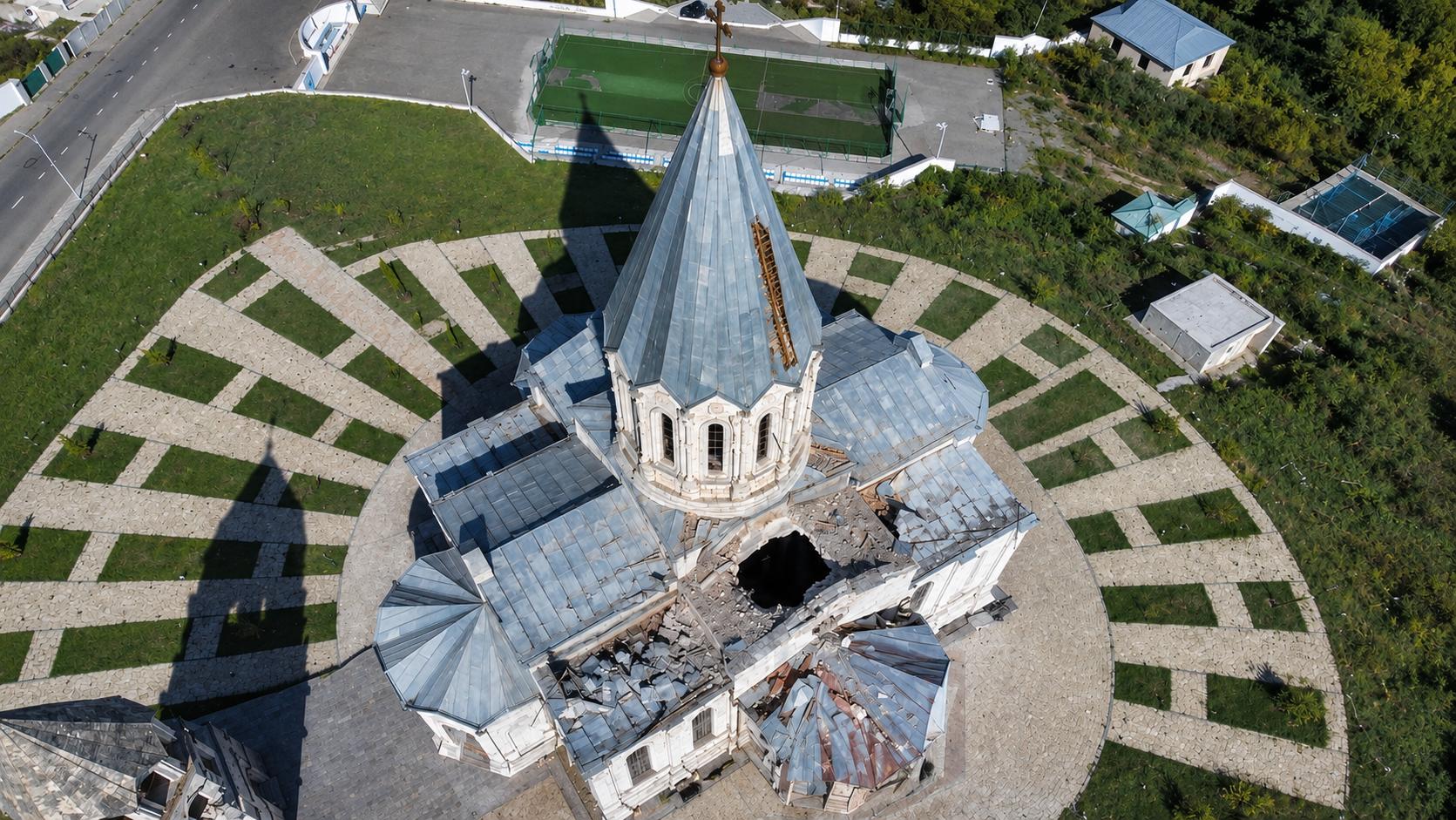
Cultural Erasure: Baku Uses Tourism to Rewrite Artsakh's History
By Mattis Choquart (Hetq intern)
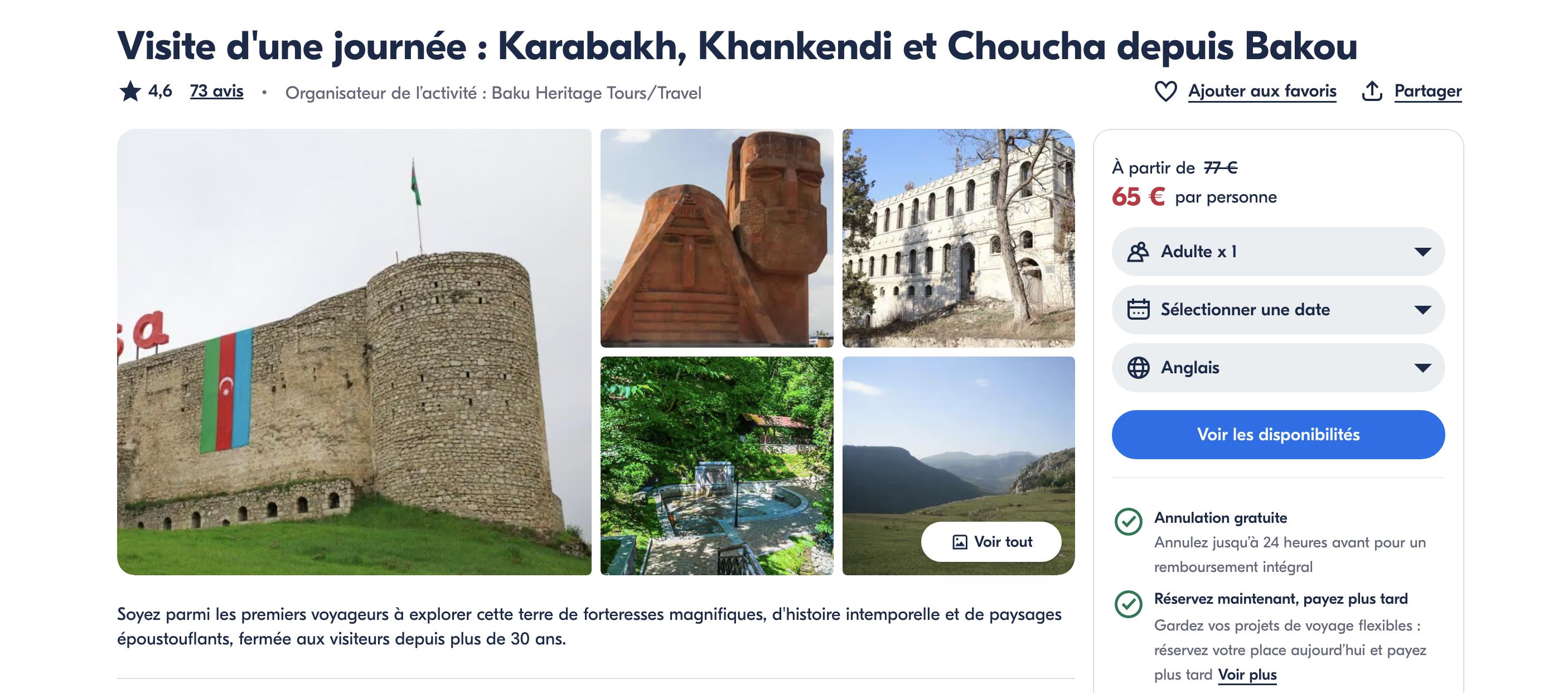
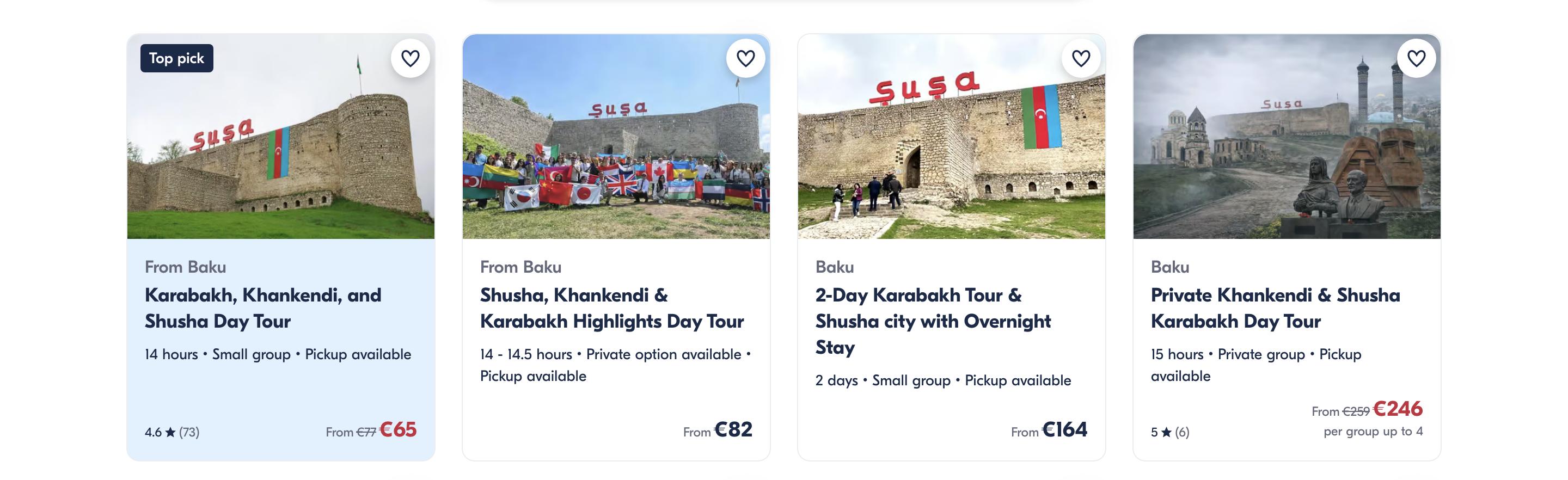
Sixty-five euros. That's the price on the GetYourGuide booking platform for a "one-day tour: Karabakh, Khankendi and Shusha from Baku. The listing promises to be among the first offering travellers the opportunity to explore a region “closed to visitors for over 30 years”.
Nowhere does it mention that this land was forcibly emptied of its entire Armenian population three years ago.
In September 2023, after a lightning offensive and months of blockade, over 115,000 Armenians fled Nagorno-Karabakh in a matter of days. Today, that same territory is being sold online as a tourist destination, and travelers from around the world are booking guided excursions.
The Narrative Machine
On GetYourGuide, recent reviews paint an idyllic picture. Rated 4.7 out of 5, 62 reviews, free cancellation, guides available in English, Russian, Turkish, Spanish and Italian.
An Australian traveler, in July 2026, says she was inspired "to see so many reconstruction projects after the war," a region "gradually restored to become a peaceful and magnificent destination again." A Turkish client speaks of "the country's resilience." The words keep returning: reconstruction, renaissance, resilience. These are the exact phrases used by Azerbaijani official communiques.
What these travelers describe is true. The past three years has seen a burst of new Azerbaijani construction projects in the region. But what they are shown is carefully curated. A Czech tourist, more critical, noted this in May 2026: "We were shown mainly renovated and rebuilt city neighborhoods, very carefully selected, where we were allowed to go, without really having time to observe sites for ourselves." He concluded: "If you want to see the real traces of what happened, go on your own."
This is impossible because Azerbaijan closely supervises the advertised tour. In a report from Füzuli in December 2024, a Radio France International reporter describes being accompanied constantly by a driver, a translator, and a state representative. Azerbaijani authorities cite mines as justification. But, notes the journalist, it is also "a way to frame, to monitor movements and people encountered."
This form of “controlled” tourism is not new and was not limited to anonymous clients booking online.
Since 2021, Azerbaijan has organized roughly fifteen trips for delegations from international traveler clubs, including Most Traveled People, led by American Charles Veley, ETIC, and the British club Piki Reels. The tours include military escorts, fixed itineraries, and sometimes end with breakfast with Hikmet Hajiyev, President Aliyev’s communications advisor. Many of these travelers, often well-intentioned, leave with images that reinforce the official narrative of renewal.
What Tourists Don't See
You only need to look at Karabakh by computer to understand what controlled excursions leave out. On Google Earth, archived satellite imagery allows you to travel back in time, year by year, and follow the fate of Armenian monuments in the region.
A computer-generated map of Karabakh quickly reveals what these supervised excursions omit. On Google Earth, archived satellite imagery lets viewers move year by year through the region and trace the fate of Armenian cultural monuments.
In Shushi, an Armenian place of worship, Kanach Zham, stood proudly in 2020. Today, no trace of this church is visible.
Farther north, near Tapakend, Erits stands as an isolated monastery amid the forests (40.2519 N, 46.6395 E), its history unfolding in three acts. In August 2019, the structure appeared intact. By August 2023, it had been partly destroyed at the dome. Images later surfaced of Azerbaijani soldiers filming themselves firing automatic weapons at the bell tower.
These acts of destruction were not mere collateral damage. They occurred after the ceasefire at sites no one could visit independently, and they are absent from tourist itineraries.
The Paradox of One-Sided Memory
The narrative ends where the other half of history begins. These visitors are not shown altered Armenian churches, vanished khachkars, or decaying monasteries far from any frontline. Destruction is presented selectively. Azerbaijani suffering is displayed, while Armenian suffering is erased from both the landscape and tourist guidebooks. In this organized silence, the real "show" is revealed.
The Operators' Responses
Questioned directly, tour operators hide nothing, they simply explain it away. When asked how they brief tourists on risks, they respond that "officially open and authorized zones" are presented before each tour, insisting on "the importance of following the guide's instructions." Yet, on the ground, tourists report that guides forbid photos of certain places and visits to certain locations, citing mine danger.
When asked about the region’s millennium-old Armenian presence, the operator replied, “These territories are internationally recognized as part of Azerbaijan, so our tours primarily present Azerbaijani history.” Asked about the visible destruction of Armenian churches and the displacement of 115,365 people, according to Armenia’s Migration and Citizenship Service, the operator declined to respond: “We do not engage in political debates.”
What is striking is that these are not real answers, but formulas: reflexive pronouncements with no humanity and no acknowledgment of complexity, only organized silence.
Tourists sense this as well. The same operator claims visitors are free to explore and see what they choose. Yet on GetYourGuide, a Czech tourist directly contradicts him: “We were shown only carefully selected, renovated rebuilt city neighborhoods where we were allowed to go. Without really having time to observe for ourselves.” The freedom operators describe exists only on paper.
A YouTuber who visited the region goes further, arguing that the excursion contributes to the ongoing erasure of Armenian history.
This YouTuber shared the following with Hetq.
"I wanted to visit the main cathedral in Stepanakert, but the guide refused to let us know why we couldn't go and what happened to it. We were not able to go anywhere other than the places in the itinerary. I was not free to move anywhere. We were only dropped off in certain places for a few minutes and went back into the car to the next site. The guide briefly mentioned Armenians as the first inhabitants, but the rest of the explanation turned negative. The guide constantly referred to Armenians as the illegitimate government and occupiers. The tour was frustratingly geared toward finding small pieces of Persian or Azeri legacy in a place dominated by Armenian heritage. So no, it was not balanced at all."
This is not passive historical neglect but organized reappropriation, where silence about the past helps normalize the present.
The Silence on Crimes
Yet crimes occurred. Armenian churches were deliberately bombed after the ceasefire; monasteries were vandalized; khachkars (stone crosses) were destroyed; and fortress walls were demolished. This systematic destruction was documented by satellite imagery and, at times, filmed by soldiers themselves. Still, none of it appears in tourist brochures.
Visitors walk over rubble without knowing the true story. They are shown "reconstruction projects" without ever being told what was destroyed. They are told about a "renaissance" without the context of the cultural cleansing that preceded it. It is a form of real-time denialism: rewriting recent history and selling tickets to tourists to view the aftermath.
GetYourGuide lists these tours without warning, context, or any reminder that visitors are entering a region where 115,000 people were expelled just three years ago, where war crimes were committed, and the heritage of a millennia-old civilization was systematically erased. What could be a complex historical visit is instead packaged as a propaganda tour: framed, censored, and sold as an experience of “discovery.”
Notably, the UN International Court of Justice issued provisional measures in 2021 and 2023 obligating Azerbaijan to prevent and punish acts of vandalism against Armenian cultural heritage. Yet these documented destructions continue without consequence. Azerbaijan has barred UNESCO fact-finding missions from the region for years, actively preventing international verification of the facts on the ground.
The Legal Trap
Nagorno-Karabakh was arbitrarily placed within Soviet Azerbaijan by the 1921 decision of the Bolshevik Caucasus Bureau, a party-political decision driven by Joseph Stalin, not an act of international law.
Even if many countries recognize that territorial assignment as legitimate, it does not justify destroying another community’s cultural heritage or normalizing the forced displacement of 115,000 people through commercial tourism. Tour operators invoke sovereignty to justify wholesale narrative reappropriation, but control over land does not confer the right to erase its past. Selling a region emptied of its population as a ‘discovery destination’ is not tourism; it is geopolitics disguised as leisure.
By aggregating these tours, GetYourGuide helps distribute them worldwide. Each five-star review and cliché of “renaissance” becomes free propaganda, reaching tourists who may never learn that a thriving indigenous Armenian presence once existed there.
Top photo: caucasuswatch.de
Write a comment