 Videos
 Photos


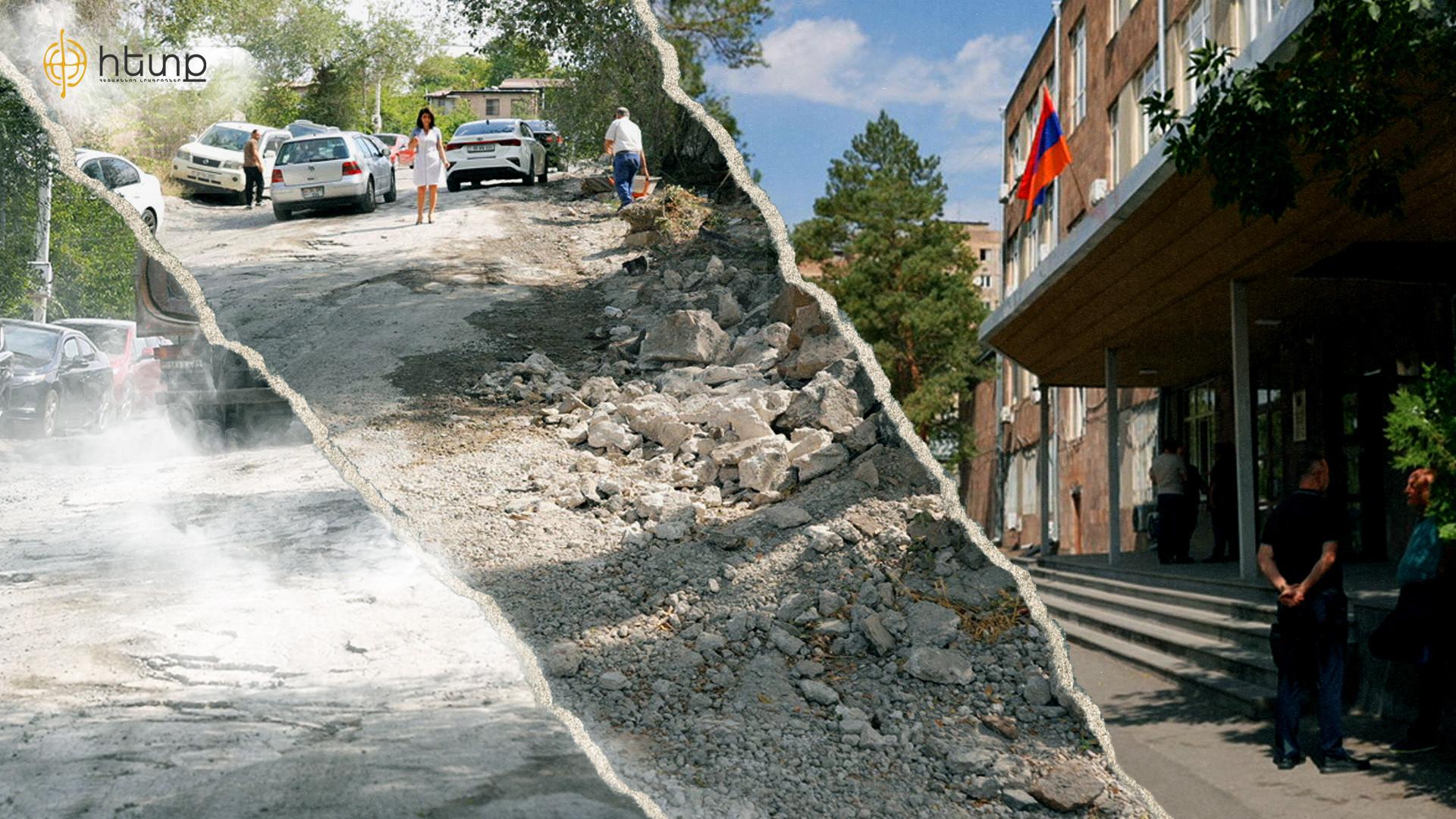
Choking on Dust to Recover Billions: The Dilapidated Road to Armenia’s Anti-Corruption Court
The road to justice in Armenia is quite literally paved with dust and broken concrete.
At Tbilisyan Highway 3/9 stands the nation’s Anti-Corruption Court, a pivotal institution tasked with reclaiming stolen wealth and safeguarding state and community interests. Inside its halls, massive legal battles unfold. In 2025 alone, lawsuits aimed at protecting public interests successfully recovered approximately 67 billion drams (around US$165 million). Meanwhile, the court is currently managing 155 high-stakes lawsuits seeking the confiscation of illicitly acquired assets valued at an astronomical 596 billion drams.
Yet, the infrastructure outside this bastion of accountability remains frozen in a bygone era.
A Broken Infrastructure Frozen in Time
The primary road leading to the courthouse is in a dilapidated and deplorable state. Over time, the asphalt has completely disintegrated, reducing long sections of the thoroughfare to mere dirt paths choked with loose stones and sand.
The physical deterioration is compounded by heavy industrial activity in the immediate vicinity. Located near the court are Yerevan Regional College No. 1, an Electric Networks of Armenia (ENA) station, and a sand storage site operated by the company "ML Mining." Heavy trucks laden with soil and sand continuously rumble through the area, kicking up thick clouds of dust that blanket the entire length of the road.
Choking on the Daily Commute
For those who must visit the court regularly, the daily commute has become a physical ordeal. Anna Melikyan, a legal expert with the non-governmental organization "Protection of Rights without Borders," frequently navigates this path for her work. She notes that the route is equally treacherous for both motorists and pedestrians.
"Especially when trucks are passing along the road, the dust is quite thick, and it is impossible to traverse that section without a mask," Melikyan says.
For many, the journey is made worse by the lack of transit options. Visitors who cannot afford a car or taxi must walk from the nearest bus stop to the courthouse. This creates an immediate dilemma for legal professionals, prosecutors, and court staff who must adhere to professional dress codes. "Athletic wear is not considered appropriate in state institutions," explains Melikyan. "So, a problem arises—especially for lawyers required to dress formally—as their shoes and clothes get completely covered in dust by the time they arrive."
To Melikyan, the road presents a glaring paradox. On one hand, the Armenian government declares the fight against corruption a top priority, even building a specialized judicial branch to manage it. On the other hand, the state fails to provide the most basic infrastructure necessary to access the court or ensure its smooth operation.
Beyond the Court: A Hazard for Students and Faculty
The consequences of this neglect extend far beyond the legal system. At Yerevan Regional College No. 1, the road has become a severe safety hazard. Armine Asatryan, an informatics and mathematics lecturer at the college, recalls instances where elderly faculty members fell on the uneven, broken surface, suffering severe fractures.
Despite the college director appealing to the city, no satisfactory solution was provided. The road is now actively harming the school's enrollment.
"When prospective students come for admissions and see the road, they wonder how they would manage to get here in the winter, rain, or mud, and they decide against it," Asatryan shares. "Essentially, we are losing students because of this road."
Silent Authorities and Unpaved Billions
Frustrated by a particularly blinding, dusty trek during a visit in August, Melikyan acted, filing a formal complaint with local authorities using the Yerevan Municipality’s "Active Citizen" platform. The response she received highlighted the deep-seated nature of bureaucratic inertia. The Yerevan Municipality acknowledged the road's dismal condition, admitting that it has been left untouched without any major repairs since the Soviet era. While city officials indicated that renovating the road might eventually be integrated into work plans for coming years, they offered no concrete timeline.
Seeking further answers, investigative outlet Hetq submitted a written inquiry to the Yerevan Municipality. The questionnaire pressed city officials on whether they were aware of the road's condition, if they had received past complaints, and if any municipal funds were being allocated for immediate repairs or a major overhaul. Hetq also asked if the city planned to restrict or regulate the heavy industrial truck traffic destroying the area. The municipality has yet to respond to the inquiry.
The reality on Tbilisyan Highway remains a striking contrast: inside the courtroom, judges and prosecutors fight to return stolen billions to the state treasury. Outside, those very same public servants are left choking on dust. While the state has proven highly capable of tallying its recovered billions, it has yet to figure out how to pave the single road used to reach them.
Write a comment