 Videos
 Photos


Two Worlds, One Language: How a 1962 Short Film United Soviet Armenia and the Global Diaspora
By Minas Urghoulian
In the landscape of Soviet Armenian cinema, few films occupy a more sacred and culturally indelible space than Arman Manaryan’s 1962 short film, Dzhvzhig (also known as Tjvjik or Fried Liver).
Conceived merely as a student thesis project at the Yerevan State Institute of Theatre and Cinematography, this 22-minute masterpiece stands as a towering achievement in compressed storytelling. Written by the director’s brother, Yervand Manaryan, and adapted from a 19th-century short story by Atrpet (Sarkis Mubayeajian), Dzhvzhig transcends its brief runtime to deliver a scathing critique of class dynamics, an intentional act of linguistic preservation, and a brilliant display of tragicomic acting.
Production Backstory: Subverting the Soviet Mold
The creation of Dzhvzhig was an act of quiet defiance against prevailing cinematic norms. In the early 1960s, state-run film apparatuses like Armenfilm operated under the strict watchful eye of Soviet bureaucracy, which aggressively championed Socialist Realism. The state favored grand, industrialized narratives, revolutionary histories, or idealized depictions of the Soviet working class.
A localized, psychological tragicomedy set in 19th-century Erzurum (Western Armenia) under Ottoman rule ran entirely counter to what Soviet authorities deemed useful. The Manaryan brothers faced pushback for choosing a narrative that resisted standard industrial and ideological templates. Furthermore, because shooting on location in Eastern Turkey was geopolitically impossible, the filmmakers faced the steep technical hurdle of meticulously reconstructing the tight alleyways and specific architectural textures of historic Erzurum using local Armenian village settings and studio backlots.
The Narrative Concept: The Anatomy of Toxic Charity
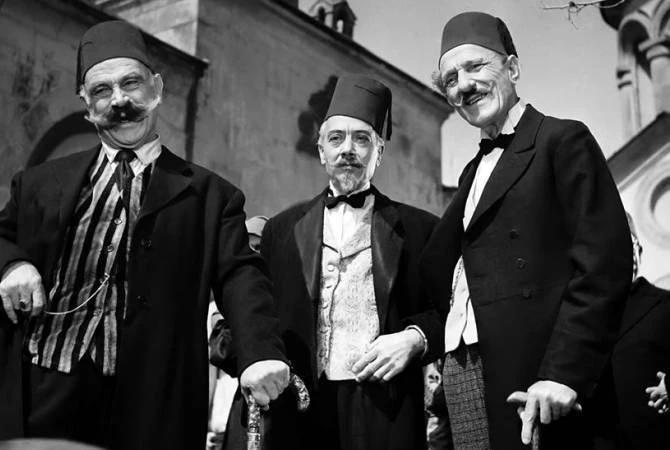
At its core, Dzhvzhig is an exploration of "toxic charity" and the psychological asymmetry of wealth. The plot centers on Nerses Akhpar (Hrachia Nersisyan), a proud but destitute man who receives a meager gift—a single piece of beef liver—from the affluent, arrogant merchant Nigoghos Agha (Tsolak Amerikyan).
What begins as an apparent act of benevolence quickly curdles into a tool of public subjugation. Nigoghos Agha cannot let the deed go unnoticed. Every time he encounters Nerses in the crowded streets, at the local tavern, or in the marketplace, he loudly reminds him—and everyone within earshot—of the liver he provided, demanding perpetual gratitude.
Manaryan brilliant tracks Nerses’s internal decomposition. The liver, long since digested and forgotten, transforms into an invisible, suffocating debt. The film builds toward a brilliant, cathartic climax where Nerses, driven to the brink of madness by public humiliation, buys a piece of raw liver, tracks down his tormentor in a public square, and hurls it directly into Nigoghos Agha's face, screaming, "Here is your liver!" It is a profound, universal statement on human dignity: the poor would rather starve than feed on charity that demands the surrender of their self-respect.
The Visual and Sonic Craft: Why Black and White?
Though color film technology was widely accessible by 1962, Manaryan consciously opted for monochrome cinematography. This stylistic choice serves a dual purpose:
- Historical Authenticity: The black-and-white framing grounds the film in a gritty, documentary-like reality, evoking the aesthetic texture of 19th-century photography.
- Socio-Economic Contrast: The absence of color strips away distractions, forcing the audience to focus entirely on the stark visual contrasts between the characters. The frame isolates the wealth gap between Nerses’s threadbare, dusty clothes and Nigoghos Agha’s rich, heavy textiles, heightening the claustrophobic anxiety of Nerses’s public encounters.
Complementing this visual starkness is the minimal score by renowned composer Eduard Baghdasaryan. Rather than deploying a sweeping, melodramatic orchestral arrangement, Baghdasaryan crafted a sparse, atmospheric landscape. The music utilizes traditional folk-infused motifs that initially lean into the film's lighter, satirical comedic exterior. However, as Nigoghos’s psychological harassment intensifies, the score subtly shifts. The bouncy market melodies give way to tense, repetitive, and agonizing sonic rhythms, perfectly mirroring Nerses’s fracturing patience leading up to his final outburst.
Linguistic Importance: An Archive of Western Armenian
Perhaps the most lasting cultural legacy of Dzhvzhig is its linguistic architecture. It holds the historic distinction of being the first film produced entirely in Western Armenian. Following the 1915 Armenian Genocide, the western Armenian language—historically spoken across the Ottoman Empire—was plunged into an existential crisis as its surviving speakers scattered into a global diaspora. For the Manaryan brothers, making this film was an urgent exercise in cultural preservation.
The success of this linguistic experiment relied entirely on the actors' background. Legendary performers Hrachia Nersisyan and Tsolak Amerikyan belonged to an older, pre-Soviet generation of theater artists. Born in the late 19th century, they had lived, studied, or performed in major Ottoman cultural hubs like Constantinople and Smyrna before migrating to Soviet Armenia.
Consequently, they did not merely memorize their lines phonetically; they possessed an organic, native fluency in the cadence, regional idioms, and natural rhythm of Western Armenian. Their effortless delivery gave the dialogue an undeniable authenticity, cementing lines from the script so deeply into the national consciousness that phrases from Dzhvzhig remain standard idioms in everyday Armenian speech today.
Cultural Reception: A Unifying Mirror for Armenia and the Diaspora
Upon its release in 1962, Dzhvzhig achieved an immediate and enduring resonance that crossed geopolitical boundaries. Its impact was split across two distinct spheres—the local population of Soviet Armenia and the global diaspora—yet it served as a powerful cultural bridge between both.
In Soviet Armenia: A Relatable Classic and Linguistic Revelation
Within the Armenian SSR, the film was an instant critical and popular success. While Soviet censors initially looked askance at its avoidance of Socialist Realist tropes, the public embraced it for its deep humanity and subtle subversion of authority.
- The Transgression of Idioms: The dialogue was so brilliantly rendered that it immediately slipped into the local vernacular. Lines like "Here is your liver!" became shorthand in Soviet Armenian society to mock performative generosity or overbearing bosses.
- A Cultural Window: For Eastern Armenian speakers who grew up under the Soviet educational system, the film offered a rare, mainstream window into the linguistic world of their Western counterparts. It demystified a dialect that had largely been relegated to academic circles or the homes of recent repatriates, fostering a deeper sense of national cohesion.
In the Diaspora: An Emotional Lifeline and Act of Validation
For the global Armenian diaspora—scattered across the Middle East, Europe, and the Americas following the 1915 Genocide—Dzhvzhig was nothing short of a cultural revelation.
- Linguistic Validation: Prior to 1962, Soviet Armenian cinema was exclusively an Eastern Armenian medium. For diaspora communities who spoke Western Armenian, seeing their native dialect spoken on screen by actors of Hrachia Nersisyan’s caliber was a profound validation of their identity. It proved that their language was not a dying relic of history, but a living, breathing medium for high art.
- Preservation for the Youth: Diaspora schools and community centers frequently screened the film for younger generations. Because the short film used humor and a simple, compressed storyline, it became an effective educational tool to keep the endangered Western dialect engaging and accessible to children born far from their ancestral homeland.
The Merging of Two Worlds
Ultimately, Dzhvzhig performed a rare feat in 20th-century Armenian history: it united a politically divided nation. During the Cold War, ideological rifts frequently separated Soviet Armenians from diaspora organizations. However, Manaryan's film bypassed political theater entirely. By focusing on a shared, pre-Soviet history and a deeply human moral dilemma, Dzhvzhig became a universally cherished cultural touchstone that belonged equally to Armenians in Yerevan, Beirut, Fresno, and Paris.
Write a comment