 Videos
 Photos


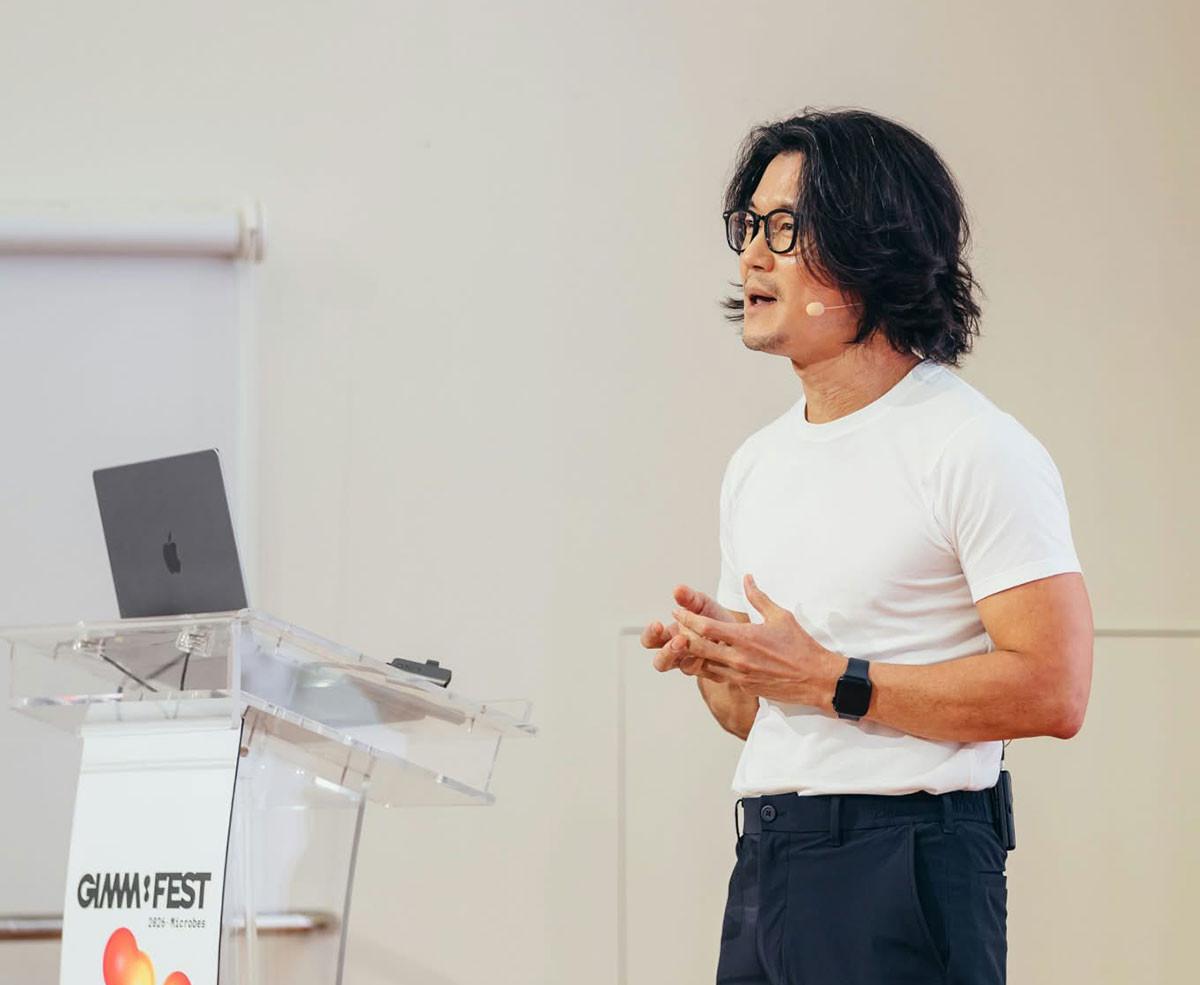
From Gut to Target: Turning Human Bacteria into Precision Anti-Cancer Couriers
LISBON — In a quiet room, on the sidelines of the GIMM Festival 2026, a major scientific forum organized by the Gulbenkian Institute of Molecular Medicine—renowned synthetic biologist Matthew Chang sat with a notebook, listening to fellow speaker and Nobel laureate virologist Charles Rice. In a joint interview with journalists from Armenia, France, Romania, and North Macedonia, Chang called his colleague’s talk a "brilliant lesson in biology" before introducing a groundbreaking lesson of his own: engineering the human microbiome to fight cancer.
Decoding the Trillions Within Us
As the director of a leading laboratory at the National University of Singapore, Chang specializes in synthetic biology—one of the fastest-growing branches of modern science. His research focuses heavily on the human microbiome, the trillions of bacteria, fungi, and viruses living inside and on us. Chang explained that the gut microbiome possesses a powerful, distinct impact on a vast array of biological functions, ranging from heart rate to skin health.
"We aim to develop methods for the targeted and controllable modification of the microbiome," Chang noted. By modifying the natural properties of these microorganisms, his team is using them as experimental tools to uncover the exact biological mechanisms governing how microbes interact with their human hosts, particularly during the onset and progression of diseases.
Engineering Microbes as Target-Seeking Missiles
To map these complex pathways, Chang’s lab employs advanced bioengineering approaches to endow ordinary, harmless human microbes (commensals) with entirely new properties. The core objective is to program these bacteria to selectively navigate and attach to specific tissues within the body.
"In one of my laboratory's previous studies, we sought to endow microbes with a new property: the ability to selectively bind to specific cells," Chang explained. His team successfully engineered natural human microbes to recognize and latch onto colon cancer cells, a breakthrough previously published in the journal Nature Biomedical Engineering.
A New Biological Delivery System for Cancer Drugs
Building on that success, the laboratory—which maintains a massive library of microbes isolated from human samples and food products—turned its attention to nasopharyngeal carcinoma, a type of cancer highly prevalent in Southeast Asia and Southern China.
After screening their collection, the scientists identified natural microbes that possess an innate affinity for these specific cancer cells. By analyzing their molecular biology, Chang's team uncovered the surface proteins responsible for this binding mechanism and used them to design a highly advanced biological conjugate.
Essentially, while conventional treatments like chemotherapy aggressively flood the entire body and damage healthy cells, Chang’s laboratory is transforming the bacteria already living inside us into highly precise biological "couriers." Equipped with anti-cancer medications, these microparticles act as targeted delivery systems, traveling straight to the tumor and allowing the drug to hit its target with unparalleled precision.
HETQ: You note that the core idea of your work is the possibility of reprogramming and transforming the functions of microbes and cells. Is this the path by which you can help humanity solve global challenges?
Chang: My laboratory focuses on engineering the microbes within our bodies to turn host-microbe interactions into a controllable, validated parameter. While past research primarily focused on observing loose correlations between the microbiome and disease, using engineered microbes provides a highly controllable platform to conclusively map these cause-and-effect relationships.
The Rise of Quantitative Data and Predictability
HETQ: You have mentioned that we may well be witnessing the dawn of quantitative biology. Why is this shift happening now?
Chang: Predictability in biological design is impossible without precise, quantitative measurements. Today, our measurement capabilities have expanded significantly, allowing us to apply strict metrics at the DNA and genome levels. In microbiome research, advanced imaging now lets us analyze the exact spatial distribution of microbes in the gut. As we gain a more precise, data-driven understanding of individual parameters, biology is transforming into an increasingly quantitative science, generating vast pools of data that can be paired with artificial intelligence.
Balancing AI, Generative Biology, and Biosecurity
HETQ: Is it easy to improve the way AI influences reality? Knowing that while AI cannot create life, it holds the potential to destroy it?
Chang: Publicly available DNA sequences are essentially a form of text, and large language models excel at processing text patterns. By training AI on these vast datasets, we can utilize it for "generative biology" to design specific, new biological functions. However, this capabilities can understandably cause anxiety regarding biosecurity and misuse. Because of these risks, we must approach biological AI design with immense responsibility.
Ensuring a Safe Path Forward
HETQ: How do we achieve that responsibility?
Chang: The only viable way forward is to actively foster frequent discussions and a continuous exchange of views among all key global stakeholders. We must maintain a highly comprehensive approach to regulation and ensure absolute transparency across the scientific community.
Write a comment