 Videos
 Photos


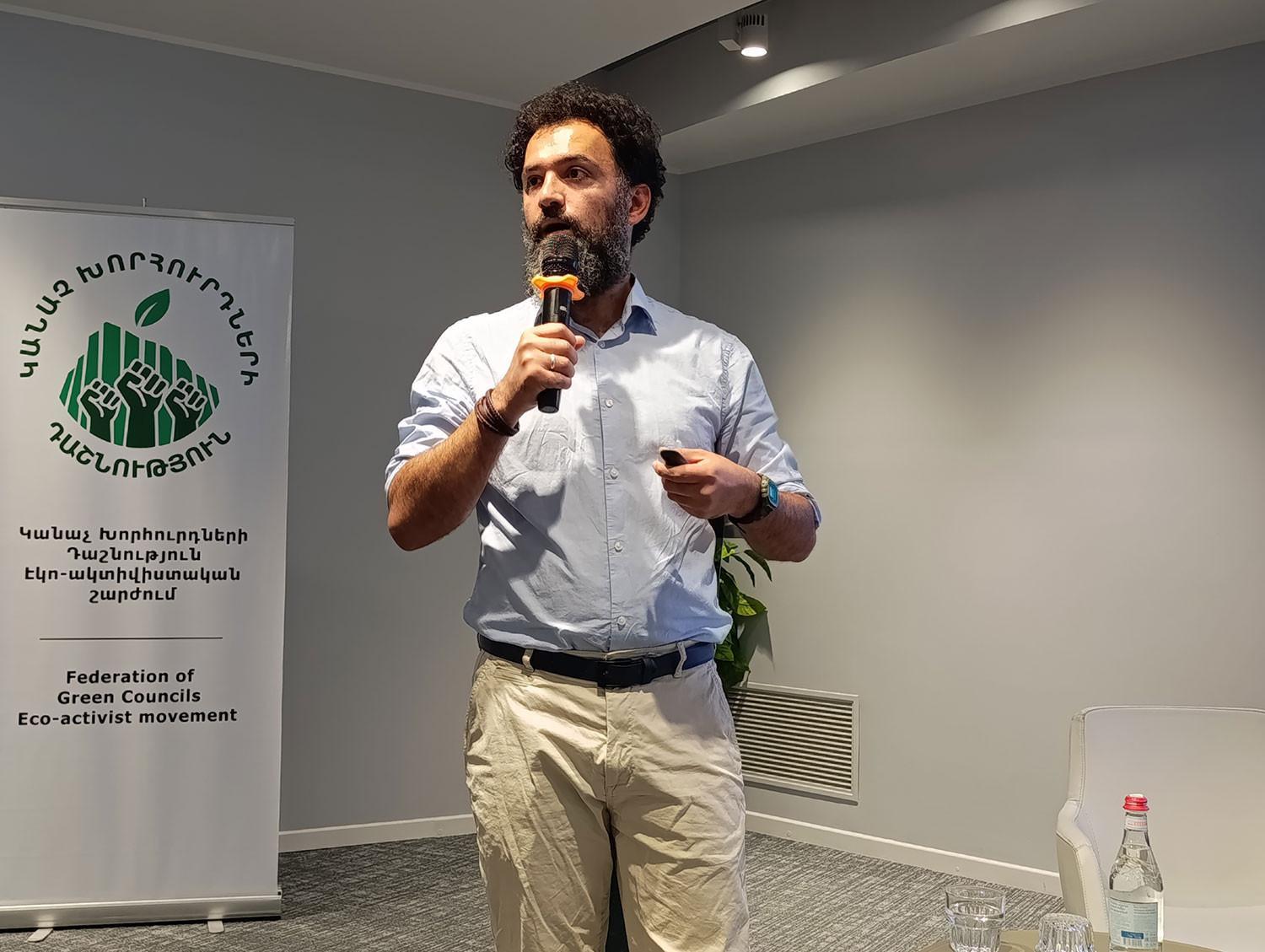
Activists Accuse Armenian Government of Suppressing Dissent Ahead of Global Climate Summit
YEREVAN— Armenian Prime Minister Nikol Pashinyan’s recent declaration of the official launch of the Amulsar gold mine as a "success story" has sparked sharp criticism from civil society, with environmental leaders warning of a dangerous shift in the government’s attitude toward public dissent.
Speaking in an interview with investigative outlet Hetq, Hayk Abrahamyan, co-founder of the eco-activist movement Federation of Green Councils, argued that the administration increasingly views public protest as a risk to be managed or neutralized rather than a legitimate form of civic participation.
Government Under Fire Over Anti-Protest Stance
During the mine's opening ceremony on October 10, Pashinyan highlighted the total absence of local protests as evidence of the project's smooth initiation. Abrahamyan called this perspective highly problematic, suggesting it extends far beyond the Amulsar dispute.
"This mindset could lead us toward far more problematic developments," Abrahamyan told Hetq. "Protest is viewed not as an opportunity to address underlying concerns, but rather as a challenge to be managed... It reflects a specific attitude held by the Government toward public participation."
Why the Resistance Fell Silent
The Amulsar gold mine project has faced fierce public opposition for over a decade, primarily led by the nearby resort community of Jermuk. Addressing why protesters were absent from the launch, Abrahamyan cited a prolonged, exhausting campaign by authorities and developers that fractured local unity.
The decline of the local resistance movement is attributed to several key compounding factors:
- The Pandemic and War: The compounding toll of the COVID-19 pandemic and recent military conflicts, which claimed the lives of several key local resistance figures.
- Security Narratives: Rhetoric intensifying after Azerbaijani military incursions, which claimed that foreign investments in mining provide implicit national security guarantees.
- Sustained Pressure: A long, draining process of systemic pressure designed to compel Jermuk residents to either fall silent or step aside.
Secret Launch Sparked Immediate Backlash
Abrahamyan further revealed that the official launch was executed in near-total secrecy without prior public announcement. The timing—occurring just ahead of the COP17 climate conference—caught the broader environmental movement off guard.
Despite the unannounced opening, civil society organizations, human rights groups, and environmental networks launched immediate critical reactions and targeted protest actions. Abrahamyan emphasized that the fight is far from over, promising continued international engagement and domestic statements. He also condemned the recent personal targeting of veteran environmentalists, warning against narrow public perceptions that seek to diminish the evolving nature of modern Armenian activism.
Shift Toward Community-Driven Activism
Critics argue that public expectation unfairly burdens "professional" or veteran activists with the sole responsibility of continuous resistance. Abrahamyan emphasized that these individuals are ordinary citizens who face burnout after years of sustained opposition, making shifts in their personal priorities entirely natural.
Instead of fading, Armenia's environmental movement is undergoing a decentralized transformation. This shift is evidenced by more than two dozen successful local interventions in the mining sector across communities such as Marts, Urrut, Gogavan, Shenavan, Gladzor, Arjut, and Stepanavan.
Media Blindspots and Local Successes
While high-profile cases like Amulsar dominate headlines, smaller community-led movements frequently avert environmental risks with little to no media coverage.
Key characteristics of this evolving activist landscape include:
- Decentralized Resistance: Activism is increasingly driven by local residents organizing within their own villages rather than relying on groups traveling from Yerevan.
- Proactive Policy Solutions: Contemporary movements focus on constructive alternatives rather than just opposition. For example, environmentalists recently designed an ecosystem protection policy for the Marmarik River, which was officially adopted by the Tsaghkadzor municipal council.
Abrahamyan called for greater media coverage of these localized victories, arguing that highlighting community-driven success stories is vital to shifting public perception and demonstrating the enduring strength of the broader movement.
"The Marmarik River suffers from very high levels of pollution. Rather than simply fighting against this pollution, the activists—by engaging the local community and other stakeholders—succeeded in developing a document that outlines the steps the community should take over the next decade to protect and develop the river's ecosystem. This activity also requires the attention of the media," said Abrahamyan.
"Judicial lawsuits aimed at silencing"
Abrahamyan told Hetq that since 2018, there has been an increase in Strategic Lawsuits Against Public Participation (SLAPP) filed against activists and journalists. According to Abrahamyan, more than half of these occurred in 2019–2020—the years immediately following the change of power.
He noted that while there has been no quantitative increase in recent years, a different trend has emerged. Abrahamyan explained that, whereas previously such lawsuits were typically filed by a single company, the number of entities initiating them has now grown. In other words, the range of those resorting to SLAPP suits has expanded. The scope of targets has also broadened: beyond activists, journalists and media outlets are now being targeted as well. Abrahamyan pointed out a recent instance where a representative from a regional governor’s (marzpet’s) staff became the target of a SLAPP suit.
"In other words, when discussing the scale and impact of SLAPP suits, we shouldn't just look at the numbers. We need to examine who is filing these lawsuits—has the number of plaintiffs increased?—who the targets are, and whether the types of activities being targeted by SLAPP suits have expanded. In every respect, the answer is yes," said Abrahamyan
Abrahamyan noted that they sought an Armenian equivalent for 'SLAPP “ since the objective of these actions is precisely to silence people. Furthermore, the intent is not merely to silence those directly targeted by the plaintiffs, but also to send a message to the broader public and affected communities: they, too, could face such lawsuits, so they would be wise not to dare speak out about these issues. The impact of "silencing lawsuits" manifests not only through the legal proceedings themselves but also through problematic elements, such as demands for unfounded, inflated compensation. The adjudication of these cases often spans years. According to Abrahamyan, they drain activists both financially and in terms of time. Furthermore, such lawsuits are frequently accompanied by smear campaigns against journalists and activists.
"Silencing Lawsuits" Used to Suppress Public Participation
According to Abrahamyan, SLAPP suits (Strategic Lawsuits Against Public Participation)—internally referred to as "silencing lawsuits"—are part of a coordinated corporate and state toolkit. These legal maneuvers are systematically weaponized alongside disinformation campaigns, false narratives, and personal smear tactics to compromise the private lives of watchdogs.
Local and international monitoring organizations warn that this environment induces a severe chilling effect. The financial and emotional toll of multi-year litigation deters not only those directly targeted but also forces the broader public and affected communities to become far more cautious about speaking out.
Executive Branch Fails to Act Ahead of COP17
To counter this aggressive strategy, the Federation of Green Councils submitted formal legislative proposals to the Armenian government. The framework urges the executive branch to adopt statutory protections aligned with European Union directives and Council of Europe recommendations to prevent groundless litigation from stifling civic engagement.
The eco-activist movement strongly pressured the government to introduce an anti-SLAPP bill or launch an official legislative review in the direct lead-up to the COP17 climate conference. Activists argue that establishing legal safeguards prior to the high-profile summit would have sent a powerful, positive signal to domestic citizens and the international community.
"Unfortunately, we do not see this happening," Abrahamyan told Hetq, pointing out a critical contradiction in state policy. "I believe that Armenia, as a COP host country, cannot position itself as a frontrunner in the fight for biodiversity and the environment when, within Armenia itself, those working to protect that very biodiversity and environment are being persecuted and targeted—while the state takes no steps to protect them."
Government Economic Policy Clashes with COP Principles
Activists argue that the Armenian government’s domestic economic priorities run completely counter to the core tenets of the upcoming COP17 summit. In an interview with Hetq, Abrahamyan stated that while hosting the international climate conference offers diplomatic advantages, these opportunities should not overshadow the lack of meaningful reform at home.
"Unfortunately, our experience shows that statements made by the Government of Armenia on such international platforms are usually merely declarative," Abrahamyan noted. They do not translate into actual policy, and we see no tangible improvements on the ground."
Lack of Substance Ahead of Summit
The environmental movement has criticized the administration for failing to establish a concrete policy agenda for biodiversity and environmental protection in the lead-up to the high-profile conference. Instead, civil society leaders accuse the state of actively pursuing commercial interests that directly undermine global climate goals.
Rather than celebrating international diplomatic milestones, activists argue that the true benchmark for evaluating the effectiveness of the conference must be real, measurable improvements within Armenia's local communities and the enforcement of the progressive environmental policies expected of the state.
Write a comment