 Videos
 Photos


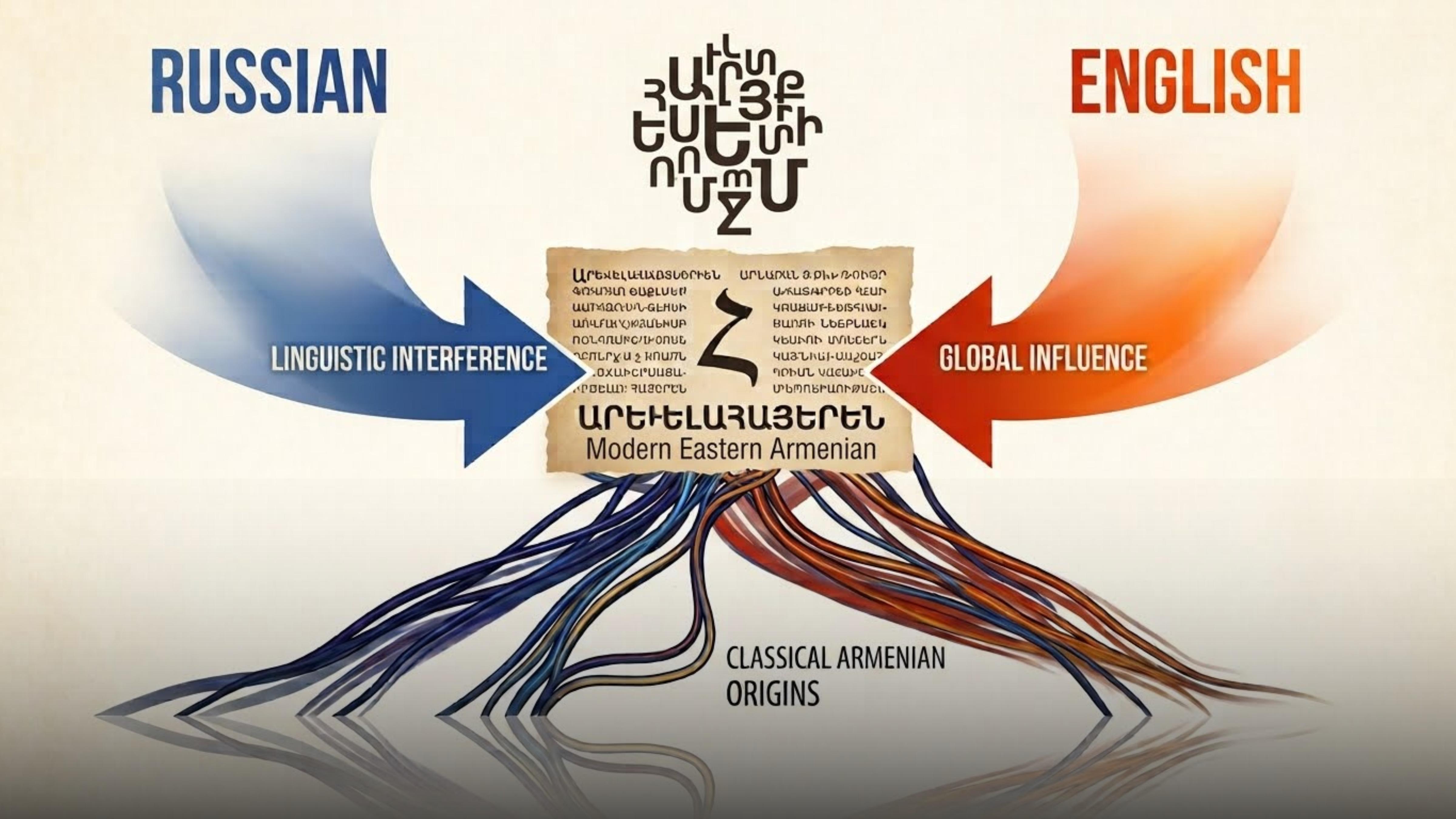
The Shadow of a Superstratum: The Russian and English Rewiring of Modern Eastern Armenian
By Ohan Chekmekchian
Beneath the surface of seemingly flawless texts, modern Eastern Armenian is increasingly bound by the hidden influence of Russian and English structures. This invisible integration violates the natural syntax and logic of the language, replacing native phrasing with foreign blueprints. To preserve true linguistic independence, we must look beyond vocabulary list purism, recognize these imported grammatical habits, and actively restore the native architecture of Armenian thought.
Language is a living archive of political history. For Eastern Armenian, more than a century of shared Tsarist and Soviet history with Russia did not merely introduce new concepts; it fundamentally rewired the way the language is spoken and written today. While structural purism has successfully kept the formal, institutional language free of overt foreign words, a more subtle, subversive shift has occurred. Russian continues to exert a powerful influence on modern Eastern Armenian through semantic and syntactic "calking"—the literal translation of foreign idioms and structures into Armenian words.
This invisible integration distorts the natural rhythm and economy of the Armenian language, creating a hybrid linguistic consciousness that persists long after the collapse of the Soviet Union.
The Architecture of the Literal Translation
The most pervasive element of Russian influence on current Eastern Armenian is not the borrowing of nouns, but the copy-pasting of sentence architecture. When an Eastern Armenian speaker constructs a sentence, they are frequently thinking in Russian and using Armenian vocabulary as mere placeholders.
Consider the ubiquitous use of the postposition "vray" (վրա - on/upon), which has expanded far beyond its original spatial meaning to mimic the Russian prepositions на and над. It is now standard to hear journalists and politicians say:
- “Nor nakhagtseri vray enk ashkhadum” (Նոր նախագծերի վրա ենք աշխատում)
This is a carbon copy of the Russian работаем над проектами (working over/upon projects). In authentic, classical Armenian syntax, a project is not an object one physically sits upon while working; one simply mshakum (develops) or zbaghvum (occupies oneself with) it.
Similarly, the heavy, bureaucratic phrase “I nkati unenal” (ի նկատի ունենալ - to have in mind) preserves the redundant preposition “i” solely because it mimics the Russian иметь в виду. A streamlined Armenian thought requires only “nkati unenal.”
The Media as an Enforcement Mechanism
This structural restructuring is not happening in a vacuum; it is actively normalized and reinforced by local news media. Armenian newsrooms, operating under intense 24-hour cycles, frequently rely on Russian newswires and press releases as their primary source material. Under tight deadlines, journalists mechanically translate texts sentence-by-sentence rather than re-authoring them into native Armenian syntax.
Consequently, television broadcasts, digital news sites, and official government briefings have become echo chambers for imported grammar. When high-profile anchors and reporters regularly broadcast these clumsy Russian syntactical structures, the public internalizes them as the gold standard of professional, intellectual discourse. What begins as a lazy translation shortcut in a newsroom eventually ossifies into standard national usage.
The Loss of Dynamic Verb Phrases
Armenian is historically celebrated for its synthesis and its elegant use of participial constructions (դերբայական դարձված), which keep sentences fluid and direct. The Russian language, by contrast, relies heavily on complex subordinate clauses linked by relative pronouns (о том, что, после того, как). Modern Eastern Armenian media has increasingly abandoned its own concise participle system in favor of these clunky, elongated Russian structures.
The media and everyday speakers frequently rely on phrases like “khosets ayn masin, vor...” (խոսեց այն մասին, որ...) to mimic говорил о том, что... (spoke about the fact that...). Where a native Armenian mind would naturally say, "He spoke of the economic growth" using a concise noun-phrase, the Russian-influenced speaker stretches it into: "He spoke about that matter, that the economy is growing."
The same phenomenon elongates time clauses. The phrase “Ayn banits heto, yerb...” (Այն բանից հետո, երբ...) is a word-for-word replication of После того, как... (After that, when...). It bypasses the far more elegant and native Armenian temporal participles, replacing a single, rhythmic word with a clunky four-word train.
Semantic Creep: Old Words, New Meanings
Perhaps the most fascinating aspect of this linguistic osmosis is how native Armenian words are forced to take on Russian jobs. The word “statsvel” (ստացվել) traditionally meant "to receive"—as in receiving a letter. Today, it is used by millions to mean "to succeed" or "to turn out," a direct mapping of the Russian verb получаться. When an Armenian speaker laments, “Im mot chi statsvum” (Իմ մոտ չի ստացվում - It’s not working out for me), they are not only using statsvel in its Russian sense, but they are also utilizing the structural setup “Im mot” (By me / near me) to copy the Russian У меня не получается.
The digital era has accelerated this semantic creep through the word “kisvel” (կիսվել). Historically meaning to physically divide something in half, kisvel has taken on the abstract meaning of sharing thoughts or internet posts, purely because it maps onto the dual meaning of the Russian verb делиться (to split / to share).
Even everyday idioms have fallen victim. The phrase “Khoske gnum e...” (Խոսքը գնում է...) is a literal, mechanical rendering of Речь идет о... (The speech goes about...). Words do not "walk" or "go" in native Armenian expressions; the concept is traditionally and beautifully expressed as “Khoske... masin e” (The speech is about...).
The New Digital Influx: The Rise of English Syntax
While Russian maintains its historical grip on formal and bureaucratic structures, a new generational shift is occurring under the weight of globalization and digital technology. Younger Armenians, fluent in internet culture, are increasingly superimposing English syntax onto their daily speech and text messaging.
This modern shift mimics English idiomatic architecture just as the older generation mirrored Russian. Expressions like “Im khndirn e” (Իմ խնդիրն է) are no longer used to mean "This is a problem I must solve," but rather as a calque for the dismissive English idiom "That's my problem/business." Similarly, the phrase “Im ory zbaghvats e” (Իմ օրը զբաղված է) mimics "My day is busy," treating a period of time as an active, human agent capable of being occupied, which violates traditional Armenian expressions where only people are busy. This creeping English syntax layer operates alongside the existing Russian framework, creating a double-layered hybridization in the speech of the modern urban youth.
A Crisis of Identity or Natural Evolution?
Some linguists argue that this structural blending is the natural byproduct of bilingualism and global integration. However, when a language systematically discards its own grammatical shortcuts—like its rich participle system—in favor of the heavy, passive structures of a dominant neighbor, it loses a piece of its cognitive sovereignty.
The current state of Eastern Armenian highlights a profound irony: while the nation fiercely guards its alphabet and literary canon, its daily spoken and written syntax remains quietly colonized. To preserve the true depth of the Armenian language, contemporary speakers and writers must look beyond vocabulary list purism and begin reclaiming the native architecture of Armenian thought.
(Ohan Chemekchian is a linguist and essayist who completed his studies at Yerevan State University and Beirut’s Haigazian College.)
Write a comment