 Videos
 Photos


"The Stones Will Cry Out" (Part 2)
By Muriel Mirak-Weissbach
Another piece of the jigsaw puzzle was Agin (Agn), the town where my mother's adoptive Turkish parents lived. There are two towns with similar names, one south of Arabkir, the other, to the north.
Armen reckoned the latter must be what we were looking for, since it was within walking distance (perhaps several days') from Tzack, which dovetailed with my mother's account of the distance. Today it is known as Kemaliya, named after Mustafa Kemal. The story goes that after a visit to the place, Ataturk reportedly raved about how lovely it was, whereupon it was renamed and restored. It was nothing like the other villages we had seen. The main street was lined with beautifully renovated wooden facades, giving it the air of a Swiss chalet ski resort. There was a building housing a museum which bore the unmistakable architectural traits of a lovely Armenian church with its graceful arches.
What we were looking for in Agin was the mosque on whose steps a Turkish shepherd had laid my infant mother. He had found her, the only survivor among a field of corpses of women and children who had been taken from Tzack and shot. As was the custom with foundlings, he took her to the town, perhaps his home, and left her on the mosque steps, where a gendarme named Omar found her and took her in. Omar's wife, who was childless, did not want the baby because it was Giavour (Christian), and because she felt she was too old to bring up a child, so she took her back to the mosque the following day and placed her again on the steps. While Gulnaz chatted with her lady friends, the child crawled over to her and tugged on her skirt, which she took as a sign from Allah that she should take care of her, and she did.
The mosque was very old and very beautiful, built in 1070, restored in 1960 and again in 2005, located in the center of the village on a street going up from the main street. In front of the mosque was an open area like a small piazza, which was where perhaps Gulnaz and her lady friends had sat.
On the way to Erzincan, where we would spend the night before proceeding to Kars, we stopped at Kemagh Gorge. Standing on the bridge over the river, we gazed up at the rocky ledges on both sides. It was from those lofty heights that Armenian men, lined up two by two and tied by the wrists, were thrust down the gorge, after having been bayoneted in the ribs by their murderers.(8) Although the name Kemagh Gorge rings with an ominous tone to the ears of anyone familiar with the history, a newcomer to the site would have no way of knowing what he was seeing. There is a plaque fitted into the stone on one side of the bridge, but it makes no mention of the tens of thousands of Armenians pushed to their deaths into the river. Instead, the plaque commemorates six Turkish soldiers who had perished in a tragic automobile accident some years back.
In Zatkig, a village along the road to Kars, we came upon another small church bearing testimony to its Armenian past. In 1915, that province had a population of about 150,000, ten percent of whom were Armenian. On the wall of the 10th century church, though in ruins, were bits of frescoes visible, painted in blue and white. Stones had been walled into the formerly open arches, and the structure, also of the long church type, was now being used as a storage place for wood. From the abundance of hay in the back, it appeared that it may also have been being used as a stable.
A similar image greeted us just prior to our entry to Erzurum, a city that was part of the ancient Armenian kingdom at the end of the 4th century: the ruins of a church with grass growing on what once was its roof. It looked like hair sprouting from the head of a Benedictine monk which should have been shorn.
But in Kars, our next stop, the church we visited stood out in magnificent contrast. The Apostles Church, built by King Abbas in 937, had been turned into a mosque in 1064. For a brief period of forty years beginning in 1878 during the Russian occupation, it served again as a Christian place of worship. At that time the Russians built on four porticos at four entrances, adding a distinctly Russian flavor. Then it was a museum from 1969-1980, and again became a mosque in 1994.
But there could be no mistake about it – this was a church. The majestic reliefs on the upper portion of the façade under the dome between the arches are easily identifiable as the twelve apostles, at least, to anyone familiar with church architecture and iconography. The sign in English, placed there for the benefit of foreign tourists, gives no hint as to who worshipped there before it became a mosque. It said the church had been built by one "Bagratid King Abbas (932-937)" and listed its subsequent functions. The word "Armenian" was nowhere to be found. Who the Bagratids were was left to the imagination.
The same mythological reality greeted us at Ani, the magnificent ancient city which once was the capital of the Armenian kingdom. Two large plaques on the side of the city's ancient walls inform the visitor of Ani's long illustrious history, again without reference to the word "Armenian."
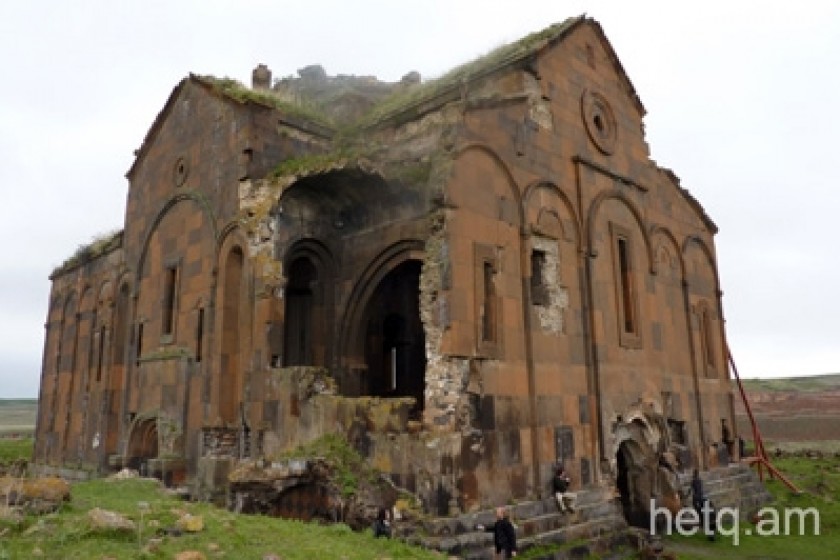
It was Ashot III (952-977), king of the Bagratids, who built Ani, the capital city "with its 1001 churches." This was clearly a metaphor, but just as clearly evidence of the fact that a large number – hundreds – of churches had graced the rolling hillsides and nested in the cave-like apertures along the steep slopes of the gorge down to the Ahurian River. One such edifice was the Church of St. Gregor of Abughamrents, erected in the middle of the 10th century, perhaps by Abughamrents Pahlavani. The structure based on a dodecagon ground plan, is still standing with its dome, though the lower portions of the external façade are damaged.
The Church of the Redeemer, completed in 1035-1036, was also associated with the Pahlavani family, built by Ablgharib, son of Gregor. The interior, which measures 15 meters in diameter, is articulated in eight large niches, all of them once graced with murals. The structure today is a shadow of its former self, literally a half circle of the original structure. But since historically accurate photographs from the later 19th century exist, reconstruction is eminently feasible.
The Church of St. Gregor built in 1215 by Tigran Honents, is a domed hall standing on a hilly mound. The triangular slit apertures and arch shapes on the facades appear here for the first time in Armenian architecture together as external decorative elements. This church hosts the most beautiful and best preserved frescoes both inside the structure and on the outer walls, frescoes that cry out for restoration.
And the masterpiece of church architecture in Ani is the cathedral, an imposing structure which, despite its advanced state of decay, still displays a proud sense of majesty. According to the account of a contemporary historian, Stephan of Taron in the tenth century, the Bagratid King Ashot died in 977 and was succeeded by his son, Smbat who ruled from 977 to 989. Smbat commissioned the master architect Trdat to build a magnificent church and he set about the task. In the year 989, the year of Smbat's death, an earthquake hit Constantinople, causing immense damage to the Santa Sophia church. A crack in the wall had burst under the impact of the earthquake. One person who knew what to do was Trdat, a famed stone mason, who had drawn up a plan and had built a model of the Santa Sophia church. So he went to Constantinople and used them as the basis for its reconstruction. Once that had been done, Trdat returned to Ani, and set to work on the cathedral.(9)
When we left Ani and set out on the road to Van we were confronted with one monument which very prominently featured the word "Armenian." This was something built between 1995 and 1997 in Igdir and modeled on the genocide memorial in Montebello, California; the Igdir structure honors the memory of Turkish martyrs killed by Armenian assassins. The monument, which houses a museum with numerous photographs, commemorates Turkish diplomats and other public figures who were assassinated by terrorists belonging to the ASALA movement. According to the plaques inside the building, up to one million Turks (!) fell victim to them.
The next stop on our itinerary, Van, boasts of an ancient history stretching back to 800 B.C. when the Urartuans built the massive walls and fortress which enclosed the huge settlement whose houses are now buried under mounds of earth. Van was also the site of a spirited Armenian resistance against the Young Turks in 1915, one of the few which succeeded.
 Nearby we visited the Varakavank monastery with its seven churches. Last year, Archbishop Ashjian had complained that the site was unkempt, and had asked that it be cleaned up. Happily, with funds collected for the effort, local residents swept it clean, and we found it in orderly condition.
The highpoint of our pilgrimage was Akhtamar. This is perhaps the most beautiful Armenian church ever built, with its unique bas reliefs depicting scenes from the old and new testaments. Its harmonious architectural forms gain in majesty by virtue of its location, high on a hill on an island in the green-blue-turquoise-colored Lake Van, surrounded by snow-capped mountains. Akhtamar has gained special significance over the past year, both artistic and political. The façade of the church has been fully restored, including the bas reliefs, the most magnificent such restoration effort in Turkey. (10) And in September 2010, Turkish authorities allowed a church service to be celebrated there, for the first time in 95 years. An altar piece with a depiction of the Virgin Mary with child, which was brought for the first service, remains. Now the church should host the divine liturgy once a year. We were allowed to sing the Lord's Prayer (Hayr Mer) inside one chapel, but when Armen started filming the event, a guard told him to turn off the camera.
Though it defies belief, there is not one mention at the site of the fact that Akhtamar was and is an Armenian church. The architect was a monk named Manuel, who had built a palace for Gagik I, King of Vaspurakan, and between 915 and 921, he erected the church at Akhtamar. Though this is documented by historian Thomas Artsruni, there is no mention at the site today of who Manuel was, or what church he belonged to. This fact -- perhaps even more than the controversy surrounding the 2010 service, the disagreements regarding who should or should not attend, or whether or not the cross could or should be placed on the top of the church -- captures the psychological dilemma in official Turkey's attitude towards the Armenian question.
The official refusal of the Turkish establishment to acknowledge the 1915 Genocide has led it to attempt to deny the very existence over a thousand years of an Armenian civilization and culture. Because to acknowledge the existence of that tradition would lead to the question: what happened to that civilization? Why was it destroyed? How was it destroyed? Thus to say or to write, "This was an Armenian church" is so charged with associations that one prefers to avoid the words.
But such an enterprise is futile. No amount of denial can eradicate the fact that such a civilization did exist in Anatolia since time immemorial. The stones do cry out, and increasing numbers of visitors from the Armenian diaspora are travelling through the region and hearing the wonderful tales that the stones have to relate. Ordinary Turkish citizens, like the many we met during our visits to the villages and towns, had no problems in acknowledging the past.
 In Peshmashen on the way from Elazig to Arabkir, residents told us that their forefathers had been resettled there from Greece and the Balkans in the population transfer after World War I. They had been brought in to inhabit the homes and farms left empty after the expulsions and killings of Armenians. They swore that their forefathers had had nothing to do with the genocide and they were telling the truth. In Kharpert, local townspeople showed us historical photographs of the Euphrates College that had been replaced by another building. Many people spontaneously offered stories about their Armenian grandmothers, or mothers, as in Tzack. In Arabkir, the neighbors remembered with affection Sarkis, the last Armenian in the town who had died last year at the age of 95.
The problem lies not with the Turkish people. In fact, there is a wave of ethnic rediscovery sweeping across Turkey, whereby hundreds if not hundreds of thousands of Turkish citizens are uncovering their Armenian roots and working through their family histories.
The problem lies not with them, but with the Turkish establishment who, as Hrant Dink put it, has been suffering from "paranoia" as a result of the historical burden of the Genocide. To protect the paranoia, the Turkish establishment has perpetuated the fantasy of denial, even going to absurd lengths of trying to rewrite a history of the region which omits the Armenian presence.
As any clinical psychiatrist will attest, overcoming such paranoia must involve facing reality. This means acknowledging the historical record, not only recognizing the Genocide perpetrated by a specific Young Turk regime in a specific time frame and circumstances, but acknowledging the existence of the Armenian component – cultural, political, and religious – as an integral part of the history of what is today's Turkey.
The most appropriate approach would entail cooperative efforts by the Turkish authorities with Armenians, from the Republic of Armenia and the Diaspora, to restore and rebuild the artistic treasures of the Christian tradition, to rehabilitate that contribution to world civilization, and to reopen the houses of worship. The role of UNESCO should not be to provide cover for the distortion of history, but to let the stones cry out.
Write a comment