 Videos
 Photos


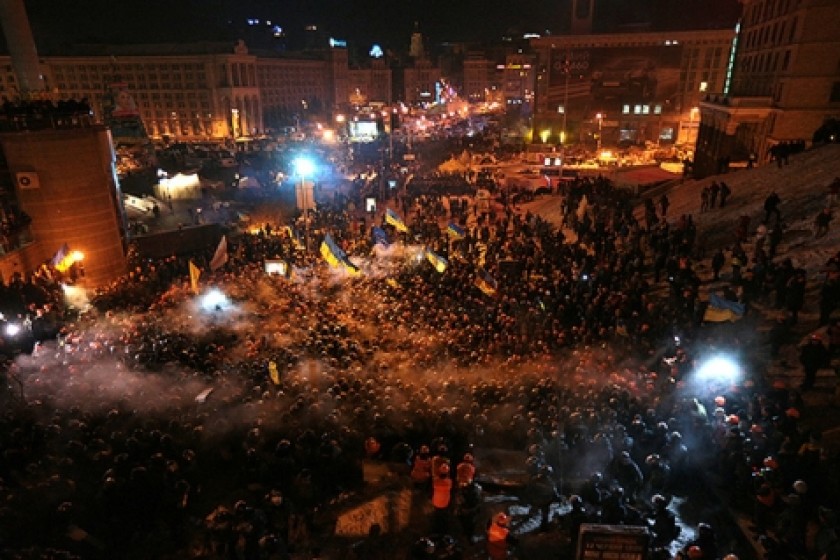
First Person: One Night In The Life Of Ukraine’s EuroMaidan
By Vlad Lavrov
It was around 2 a.m. on Dec. 11 when, alarmed by reports of an upcoming attack by the riot police, I entered Kyiv City Hall in the heart of the mass protests that since late November had been taking place in Ukraine’s capital.
Now the building was being used by the protesters as a sleeping lodge and makeshift hospital.
Inside, around 200 mostly male protesters – women had been asked to leave the building – were getting ready for the attack. They had just finished using pieces of wooden furniture to barricade the stairs leading from the entrance to the main hall where most of the people were staying. With quiet concentration, wearing white and orange hardhats, they were taping pieces of rubber mats to their forearms, chests, shoulders and legs to protect themselves against police batons. It made them look like medieval Japanese samurai from an Akira Kurosawa movie.
One of the protesters, a man in his forties, asked me to take his photo with an old scratched mobile phone. He looked ready for any outcome and amazingly at peace. He posed in front of the barricade holding a World War II-era red-and-black banner used by Ukrainian insurgents with his other hand was pressed to his heart.
The current events in Ukraine began on Nov. 21 as a protest against the government’s decision to postpone the signing of a landmark association agreement with the European Union, something that in the eyes of many citizens would have finalized the country’s shift from Russia’s orbit of influence towards European integration.
On Nov. 30, the government used brutal force against a handful of young people who were staying overnight at the protest camp. In reaction, rallies continued on a much larger scale with the crowds peaking at one million people demanding three things: punishment for those who ordered force against protesters, the government’s resignation, and early presidential and parliamentary elections.
Since then, Kyiv’s downtown area had been occupied by the protesters, who set up a stage, surrounded the area with barricades, and erected approximately 100 military-style tents, providing all imaginable services – from kitchens and warm clothes distribution outlets to a chapel and IT-tent, offering free Wi-Fi and battery-charging.
Write a comment