 Videos
 Photos


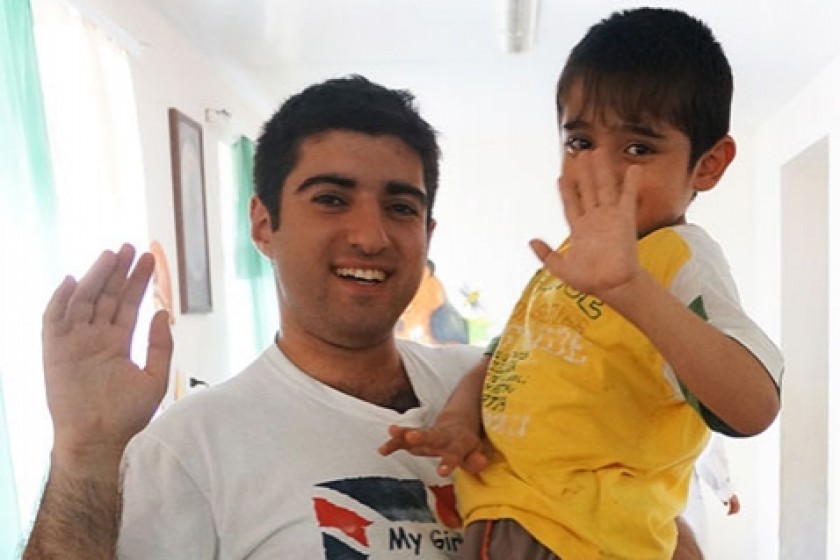
Luys Scholar Ashot Margaryan Appointed Assistant to Artsakh Prime Minister
Christian Garbis
Luys scholar Ashot Margaryan, a graduate of University College London, was appointed assistant to the Prime Minister of Nagorno-Karakakh in January.
For Ashot, who was born in Yerevan in 1989, working in the region was a dream job since his roots are based in Artsakh. He grew up listening to stories about his ancestry told by his grandfather, who also encouraged himonshaping his own future.
“I remember him saying, ‘This child should study in London.’” Ashot said. “I hope I make him proud and he sees me following the path that he wished me to take.”
Ashot received his Master’s degree in Politics, Security and Integration from the School of Slavonic and East European Studies at UCL in September 2013. Although he wished to pursue his PhD and received offers from both UCL and Graduate Institute of Geneva, he decided instead to take a year off from his studies and follow his dream to live and work in Artsakh.
Ashot’s contributions to the Luys philosophy of “Learn, Do, Co-create” has been invaluable. As a participant in Develop Armenia Program (DAP) 2012, together with his Artsakh team members they launched the Museum Information Accessibility Project, which aimed to translate materials at the Museum of Perished Soldiers into three languages in order to make them readable for foreigners. Later, they developed audio guides in five languages (Armenian, Russian, English, French and Hebrew) discussing the Nagorno-Karabakh war and the story of the museum. Now booklets in five languages are available for tourists to take away, and a sizable quantity of books and other analytical materials were donated to the museum as a result of the group’s efforts. Ashot considers their accomplishments a great success since the accessibility of the museum to the outside world has greatly improved.
“Without DAP, I would never have had such a great opportunity to make this idea a reality,” he said.
Another project Ashot is working on is called Humans of Artsakh, which is a Facebook page romoting the people and places of the region. He adopted the idea from Humans of New York, a photo-blog that started in 2010 featuring interviews of people from New York City that eventually became a bestselling title. As a result of the success of that project he wanted to take it to Artsakh. “I decided to create a unique portfolio for Artsakh Armenians illustrating their lifestyle and traditions -- Artsakh from the inside.”
He identifies the fact that foreigners associate the name Nagorno-Karabakh mostly with a conflict but not a country as a huge problem to tackle. The group’s slogan is “Artsakh is an Armenian Land, an independent country for more than twenty years, but not a conflict.”
“By promoting this page and creating a blog with more information about the photos the group aims to raise awareness on Karabakh by showing that this is a safe place to come and live, work and invest,” Ashot explained.
To date the page has over 3,200 likes and is looking for regular contributors. The group wants to organize exhibitions throughout Armenia and even Europe in the near future, and the Ministry of Culture of Nagorno-Karabakh has offered to provide some assistance. It has already arranged tours of remote parts of the region.
Another project Ashot is currently working on in Artsakh is called Woodpecker. “The intent is to produce wooden toys that will be painted by kids here and presented to orphanages throughout Armenia,” Ashot said. “I hope this small idea will turn into a bigger one and a new brand of toys will come forth from Artsakh made by kids for kids.”
Woodpecker will involve many bright, talented youngsters who have health disabilities, live in remote areas of Artsakh and cannot find a market for the handmade products they create. The project will be a new platform, a brand from Artsakh through which many of them will finally have the chance to sell their products.
Yet another initiative in the works is the Eurasian Research and Analysis Institute (ERA), a think-tank being started with two other co-founders from Washington and London. Details about the institute will be revealed soon.
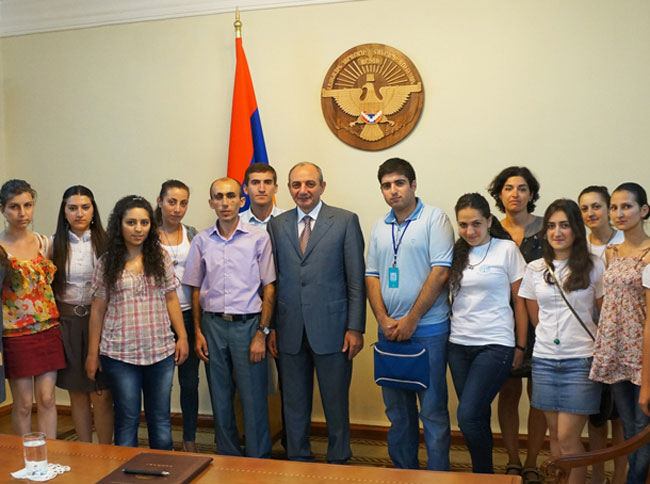
He strongly thinks that Nagorno-Karabakh’s future is reliant upon its resilience as a firmly established, effective state, and he believes his background and strengths will be added assets for governmental administration. Ashot by nature is energetic and enthusiastic, particularly about his new position, and he has a lot of plans in the pipeline.
“I am working together with my close friend and Luys alumnus Artak Beglaryan, who serves as a press secretary to the prime minister, on a number of projects,” he said. “I believe that anything is possible if you are motivated and excited about the work you do.”
During his stint in London for a year and a half Ashot interned at the Embassy of Armenia to the UK. As a result of his affiliation with the embassy and through his ties with UCL-- connections to other centers of excellence through his Luys network -- he met influential people from all corners of the globe. Because of his opportunities to network with others he felt like an ambassador of his country in the multicultural environment of London. He had the honor of participating in several conferences and discussions and even organized conferences on his own. These opportunities allowed him to raise awareness on security issues in the South Caucasus, the conflict related to Nagorno-Karabakh and the Armenian Genocide while successfully inspiring others to take stronger interests in these areas of concern.
Ashot attributes his personal and professional growth not only to his tenure at the Embassy and studies but also tohis stay at the Palestinian Mission to the UK on a research internship.
“One of my research interests is the Middle East and especially the Israeli-Palestinian conflict,” Ashot said. “After organizing the discussion on the parallels between Palestinian and Nagorno-Karabakh conflicts and having Ambassador Hassassian as a guest, I got inspired and decided to write my MA dissertation on this topic. This was an incentive for me to do a research internship at the Palestinian Mission to learn more about the Palestinian perspective on these issues.”
Ashot believes that Luys is the ideal platform through which many young people find their way into academia and also form enduring personal bonds.
“Luys is a family of bright and talented people having similar objectives who think differently,” Ashot believes. “Everyone participating in DAP is given the chance to create a large network of contacts. And it’s always encouraging to have such an organized staff behind you to support all your initiatives. I strive to constantly prove that I deserve to be a part of this great network.”
Write a comment