 Videos
 Photos


Our Boys Fought and Died So That We Could Live Well
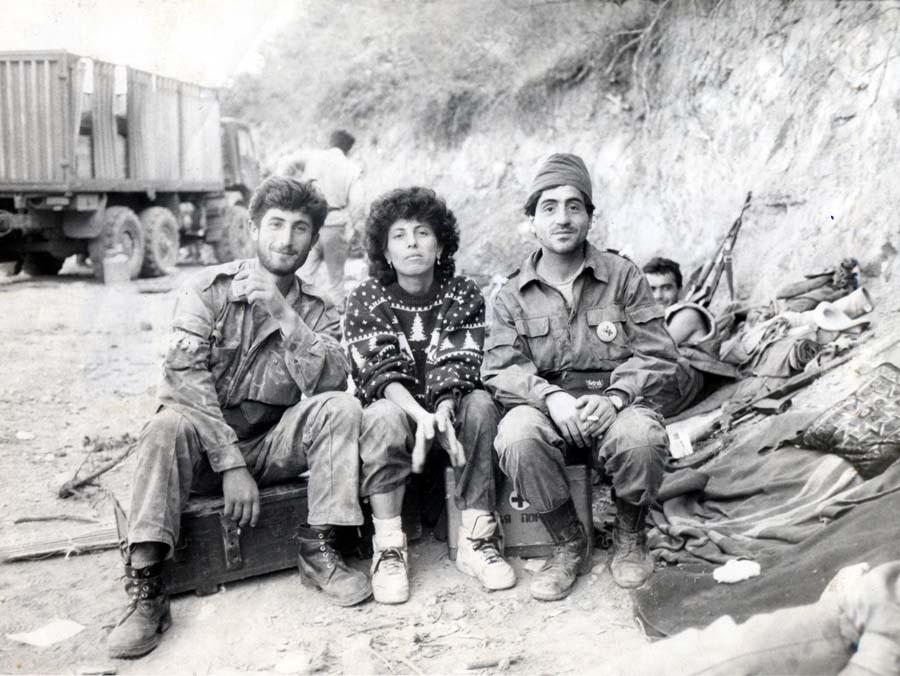
43 year-old Margarita still cannot come to grips with the fact that we lost so many good boys during the Artsakh War. “What a great bunch of guys they were - Davit, Ashot, Vitali...” she states as she counts off their names one by one. Margarita could go on telling stories about all of them: how they would try to maintain themselves correctly and at attention in the company of the girls or how the boys would delve into their pockets for some leftover sweets to give them. And the girls, in turn, would help out the boys whenever possible.
At first glance you wouldn’t think that Margarita Taranyan, a woman of graceful steps and beauty, experienced the entire tumultuous course of the Artsakh War not only as a nurse but also carrying a gun when the need arose. As she relates, carrying a gun didn’t come easy since she knew in her heart that she didn’t have it in her to kill anyone. At the same time, along with the boys and the other girls, Karineh, the Anahits the second Margarita and Gayaneh, she participated in battles along a number of fronts.
In 1992, when the Azeri forces had advanced to the gates of Askeran, she came upon a notice in Stepanakert announcing the formation of an “Artsakh Women’s Detachment” and that women and girls were being recruited. She immediately decided to enlist but knew that her traditionally inclined parents would be difficult to convince. She remained resolute however in her choice.
Margarita recounts that in the beginning she would fool her parents, telling them that the unit wasn’t participating in the battles and that they remained close to the city. Later on, when the truth came out it was too late. She describes that, “When I enlisted the training we received was quite varied. It included civil defense, first aid, map reading, physical exercises, even how to dig defense trenches. Only 12 out of the 25 women who started the course made it till the end.”
In the fall of 1992, when the unit was prepared to assume its first military operation, a commander of one of the detachments came to the training center and requested that it requisition three nurses to his command. Margarita and two girls named Anahit were sent. The first battle they participated in ended in victory and there weren’t even any casualties. “That night we mumbled about how we weren’t given the chance to show off our acquired skills. The chance to do so was quick in coming but it never occurred to me that my first act of dispensing medical treatment would be to an Azeri guy. They brought the injured Azeri soldier to our tent at midnight. We treated his wounds and even fed the tall, handsome lad.” is how Margarita recollects her first night in battle.
Margarita’s large black eyes get teary every time she relives those battles; how intense they were and how many boys died in her hands. “I still can’t fathom how we came out of it alive. It’s unbelievable that my health wasn’t affected after all those cold and difficult days.” Her eyes fill with tears as she recounts how the other girl named Margarita in the unit met her fate, how they had to wait till midnight to collect her dead body from the battlefield. Margarita wrote the following entry in her diary about that fateful day - Today, our unit had its first victim. Margarita Sargsyan was killed. We all knew that one of us could be killed at any time but we weren’t expecting such a heavy blow.”
Now, even with the war years behind her, Margarita, who received a degree in child education, continues to serve in the ranks of the Defense Army with the rank of Major at the Central Command Headquarters. She also serves as the Secretary of the Artsakh branch of the Armenian Relief Society. She tries to juggle the two jobs and extends a loving hand to all in need. She notes with a degree of sadness that, “It greatly concerns me that it is not customary to extend a helping hand to those around us. It was just the opposite during the war; every one would hand over their last piece of bread to help a soul in need.”
Sadly Margarita, who experienced the vicissitudes of the war while never loosing touch with her feminine side, never found someone to spend her life with. Now she lives alone in a one-room apartment, on a major thoroughfare in Stepanakert, allotted to her by the Army. She says her salary is enough to get by on, as she is a person with meager needs.
“We have to live in peaceful, normal conditions. We must help one another because that’s the ideal that our boys fought and died for.” recounts Margarita who, for services rendered in the defense of the fatherland, was bestowed with the honorary “Combat Cross”, 1st Class; 1st and 2nd rank of “Impeccable Service” and the “Medal of Motherly Gratitude”.
Write a comment