 Videos
 Photos


Weekend in Saakashvililand
Brian Kearney
I last worked in Georgia in the dark days of 1993/1994 and looked forward to a return visit to see what was happening after the "rose revolution". I had read reports of a massive drive against corruption, greater political freedom and a sense of a country being reborn. Was it all true? Are we looking to a brighter future for Georgia?
Protests against the fraudulent parliamentary elections in November 2003 led to the resignation of President Shevardnadze. Mikhail Saakashvili, who had led the November protest rallies, won the Presidential elections on 4 January with a resounding 96.27% of the votes on an 80% turnout. Constitutional amendments were rushed through Parliament in February strengthening the powers of the President to dismiss Parliament and creating the post of Prime Minister. Zurab Zhvania, the second of the triumvirate of opposition leaders, was appointed Prime Minister. The third member, Nino Burjanadze the interim President, became Speaker of Parliament.
The results of the parliamentary elections for the 150 seats decided by proportional representation held on 28 March mean that the governing Saakashvili/Zhvania National Movement-Democrats party dominates the new Parliament (with about 15 seats going to the Rightist Opposition Coalition, the only other party to cross the 7% threshold). The challenges facing President Saakashvili as he took office were daunting: tackling endemic corruption and high levels of organized crime and insecurity, rebuilding non-functioning state institutions, reducing the high level of poverty, dealing with Georgia 's separatist regions, establishing a new relationship with Russia ... the list is endless.
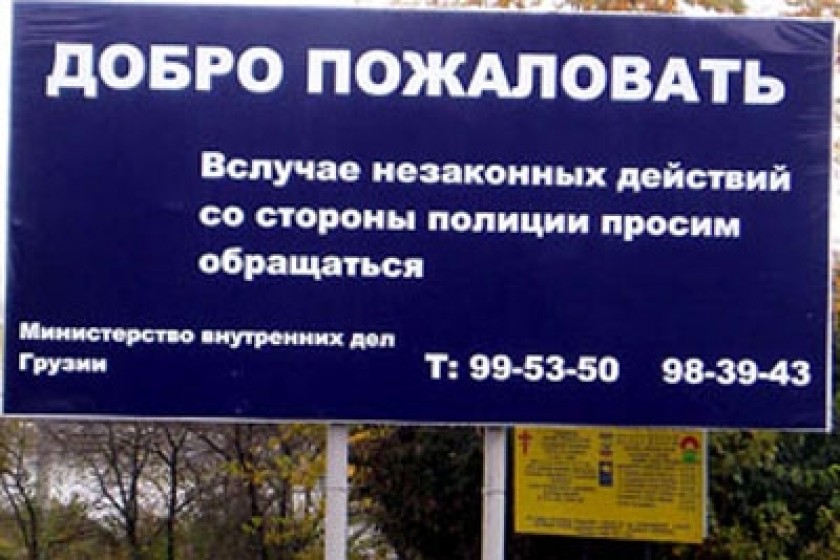
First impressions at the Armenia - Georgia border? A huge sign announced - in Russian - In case of unlawful activities of police please call the Ministry of Interior Affairs of Georgia , tel. 995350. The second sign of change were the roads - all resurfaced- a trip that used to take four hours early this year now takes two. Gone are the endless check points manned by surly traffic police demanding substantial bribes. Something seems to have worked- the traffic police now cruise about in brand new cars- brand new uniforms and with, apparently, brand new zeal to catch real offenders. Their salaries have now been increased to $200 a month or more with bonuses for catching REAL offenders.
Apparently the days of passing some lari to the policeman when you run a red light are also gone. Using a mobile phone while driving will also be against the law from January 1st 2005 . Registering a car has also been simplified eliminating the need to re-register each year- another source of revenue for corrupt officials gone. There is a form of inertia at present among government ministers where they seem to just await instructions. In a way everyone is afraid to say No or have an opinion in case it is misconstrued and the big fear is to be tainted as corrupt. In other words, if a Minister says No to what is essentially a good idea then he must not want to change the status quo.
In some ways Georgia needs the big stick or, at least, for a while as corruption is so embedded.
Another sign of change in Tbilisi was the construction work on the hotel on the main square. This hotel was home to a vast number of refugees for many years and was a reminder to all visitors of Georgia 's internal conflicts in Ajara, Abkhazia and South Ossetia . Now with a bold new sign announcing "Silk Road Construction" it is a sign that things are looking up. The refugee residents were all given $7000 each two months ago and have blended into the Tbilisi populace. Problem solved! But construction on the many building sites in Tbilisi has also been halted while planning permissions for construction are clarified.
As is usual in Georgia conversations at the dinner table were 100% political with views ranging from "he has replaced all competent government people with teenagers" to "nothing has changed" to "is this what we held candlelight vigils for?" to "he is acting like a Dictator." He is the sole subject of conversation everywhere! For every anecdote demonstrating how he is a man of the people (eating in normal restaurants, taking public transport to work), there are ten others demonstrating how he is ruining the country (renovating roads which do not need renovating, making political decisions based on little except a desire to be seen as a decisive leader).
I met two opposition supporters and they were very clear in their argument that Georgia needs a strong opposition for democracy to survive but they felt that if Saakashvili continues to make populist decisions then their role is weak. They confined themselves mainly to jibes and anecdotes about Saakashvili himself - some quite funny.
On Sunday I took a trip to the Kakheti Wine Region about two hours drive from Tbilisi . The weather was excellent and as we drove fast (is there any other way in Georgia ?) through the Georgian countryside I could see signs of prosperity in rural areas. Stacks of winter feed agricultural machinery in the yards and well maintained houses. In the village of Tsinadeli , our destination, there are seven private wineries with about 300 workers. The wineries are all modern and built with private investment and the state wineries which supplied wine to the entire Soviet Union in days past lie crumbling in ruins. The talk is of quality now not quantity.
We visited the wine library in Tsinadeli situated in a huge building now empty of wine, machinery and workers but Nino still tends the wine library where the oldest wine was bottled in 1814. We visited the estate house of Count Alexander Chavchavadze where a museum showing the life of the family was still open tended by a group of sturdy women. The house and lands are now for sale by the state which can no longer maintain the house and lands. We were shown the cottage on the lands used as a "resting place" by Shevardnadze when he needed a rest. For sale? Not sure.
The main objective of our visit was to visit The Wine Man. The Wine Man is Giorgi Piradashvili (Tel: 995.32.252.056; Mobile : 995.99.571.163) located in Tsinandali Village . Giorgi established his business in 1997 borrowing from his brother and purchasing 700 tons of grapes. His first output of wine he sold in barrels to an Israeli wine company and with this money established his winery. His vineyard, located between Telavi and Vachnadziani, has 15 hectares of Saperavi grapes with another 17 hectares of Sauve grapes. In 2005 he plans to build a "Wine House" on the property from a reconstructed building. This will include a winery and Tasting Room.
In the meantime he produces 300,000 bottles a year using first class Italian equipment, bottles and labels and buys his corks for Portugal and operating from a premises rented from the state. In full production he hopes to produce 1.3 million bottles a year. 99% of the wine is exported to Russia , Ukraine , Holland and Switzerland . Pricing is $5.00-7.00/bottle. He also manufacturers high quality stainless steel tanks for the wine industry. The wine is excellent and Giorgi loves wine with a passion, speaks excellent English and loves visitors.
After the wine tasting, an even faster drive back to Tbilisi but this time in Giorgi's four wheel drive which glided above the potholes to the border and back to Yerevan . Not once on our entire journey from Yerevan-Tbilisi-Yerevan were we stopped by traffic police. Is this a record?!?! An action packed weekend and a great opportunity to see how Georgia is progressing. I found the atmosphere positive and saw a great change in people's attitudes to work - achieving and moving the country forward. Go there.
Write a comment