 Videos
 Photos


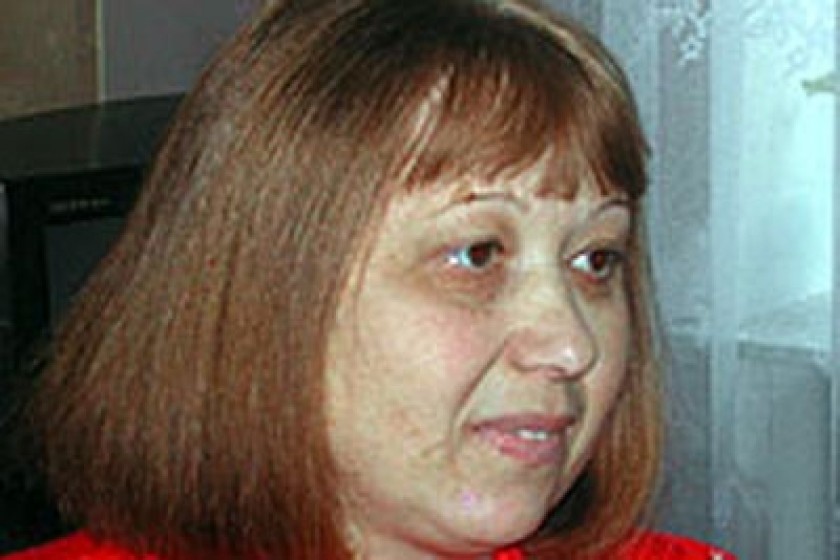
"Hello, my name is Nina-Moldovanka"
Nina's surname is Gyunashyan. Actually, it is her husband's surname because by nationality she is Moldovan. She used to live in Leninakan and during the 1988 earthquake, when Nina spent 100 hours buried alive as Doctors and rescuers from Georgia , Russia , Dagestan , Belorussia , Armenia and France struggled to save her life, her husband and daughter stayed beneath the rubble.
During that same year, the mass media published many tragic stories about entire families who died while buried under the ruins of multi-storied apartments and about the work of international rescue teams that came to Armenia from around the world. It was after reading one of those stories that I learned about Nina's tragic story.
I don't want to live
People first heard of Nina on Saturday morning, the third day of the disastrous underground motion that turned Leninakan into a dead city and the 9-storied apartment building on Shirakatsi 13 Street into a pile of ruins. Feeling a strong motion she instinctively rushed to her four- month old daughter who was lying in her cot as the walls around her collapsed.
 |
When rescuers moved the rubble they saw a narrow space that was open. A soldier with a flashlight went towards the direction of a voice that could be heard in the distance. The beam of light from his torch illuminated a woman sitting with her left hand and both legs stuck under a large building block. A doctor opened an ampoule of morphine and poured it into a bottle, closing it with rolled paper so that it could be opened with one hand and teeth. It was lowered down with string.
The French rescue team opened a track on the top but the huge building blocks couldn't be moved quickly enough. A French anaesthesiologist climbed down with syringes and after him, a doctor-lieutenant with a set of surgical instruments. They tried very hard to free Nina's lower legs that were stuck under a building panel but without success.
By the time Nina was anaesthetized they had to make a decision to ampu tate her legs or not. Reluctantly, they made the decision to amputate and when the young woman was removed from underneath the ruins, her hair was all grey. "I don't want to live", she said before losing consciousness.
In this life there is always something to live for
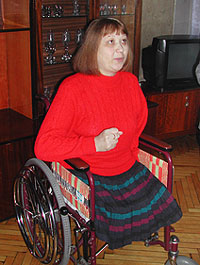
Ten years after the earthquake, the presenter of the program "Blitz" on the television station, Channel Armenia , announced that on that particular day, the program would be dedicated to the strength of the human spirit. On screen there was a woman in a wheelchair without her legs from the thigh down and without her left hand. The presenter introduced her as Nina Gyunashyan.
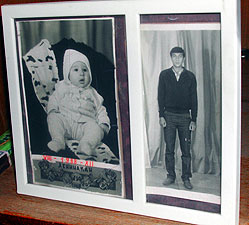 |
Answering the presenter's questions, Nina told the TV audience about herself. She came to Armenia from Moldavia in 1986, married and started working in Leninakan at the textile factory. During the earthquake she lost both her husband and their only child. She received treatment in Moscow and, through the Red Cross, in Germany where it became apparent that no prosthesis could be fitted.
Nina's desperation was significant. She was crying constantly, unable to come to terms with the realization that she would be confined to a wheelchair for the rest of her life. She was even thinking about ending everything because she didn't want this sort of life. Either that or she had to learn to live again. Although she used to say "I can't" or "I don't want" she was trying. During her stay in hospital someone gave her a Bible. At first she didn't even want to touch it. She felt resentful towards God because of her predicament but one day she started to read it.
Nina was raised in an Orthodox family in the Moldovan village of Beshtemak where there was no church. For Christmas and Easter, however, Nina's Grandmother would take the young girl and her other grandchildren to the next village where a small church was kept and where people could light candles. Nina liked those trips and especially her grandma's stories about how god-fearing people that went to church had decent lives. How often she remembered her grandma and this pure, childish faith during these terrible years.
Then one day Nina says she believed that God had showed her hell and brought her back to life for a reason. Considering that everything has a purpose, Nina decided that she wanted to live. After recounting all of this, Nina looked straight to the camera and told the audience with a clear and open look on her face," my dears, don't get disappointed under any circumstances. Find courage in yourselves and you'll see that there is always something to live for."
I remember how this program encouraged so many people and as a result, I decided to find Nina.
You are a very rare patient, an excellent one
Nina lives in Yerevan in a one-room apartment on Tigran Mets Street #36. Upon ringing the doorbell she opened the door and invited me into the room. Just one look at her apartment is enough to understand that she is a 'clean woman.' "I don't like untidiness," said Nina. "Girls from the " Mission Armenia " organization visit me but there are many things that I try to do myself. People need to tidy their home every day."
There is not much furniture, just the most necessary items: a cupboard, sofa, table, chairs and a Japanese TV set. The window sill is covered with house plants. It is a cosy home with a hospitable landlady. I was reminded of what she said on TV. "There is always something to live for." As times have not been easy in my own life it was important to hear how Nina managed to start her life from scratch, wheelchair-bound in an alien country.
What gives her strength so that she doesn't break while also supporting others?
"People," she says, pausing. "Yes, people."
After she was found under the ruins of the earthquake Nina saw how others did everything they could to rescue her. She saw how people from other countries struggled to save for her life. She saw people of different nationalities all with the desire to help, comfort, love and share. When she was receiving treatment in Germany a newspaper wrote an article about her and people she that she didn't even know flooded into the hospital to visit her.
She hardly understood the language but the words and presents were not important. Instead she felt that her life was gradually gaining some colour and reason as a result of their attention and their desire to somehow help her. She can talk for ages about those days spent in Germany and about the people surrounding her. For example, in the rehabilitation centre she was taught to do many things on her own. They were difficult lessons but she was coached by Frau Rosh who understood well Nina's predicament and from time to time said tenderly, "You are a rare patient, an excellent one".
When Nina came back to Armenia she spent three years in the Centre of Orthopaedics and Traumatology. Although it was a great temptation for her to spend one whole year lying on her stomach, Doctors and nurses helped her to overcome all her sufferings, nursing her like a relative. "Can I forget that?" she asks.
|
|
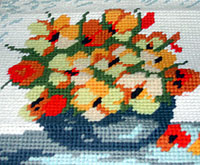
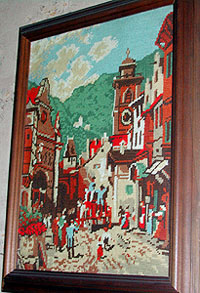
In 1991, it was again people who helped her out with an apartment in Yerevan as she had to start her life from scratch once more. The last time, however, she had a husband, was young and stood firmly on both legs but now she was restless. She managed to calm down, though, remembering what she was taught in Germany. They not only helped her materially but also taught her to knit carpets with one hand so that she could earn a living. Her friends sold them in the Vernisage and it is with that money that she could sustain herself.
A TV journalist heard about her and the TV station rang her up. At first she refused to be filmed for "Blitz" but when they explained that the program would encourage the audience during those times of economic crisis, unemployment and general apathy, she agreed. She wasn't infuriated at all and her words came by themselves. She was absolutely relaxed when they filmed her knitting a carpet with one hand. During the course of the program, TV viewers learned that Nina not only washed herself and did her own cleaning but she also cooked for herself, making salads and even wrapping tolma.
Nina Gyunashyan has many friends. People come to her to relax, to touch base and to cry out. One day I witnessed that when one of her friends came and was treated with tea and sweets, warmed herself up and complained about her health and life. In the past, Nina used to listen for hours before comforting them but one day she understood that this wasn't the right thing to do. She says she understood that people are often not in as bad a state as they might imagine.
"You know, what is the tragedy of so many people?" Nina asked me one day before proceeding to answer the question herself. "We don't know how to be grateful for the many things that we take for granted. I had to lose both my legs before I understood how wonderful it is to walk, to move. One day on TV there was a young man who fought in Chechnya . He was wounded and blinded and lost both his hands. I looked at him and cried. I was so sorry for him. He is so young but can't even see the light given by God. But I can look at the face of a kind person and feel happy. Thank God for everything. You know, I understood why God kept me alive. It was so that he could teach people through me. By communicating with me, I can help them carry their difficulties and teach them to be grateful for everything".
Be quick to do good things
I became acquainted with the Nina's neighbour, Eleonora Grigoryan, and when she discovered that I was a journalist she asked, "Are you going to write about her?" When I said that I would she responded. "Don't even try to pity her. You know what sort of person she is? If someone else was in her place. But she lives and helps people. Nina helped me to raise my youngest child. I was tight with money, three kids and I was suddenly offered a job. I was going to refuse it because my youngest kid was only one year old. There was no one to leave him with but during a conversation with Nina she told me not to refuse it because I needed work. "Don't worry about the child," she said. "I'll help.""
At the beginning I was afraid that she'd drop the child or something but when I saw how skilled she was looking after my child with just one hand, my mind was put to rest. This is how she is. She is a sister for me and an example. Next to her it is even a shame to succumb to desperation. You know it is easy to be kind when it doesn't take any special efforts but my Nina will share her last peace of bread if she has it."
From her own experience Nina understood a very important truth. There is nothing better than the feeling that you displayed even a little kindness to people. That's why she is quick to do good. When I asked Nina how much pension she gets it turns out that she receives 4800 drams with an additional 4500 drams from the Paros poverty benefit scheme. Altogether that makes something like $17 which is not much if you take into consideration utility charges such as electricity, gas, telephone and water. All her pension goes towards paying her bills but even so, the debt is piling up to amount to quite a significant sum.
Thanks to the electrician he has not cut off power to he apartment because he understands her situation but she still needs to pay it. She has no privileges. " Mission Armenia " gives medicines of general use like Analgin once a month but she also needs sleeping tablets. Tazepam helps her very well but one pack is 1350 drams and lasts for one and a half months. She doesn't want to talk about her difficulties, especially financial. She'd rather speak about kind people who help her.
How can she not remember Mnatsakan Hovsepyan without gratitude? Her apartment didn't have a balcony but the master builder constructed one for free. It is a small and cosy balcony that looks upon a lively avenue and is in the vicinity of a huge plane tree. She confessed that she was really happy twice in her life. The first time was when her daughter was born and the next, when after so many years in her little apartment she went to her balcony and felt as if she was in a forest and among the nature that she has liked since childhood.
From time to time, Nina has a dream. With open hands she is running through a flowery meadow towards the setting sun. Her heart is filled with unreasoned joy. Nina is listening to the sounds of the village that she was born in as it wakes The call of roosters, the slow mooing of the cows and the high-pitched voice of a woman calling her. She can hear the sound of bees and crickets in the grass all around her.
When she wakes up she lies for a long time with her eyes closed as she tries to keep these long forgotten feelings with her before reaching for the nearby horizontal bar that she uses to lift herself up from the bed.
On the other side of window the world is alive. She wants to go to forest one more time to listen to the silence and to breathe the fresh air. Now that she has a balcony, early in the morning during the summer when the city is asleep she takes her wheelchair to the balcony and touch the leaves of the tree. It is funny, she is so much filled with emotion that she talks to the tree as if confessing love to a friend.
Of course, with the money Nina is getting from the government she can't afford either a Japanese TV set or a balcony and guessing what I am about to ask, she says that sometimes different people help her with money. There's Erna and Chitian Hubers from Germany and the Tufenkian fund. "I am very thankful to Jarakyan family from Yerevan , Eric Ghazaryan, Anahit and Ruben Chobanyan," she says. "Ruben offered to sell my carpets but I suspect that he doesn't always manage to sell them. Yet, he always brings money. I am thankful to everyone who helped me to live but unfortunately, I don't have a permanent sponsor and sometimes I am worried how I'll live if one day the source of humanity ends."
To the Internet for help
To prevent that situation from happening people have suggested one possibility, to write about herself on the Internet. And she wrote a letter that started something like this. "Hello, my name is Nina-Moldovanka." No, she didn't ask anything from anyone but just described what had happened to her. She wrote the amount of her pension and the allowance she receives. Her laconic letter ended like this. "I believe that the world is not without kind people and in your country there are people with gentle hearts ready to help me survive. I ask, I hope and I am thankful to everyone beforehand."
I promised Nina to put her letter on the Internet and asked a final question. "Why didn't you go back to your motherland, Moldavia , from Germany instead of returning to Armenia ? You have relatives there."
"Where else I could go?" she responded. "All my great losses and achievements dear to me are connected with Armenia . Here is where my husband and daughter are buried. Here are my friends. Even the Armenian language became mother tongue. In Armenia every second person is a relative. Many people have difficult lives. Who will want to support me there when financially they can hardly survive themselves. Times are so."
Eleonora Vartanyan
South Caucasus. Monthly Magazine
Write a comment