 Videos
 Photos


Depi Hayk - Birthright Armenia
Varty Defterderian
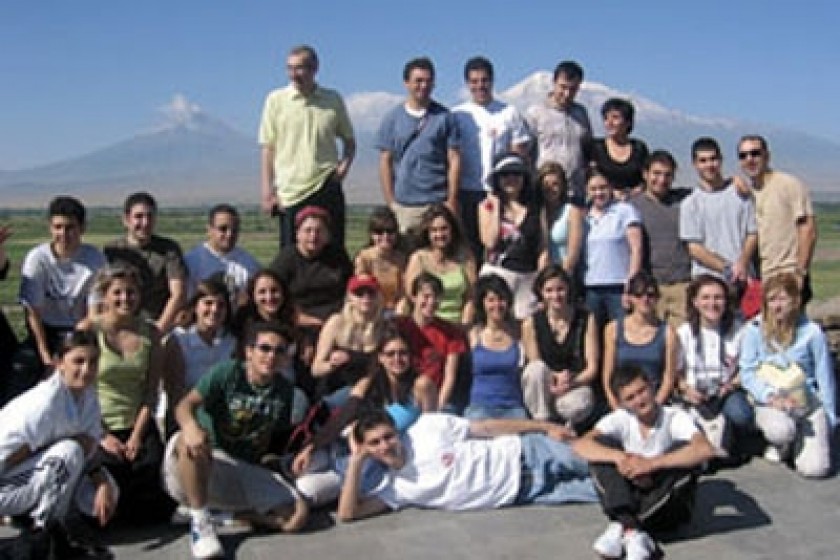
By the end of the summer, over 85 Diasporan youth, representing ten countries world-wide, will have will have made their journey home with the help of “Depi Hayk/Birthright Armenia”, to reclaim their birthright – to call ittheir Armenia.
In its second year of inception, Birthright has doubled its size of volunteers. From the biweekly forums regarding social, economic and political topics, to the language classes, to the Saturday excursions to different parts of Armenia – Birthright aims to foster a sense of Armenian spirit, culture, and understanding.
“I had a fear that because our Diasporan community is so strong and very vibrant, that I started sensing among my younger cousins that they could define themselves as ‘good Armenians’ without necessarily having a connection with the homeland. I was very concerned about the Diaspora, once the genocide recognition happens and I think we all sense that it will happen very soon, how do we as a diaspora survive without a connection to the homeland?” says founder Edele Hovnanian of her reasons for creating Birthright Armenia. It is not simply a tourist’s visit to see the sites and leave within a week; it is rather a chance to create lasting bonds with the country, the locals and the culture by affording them an opportunity to be a part of Armenia’s daily life and to contribute to Armenia’s development. To cultivate life-long relationships with host families and friends from around the globe, to create business partners, and to even create the seeds of family while renewing the volunteers’ sense of Armenian identity.
The volunteers comprise a plethora of experiences and backgrounds, from those with only one grandparent of Armenian decent to the 100% ones, from those who were born in Armenia and those who are 3 rd and 4 th generation Diasporans, from fluent Armenian speakers to those who do not even know a word. With that in mind, Executive Director Linda Yepoyan stresses full immersion, to as she puts it “put on your walking shoes” and go explore the city, speaking Armenian as often as possible. She stresses the importance of being open-minded and curious, citing it as the only way to get to know this land and its people.
However, it is simply a matter of fact that many of the volunteers struggle with communicating with the locals, whether it be ordering a meal at a restaurant or asking directions or asking about someone’s day. “It’s one of the most frustrating things trying to communicate with someone when you don’t speak the same language, especially when you meet people that you so badly want to get to know, you want to ask them all about their life and all about their experiences, and find out everything you can about them, but you can’t because it takes 20 minutes to ask one question,” says Sarah, who has only in the last year been learning the language.
But besides having Armenian blood, there is one other thing that most volunteers can share: their first impression at finally beholding the legendary Mount Ararat. “The first time that I saw Mt. Ararat. …It was amazing to see it in person, because before that it had been something that I had only heard about in stories. I feel like there is so much power linked from Mt. Ararat to Armenia, and the fact that I looked at that everyday, and said, Oh my God, this is a real place and I’m really here and I’m actually doing something that attaches me to my cultural background,” says Sarah Wilkinson, a 27-year-old intern here with Depi Hayk for the second year in a row, of her most memorable experience. The most emotional and meaningful memory that many first-time volunteers take away is that of the site of the historical and symbolic mountain of our people – weather this is accompanied by goose bumps, tears or simply a smile.
This journey of self-discovery is trying and eye-opening. Most, if not all, of the Diasporan volunteers represent the western world, and are not quite sure what to expect. Many are faced with a language barrier, uncertainty of home stays, culture shocks, and lack of the comforts of western accommodations. As opposed to mere tourists, a two-month stay forces them to immerse into the life and culture of present-day Armenia. Instead of quick once-over from a plush hotel room, they are confronted with taxis and storeowners overcharging the tourists, the trash on the roads, the rampant corruption in everyday life and the dire reminders of poverty amongst the locals.
To get a glimpse of the harsh realities and the strength of the Armenian spirit, the volunteers were taken on a three-day weekend excursion to Nagorno-Karabagh—Artsakh to the Armenian people. Ms. Hovnanian realizes the inability of some to cope. “When we take them to places like Shushi, which has no running water, etc., there are those who get it, that even though we’re putting you here for three days, part of the reason we’re putting you in Shushi and not a hotel in Stepanakert is because we truly want to get you to –almost through shock value— get a window into the hardship of living in certain regions of Armenia. I think most people get it, some tolerate, some thrive in it and some are just miserable, and can’t imagine a life without flushing toilets and just whine and complain, but in general that’s only 1 or 2%.” This summer’s participants returned with mixed reactions: some were unable to deal with the lack of western conveniences (i.e.: flushing toilets, paved roads, etc), others left saddened by the rampant poverty, while others still left with an unparalleled love for the people and the land and a determination to make a difference. A handful left determined to return to either Shushi or similar regions to do humanitarian community service in order to help rebuild the war-torn villages.
“When I got here, some things were better than I expected and some things were worse than I expected. But honestly, everyday, I learned something new and everyday I experienced something that changed my life or opened my eyes to something that I had never before experienced or thought about experienced. So I think I walked away with a better idea of not just life in Armenia but life outside of the United States. We’re on our own little island over there, we’re separated by this big ocean and I think we forget that there’s a whole rest of the world that doesn’t experience things the same way we do, ” says Sarah. Despite he culture shock aside, or rather because of it, the volunteers begin to create a new home, a new set of priorities and a new sense of identity.
It is one thing enabling those in the Diaspora who were raised in flourishing Armenian communities the likes of Boston and Los Angeles, but it is quite a different story for those coming from remote areas of the world, where the only hint of anything Armenian in the surroundings is the small percentage of their blood. “The real turn on for me is saving those who were effectively on the road to being lost,” Ms. Hovnanian explains, “When you have the ability to take someone who is 25% Armenian, and did not grow up in an Armenian home, and did not speak Armenian, and give them an experience and enough understanding of the language to feel at home here, is really what moves me.”
Sarah is the mark of a true success story, “Whenever I would tell people here that I’m only half Armenian, they would say ‘No, not only, you are Armenian.’
For more information, please visit www.birthrightarmenia.org
Write a comment