 Videos
 Photos


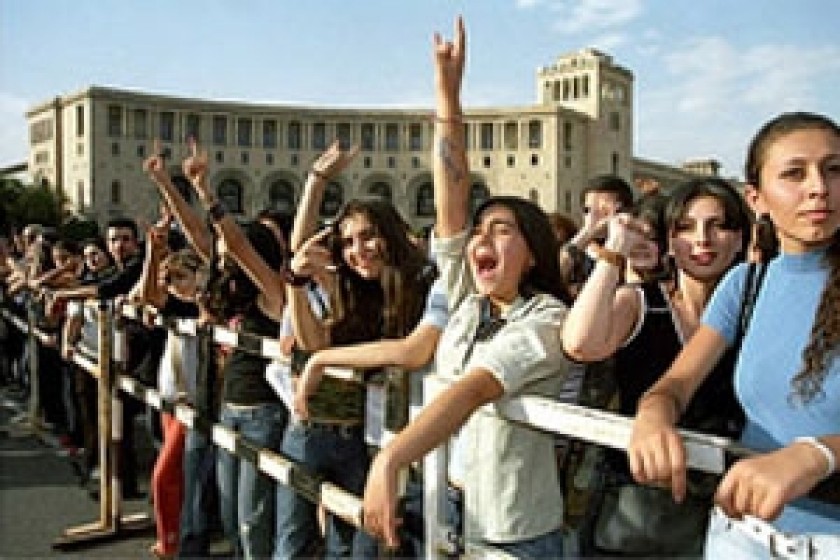
Armenian Youth: Ready to Rock?
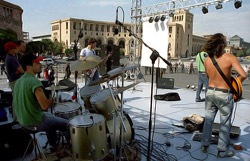
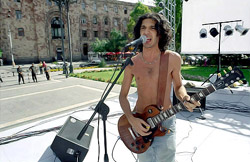
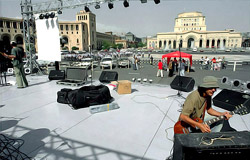
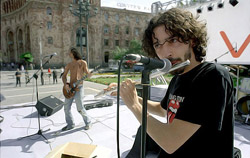
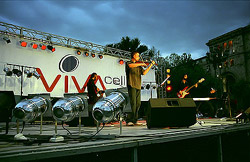
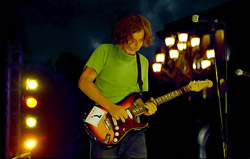
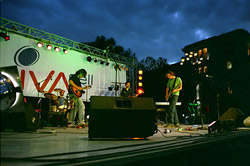
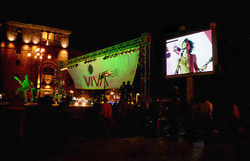
On September 2, 2005, Yerevan staged its first international rock festival, Rock 'n People, in the capital's central Republic Square. In a country where most "live" pop music concerts - a music genre much preferred over rock - are lip-synched, there are many obstacles to overcome. However, the organizers of the festival were convinced that audiences in Armenia would prefer to hear music being played live.
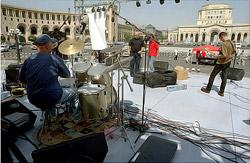
Sound checks, a relatively new phenomenon in the country, can prove problematic. During the middle of a sound check by Empyray, a band typified by heavy bass and drum rhythms as well as searing guitar solos, an official from the nearby Ministry of Foreign Affairs requested that preparations for the concert be put on hold for half an hour while an important diplomatic meeting took place.
 |
 |
 |
 |
 |
 |
 |
 |
 |
 |
 |
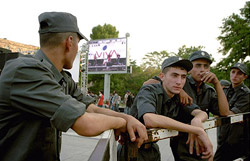
The number of police, including Ministry of Interior troops deployed as security for the event, also surprised many. Although the festival would only attract a few thousand people, hundreds of police assembled in front of the stage. "Perhaps they think we'll start a riot," said one young rock fan, arriving early to watch the main stage being set up. "Maybe they like rock music," joked another.
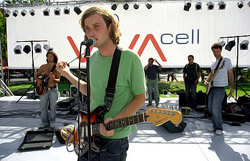
The location, flanked on all sides by government buildings, a luxury hotel and the National Art Gallery, might not seem the most appropriate of venues to stage a rock concert, but with sponsors such as Radio Van and Viva Cell involved, permission was granted. Viva Cell, the long awaited competitor to ArmenTel, has been consistent in targeting its advertising and promotional campaigns towards youth.
Yerevan hasn't seen a rock festival in such a high profile location since the end of the Communist era. Even today, many consider the last years of the Soviet Union to be the heyday of Armenian rock. Bands such as Asbarez had huge followings and others even had a role to play as ethnic conflict between Armenians and Azerbaijanis erupted over the predominantly ethnically Armenian populated territory of Nagorno Karabakh.
In 1989, for instance, Vostan Hayots took their set based on the 1915 Armenian genocide by Ottoman Turkey throughout the country and even performed in Stepanakert, the capital of Nagorno Karabakh. The next day, Soviet troops confiscated their equipment.
"We soon earned the reputation for arriving somewhere just before trouble broke out," remembers Hovhannes Kourghinyan, Vostan Hayot's vocalist. "When we went to Agarak [in Southern Armenia] there were clashes between Armenians and Azerbaijanis and the same happened in Kapan. We even brought information from Meghri to the Karabakh Committee. A few people knew what was going to happen and were getting ready by arming themselves. We were involved in that."
Gradually, as tensions with Azerbaijan over Karabakh turned into full-scale war, rock music became less and less popular in Armenia. In particular, military conscription put an end to the careers of many young and promising rock musicians. The electricity crisis of the early nineties also forced many others to find work abroad. "Without electricity you really can't play rock music," says Kourghinyan, "It's as simple as that."
Other musicians were more fortunate, however. Hripsime Jangiryan, wife of Eduard Abrahamyan, lead singer with Manic Depressive Psychosis (MDP), remembers how the band assembled a hundred fans in Yerevan's Agricultural College in 1993 when the capital was otherwise deprived of electricity. At the time, Abrahamyan worked as an electrician at the college, one of the few buildings supplied with power.
A bottle of cognac convinced the college's elderly security guard to leave, and the premises became MDP's to use.
But, even with electricity supplies now constant and Armenia's economy well on the mend, there are few people who listen to rock music in the Republic. Instead, contemporary singers and musicians are reliant on the support of government-connected businessmen rather than CD sales to sustain their careers.
Even among those young Armenians that do like rock, however, many say they instead prefer foreign bands. "In the nineties there were maybe 20 or 30 rock groups in Armenia," says MDP's Abrahamyan. "However, after those difficult years, many left for England, the United States and Russia. As a result, the market is under-developed and when the quality of rock music deteriorated, the audience instead turned to Western groups."
Attracting listeners is also an ongoing obstacle, especially as rock music is starved of exposure in the mainstream media. Live concerts are also out because many young rock fans find it difficult to pay the 1,000-1,500 drams [$2-$3] entrance fee to Yerevan's two rock clubs. Pricing tickets higher - over $15 - can lead to inadequate sales and cancellations, as one three-day-event planned this August near Lake Sevan showed.
Armenia's large Diaspora, a potential market for Armenian music, is also off-limits to local rock bands because ethnic Armenians living abroad instead prefer to listen to music that serves a nostalgic or nationalistic purpose. Even Bambir, a charismatic young band from Gyumri that is fast earning a reputation with its eccentric live performances in Yerevan, has so far been unable to find an audience outside of Armenia.
Narek Barseghyan, Bambir's 21-year-old guitarist, says that young Armenians want something different, but a monopoly on the music industry prevents rock bands from being shown on television or played on the radio. He also says that when compared to other former Soviet republics, Armenians are more conservative in their mentality. "In Georgia, it's different," he says. "Here, if you have long hair, people call you a gypsy."
Despite the problems, however, Artyom Ayvazyan, president of the Antennae non-governmental organization (NGO) and the main organizer of the rock festival, is optimistic. In the past, national rock festivals in Yerevan have attracted audiences of around 500. The free festival staged on 2 September, however, attracted at least 2,000 people as well as rock bands from neighboring Georgia.
"It's true that rock music doesn't attract a large audience in Armenia," he admits. "However, there are many people who want to listen to something different, even if they don't yet know what. Although very few rock groups are played on the radio, there was almost nothing before."
Marieke Kitzen, a Dutch volunteer working with the Bem Youth Progressive Action Center, a local NGO that considers the development of youth culture key to involving young Armenians in the country's socio-political life, agrees. "I thought the rock concert was a great success, although at the beginning, when there were more police than spectators, I had my doubts if rock in Armenia would ever work," she says.
Text and Photos by Onnik Krikorian
Write a comment