 Videos
 Photos


When We Die, the Housing Problem Will Be Solved
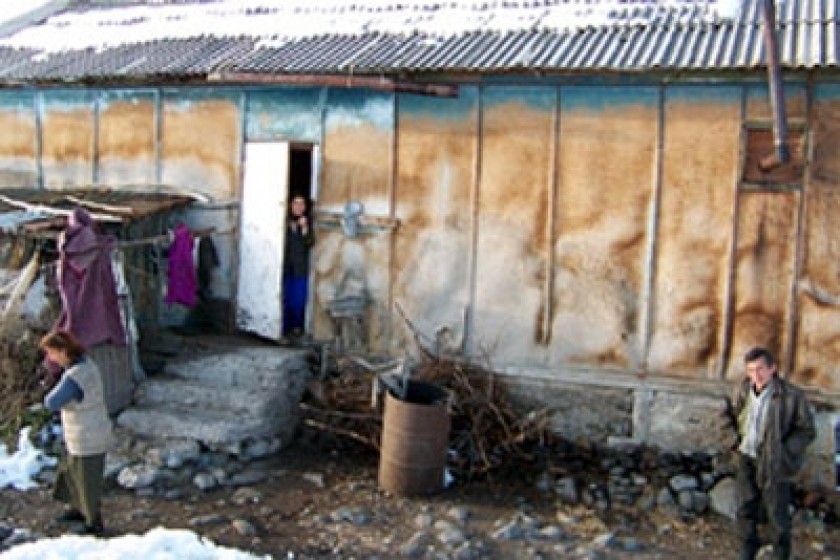
Samvel Movsisyan's family has found shelter in the village of Karchaghbyur the Gegharkunik Marz. His family is one of the thirty-two families that in 1992 were deported from Azerbaijan's Shahumyan region. The refugee families were housed temporarily in the half-wooden, half-stone cabins of the Lchap Pioneer Camp. As the years went by their hopes of receiving permanent housing faded away, and the refugee families started to leave Karchakbyur. Of the original thirty-two families, only two families now remain.
Lavrenti Harutyunyan's family received housing with the financial support of the government since they were the family of a freedom fighter who was killed in the war. Samvel Movsisyan, meanwhile, has not received any housing to this date.
The Movsisyans are a family of five. Samvel graduated from Yerevan's Polytechnic Institute, but he is does not have a job at present. His wife Adeline isn't working, either. The couple has three children of school age. They have no kitchen garden, no cow, no land of their own. The family lives on Samvel's disability pension, and they make a little money reselling the fish they buy from fishermen.
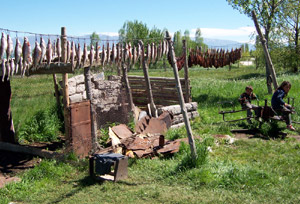
The dormitory this family lives in can hardly be called housing. It doesn't have any basic sanitary or living conditions. It stinks of fish, outside and inside--the barrel used for smoking fish and the smoked fish hanging from a laundry line are the centerpieces here. Poverty is engraved in every corner. Meanwhile, children have been born and raised in these conditions. The couple sleeps in one of the two beds, their fifteen-year-old daughter in the other. Their two sons, fourteen and ten, sleep on the floor.
Some months ago, the family received a voucher with a face value of 780,000 drams as part of a program funded by the state budget entitled "Providing housing by giving vouchers for purchasing housing." But the family wasn't able to purchase a three-room apartment with a bathroom in Karchakbyur. In that village, a house or an apartment costs at least two million drams. "For that sum [the voucher's face value] you can't even buy a barn in Karchakbyur," Adelina Movsisyan told us. "Have you looked for an apartment elsewhere, like in Vardenis?" I asked. Adelina replied, " We didn't want to become super-refugees." It's not possible to buy housing in Vardenis for the voucher's value, as prices there have also increased. After six months the Movsisyans were forced to return the voucher, and their housing problem remains unsolved, indefinitely.
 There were thirty-nine refugee families in the housing voucher program in the Gegharkunik Marz. But nineteen of them were not able to buy an apartment within the designated six-month period and the vouchers expired. In the same period, thirty more families applied to the regional government for vouchers.
The voucher giveaway had its influence on the housing market prices. In those places where several families received vouchers, the market prices immediately rose. The greatest number of vouchers were received by refugees living in dormitories in the town of Sevan. But, like anywhere else, housing prices were high and rose even higher during the vouchers' six-month expiration period.
The dormitory at 57 Nalbandyan Street in Sevan is in an appalling state. The bathrooms are public, and there is no running water. In the winter, when the pipes freeze, the residents throw out all types of dirty water out of the windows. The building and the area surrounding it are a despairing display of poverty and stench.
For Aramayis Sahakyan's family, one room in the dormitory serves as guest room, bedroom and bathroom and the other as storage and kitchen. "Where there is no water, no toilet, or bathroom, how can we adapt?" the residents ask desperately. They received a voucher for the apartment but were not able to buy an apartment with it. In Sevan, the market value of housing is high. Aramayis has five children. His four daughters have gotten married and move away. His son is recently married; now the young family has to live in this dormitory.
Anna Eghakova, a refugee from Baku, lives in this dormitory as well. She is single, and has no relatives - her parents died when she was two years old. She lives in horrid conditions. She was also given a housing voucher, but like many others she wasn't able to buy an apartment with it.
Yevgenia Asryan is another single woman living on a pension. In 1988, she fled empty handed from Sumgayit, the horrors of Sumgayit still before her eyes. After living in the dormitory seventeen years, she received a voucher, but she too was unable to buy an apartment. "They say in six months they'll give new vouchers. But who knows whether they'll give them or not. And if they do, will we able to buy housing?" she asked desperately.
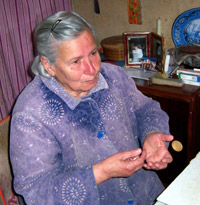 Nina Kadamyan is another resident of the Nalbandyan Street dormitory. She and her son used to live in the Arevik Sanitarium. She was given a 1-million 31-thousand dram voucher. Vouchers like this were given to families of one or two, to buy single-room apartments. Several families quickly bought apartments in the nine-story dormitory, which is owned by Yunona CJSC. "I wasn't even able to buy an apartment in that building. On the 7 th floor they were selling an apartment for $3000. The floor was rotting, everything was ruined. Where would I get that kind of money?" Nina asked. This old woman, who lives on her own, is unwell. "The hardest part is bathing. We go to the public showers. One hour there costs 600 drams. But for me and other poor pensioners this is a lot of money. What can we do? We pay 300 drams, and bathe for 30 minutes." She stopped and added hopelessly, "When we die, the housing problem will be solved."
Lusine Toplaghaltsyan
Write a comment