 Videos
 Photos


Pretending Not to Notice
Areguni stands out among the 35 village communities of the Vardenis administrative region in that it lacks a local administration building. The village council building burnt down in 1992 and the local administration hasn't had its own premises since. For years, it was housed on the ground floor of the village school, but the space it occupied has been renovated and now serves as a cafeteria for first through third-graders.
According to Rubik Manukyan, secretary of the local administration, when the school was renovated, the mayor of the village of Areguni, Aram Vardanyan, allocated one room in his private house to the local administration (without a formal corresponding decision) but sessions of the local council are held not in that room, but in the school building, since three members of the council are teachers in the school. Visitors to the village are forced to seek out the well-informed secretary for answers to their questions not in the room allocated to the administration, but in his own house.
The situation is almost the same in the village of Antaramej village in the Tchambarak administrative region of the Gegarkunik Marz.
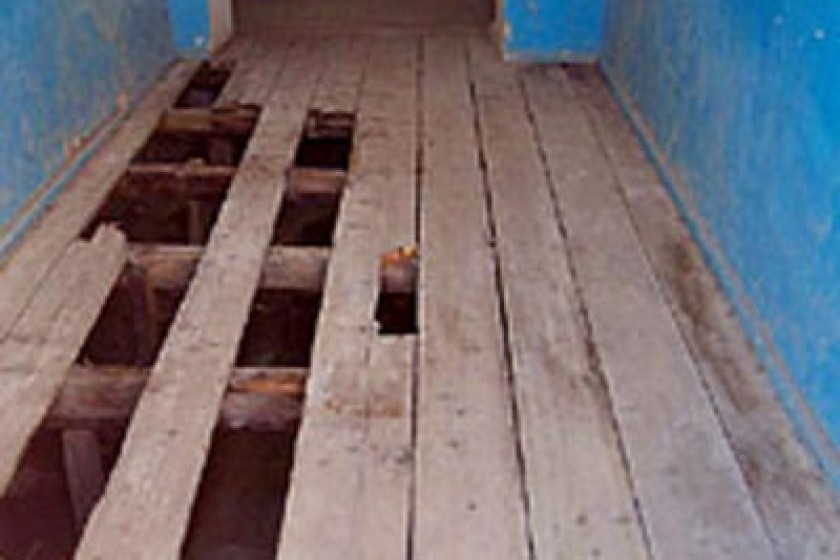
This remote village, population 234, also has no local administration building. Part of the old building collapsed, rendering the entire structure unusable. But Antaramej, unlike Areguni, has very few visitors. No public transportation reaches this village. The 5.2-kilometer road from Dzoravank is in a pitiful condition. In fall and winter it becomes completely impassable. On snowy days, the village is cut off from the outside world.
The quality of work on the part of community administrations has become worrisome, especially in the remote villages with small population where there is little supervision of local authorities.
There are 87 village communities in the Gegharkunik Marz. More than half of these, 49 in total, are remote villages, located mainly in the Vardenis and Tchambarak administrative regions. These are the most vulnerable communities, both because they are remote and because they are situated in border zones and mountainous areas. Local self-governance in these sparsely populated villages is a deplorable condition; civic participation is weak and local authorities are left to do as they please.
It is rare in these villages to find administration offices open for business, or employees at their desks, actually working. On one visit, we were surprised to see, after the lunch break, that the office of the mayor of Pambak in the Vardenis region had its doors open. It turned out, however, that this was just because a policeman was paying a visit. And only one employee - administration secretary Lena Djumanyan, was present there, although there are ten people on the payroll.
Of course, salaries are low here. Lena is paid 23,000 Drams a month. This year she and others only received their salaries twice. In 2005 the community spending equaled only 21% of the projected budget. There are no telephones and the heating system is shut off during the winter months.
We asked the secretary how local council members were informed of meetings.
"The village mayor informs the village council members two or three days before a session. And for residents, we post a notice on the door of the mayor office, some three days in advance. Are the legal requirements any different?" she concluded with a question. When we asked if the council followed any rules of procedure, she said that had worked for the mayor's office for three years and didn't know whether they did or not. We asked how many council meetings had been held this year. She said that she didn't remember. There were meetings that she missed. What about the minutes, we wondered, wasn't it the duty of the secretary to take them? "I came afterwards and wrote down the minutes, " she said. "So what? What's wrong with that?"
Apparently, the Pambak administration has its own peculiar interpretation of the Law on Local Self-Government, which states, "A draft meeting agenda with draft decisions and other necessary documents shall be distributed to the council members at least seven days in advance.
"At least seven days before prior to a the council meeting, the head of the local administration shall publish the date, the venue, and the draft agenda of the meeting. In the communities, a notice shall be posted on the administration office door as well as in places convenient to residents of various parts of the community, in at least one place for every 2,000 residents."
Another strange thing is that one third of the village mayors in the Vardenis administrative region reside in the communities they head only legally; actually they live elsewhere, mainly in the town of Vardenis.
In some villages in the region - Geghakar, Vanevan, Azat, Kut, Geghamabak, Norabak, Djaghatsadzor, Trtuk, Kutakan, Pokr Masrik, and Daranak - it is an exceptional phenomenon to find the local administration offices with their doors open. Such "closed" community administration offices exist in every province in Armenia. But is it possible to carry out local self-governance behind these closed doors, or to develop a country that is made up of these communities?
Neither local budgets nor local council decisions are published, and citizens are not informed of council meetings. When we talked to Gohar Aslanyan, the secretary of the Geghamasar community administration, about the legal requirement to inform residents of council meetings seven days in advance, her reaction was, "It would be great if you could inform us of these legal requirements."
The secretary of the local administration of Areguni told us, "The residents themselves do not wish to participate in the council meetings."
Based on our own observations, most communities don't even have bulletin boards. They don't feel the necessity. Instead, there are only one ore two leaflets or announcements posted by NGOs or international organizations and a variety of election posters fading on the walls of local administration buildings until they are replaced by new ones.
Add to this the mismanagement of local budgets, the arrears in salary payments, poor quality of office work, the ignorance of legal documents.
The system of local self-government in our country has existed for eleven years now. Will time correct the numerous omissions and derelictions of duty within the system that which our public fails to notice? Or rather, pretends not to notice.
Lusine Toplaghaltsyan
Write a comment