 Videos
 Photos


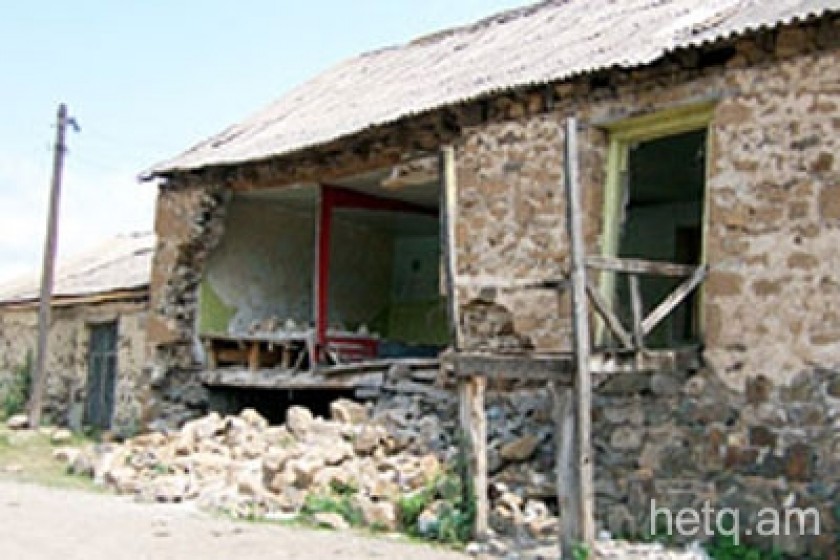
Village Communities are Barely Getting By
Starting from 1997, when the Law on Local Self Government came into force, subsidies have been determined according to the principle of equalization. As such, they have been allotted based on number of residents and taxes per resident. But these two factors, in practice, contradict the principles of equalization. The purpose of equalized subsidies is to promote equality between communities with different socioeconomic potential. According to this logic, the government should provide more money to small communities.
But the two factors in the equation are in constant contradiction, and the end result is the unfair distribution of subsidies. The per-capita revenue is calculated by dividing tax revenues by population. Therefore, Yerevan communities should have the best indicators. But Yerevan communities currently receive the largest subsidies, which clearly contradicts the principle of equalization.
"Our government is pursuing a policy that clearly violates European regulations. The regulations stipulate that according to equalization, subsidies should be given to financially weaker communities (calculated by revenue per capita). In 1997 when the law was created, Armenia hadn't yet adopted the European regulations, but once that document was legalized in Armenia, we were obliged to modify the law to meet those requirements," said Sos Gimishyan, board member of the NGO Union of Community Financiers.
Community subsidies (which are defined according to the law) make up only 4% of the overall budget. "If we say that 4% is too little, and then if, for instance, we say 10-15%, we need to show the source, that portion of the budget that we can take the money from," said Vache Terteryan, vice minister of Territorial Governance. "The allotment of subsidies according to equalization does not aim to solve community problems, but rather to support the solution of these problems. Of course it would have been better if there were 20 instead of 10, but wishes and reality are different things. We, for instance, have to think about cutting money from healthcare and giving it to communities. Pragmatic calculations show that the current situation is realistic." In Armenia, community budgets (besides subsidies, budgets also consist of income and land taxes, local tariffs and fines) make up only 7% of the state budget. That is, 930 of Armenia's communities receive only 7% of public money. And if we take into account that more than half of that 7% goes to Yerevan's 12 communities, and subtract the 12 communities of Yerevan from these 930, then the remaining 918 communities receive only 2-3 % of the state budget. And here the unfairness of the distribution of subsidies becomes clear.
In Georgia, community budgets constitute 20% of the state budget. In Russia this indicator is more than 25%, in Baltic countries it has reached 40% and in the average European country 30-35%. In Armenia this indicator doesn't even reach 10%, despite the fact that the social responsibilities and authority given to communities are far greater than this 10%.
The Union of Community Financiers has data on all 930 communities and has created a database of budgets during last 4-5 years. According to them, 75-80 % of community budgets are barely enough to cover salary expenses. Only 20-25% of the communities, after paying salary expenses, have some money left to provide services to the population. The budget, in practice, has become a way to keep on six to ten staff members, who don't do any work at all.
"Starting this year, the Law on Communal Services will come into force, which will regulate this issue. That is, we will confirm the lists of the names of community service workers, and in that regard the community will be unified," said Vache Terteryan.
According to the Law on State Government, financial support to the communities should correspond to the powers invested in them. But there is very little money to guarantee these powers can be implemented. And if a power is invested without any financial backing, then it is equal to nothing.
Since 1996, powers have been defined, but corresponding financing has not been provided. One example is kindergartens. There is no local tariff, so residents do not even pay 1,000 drams to utilize kindergarten services. (During Soviet times, a small payment was required. Now the same money is collected illegally.) In general, if an area or service is unprofitable, for example heating systems and waste management, it is given over to the communities. But profitable services such as electricity and water are not.
The water supply systems used to be managed by the communities. But after the Water Consumer Unions were created, the government took control of this sector. It's clear, though, that water and irrigation issues shouldn't be handled by Yerevan; each community should handle those issues itself, since nobody knows the problems on the ground better than the local residents. In the civilized, world there is no country where the water supply is managed by the state government.
The Millennium Challenge program plans to rebuild irrigation systems and roads. But the question of who will own these systems afterwards is not discussed. If, for instance, the irrigation system becomes the property of a large landlord, he will stop supplying water to the villager, the villager will have to sell the land, and there will be bigger and bigger landowners and property ownership will become more and more centralized.
Modern methods of communications have made it possible for the various ministries to take care of provincial affairs from Yerevan. Provincial governors have been left without anything to do, so they interfere in the work of the local community authorities. As a result, local self-government suffers. Although serious money goes to the provincial governments they do very little useful; if they were all closed down, perhaps no one would notice.
Indeed, the last ten or fifteen years have proved that the main function of the provincial governments is to intervene in elections. This also explains why governors are appointed, not elected.
"In European countries state and regional government are equal and competing entities, and there is no inequality - one deals with state government issues, the other with local issues. And which is more effective gains the trust of people accordingly. What we have in Armenia is hostility. The state government does everything it can to prevent the local self-government cannot fully develop, because the development of the local self-government means the development of democracy. The more democracy there is, the greater the danger that the current government will lose its power. This is the secret. Here the National Assembly should take on the role of a judge. But since the National Assembly is an appendix or afterthought of the executive government, it so happens that the state government is always strong and keeps everything in its hands," said Sos Gimishyan.
Nevertheless, in recent years, the government has taken one significant step towards improving the local communities. Today, in addition to subsidies, income and land tax are also added to the community budget.
The government has traditionally addressed the problems facing village communities through Diaspora donors and international programs. But it doesn't do much itself.
Yerevan is slowly becoming a city-state, and the communities outside are barely getting by.
Karine Danielyan
Write a comment