 Videos
 Photos


Hesitation Could Cost Lives
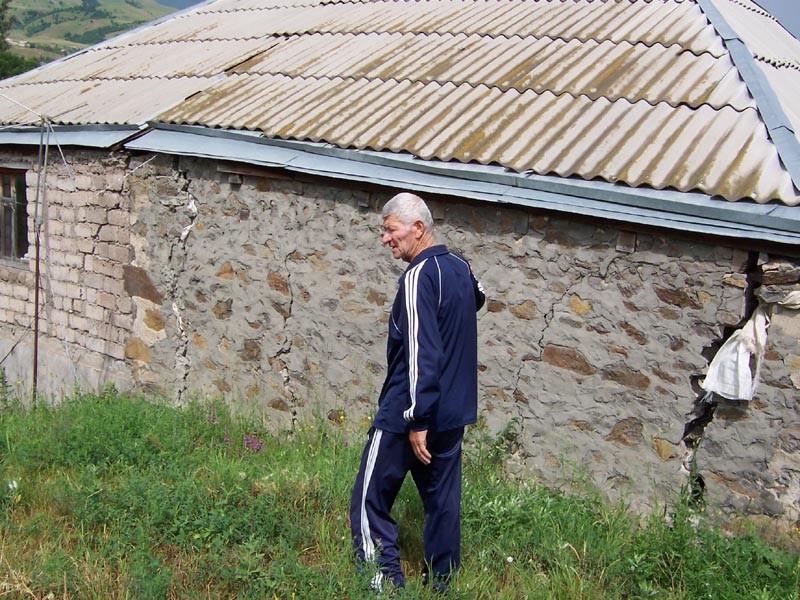
The house of Henrik Gabrielyan, a community leader in Aygut, is the most famous of all the houses in the Chambarak administrative district that have been wrecked in landslides in the past two years. His family had lived in that house for around ten years. But a year ago, they were forced to leave. Gabrielyan and his family are immigrants from the village of Chardakhlu in Azerbaijan's Shamkhor region. "We had a big, two-story house in Chardakhlu too," said his wife, Seda, "even larger and more beautiful. We came out empty-handed and reached Armenia without even a cup to our name. We built a house again, but. What can I say? You can see for yourselves."
The Gabrielyan family settled in Aygut and he built a spacious and sturdy two-story stone house. But in November 2004, cracks started appearing in the walls, and gradually deepened, making the structure a hazardous place to live. A few months earlier, the family had renovated the first floor of their house. The nature disaster destroyed all their hard work. In 2005, they set up a trailer across the yard from their crumbling house and moved in there.
Aygut is one of five villages in the Chambarak administrative district of Gegharkunik Marz in which landslides have caused maximum damage over the past two years. The community leader's house is the focus of that damage, as if the "epicenter" of the event were located right under his house. "When we water our garden, the water disappears through the ground. It seems like someone is stealing the water from underneath," said the community leader's wife, Seda.
 |
The 152 houses and buildings in the community have suffered varying degrees of damage, becoming hazardous to reside in and unusable. Ten or fifteen families in the village have already abandoned their homes and moved in with relatives or taken up free space that acquaintances may have available. However, none of them currently have the status of homeless.
The community members subjected to this unexpectedforce majeure have relived some of their memories as refugees; they have no idea what to do or where to go now to protect themselves. Residential buildings face serious threats at every moment. "The jeeps that bigwig government officials buy cost around 70,000 dollars each. How many temporary shelters could you buy with that money?" asked the Aygut community leader with surprise and anger. Meanwhile, every day, another house crumbles. They keep asking for help from various officials and state agencies, but "We haven't received any news or information," said the community leader, even though community members go to the local authorities every single day.
 |
All the officials concerned are familiar with the situation in Aygut. "Have you seen Aygut, the village head's house?" asked Derenik Hovhanissyan, head of the Department of Construction within the Gegharkunik provincial administration. Receiving appeals regarding the landslides have become part of the everyday work of the department. They often pass this information along up the government ladder and present proposals to their superiors. Government Decree No. 746, regarding the evacuation of residents in danger zones, issued in December 1999, outlined the relocation of people living in landslide areas. But the people living in this area have never received any support from the state in this regard.
What is interesting is that on one hand the landslides are doing damage to Aygut, but on the other, the community is progressing. The village was repopulated in 1988, mainly by Armenians immigrating from the Shamkhor region of Azerbaijan. There are currently 1,052 residents. Over the last few years, the number of schoolchildren has risen dramatically, from 100 to 230. For this reason, as per a presidential decree dated May 17, 2003, construction on a new school building in Aygut began in 2004. Schoolchildren will probably start using the building at the beginning of the new school year. Also, the village also started to receive natural gas, and ten households are already hooked up.
The drinking water reservoirs at Aygut are being renovated, though at the same time, the landslides are disconnecting the water pipes from each other, leaving many houses without water. This has brought about a change in the quality of drinking water. Local women say they are increasingly suffering from joint pain, and a majority of the residents have gum disease.
 |
Landslides have been noted in Chambarak over the past 20 years and have covered a total land area of 400 hectares. Landslides have hit the communities of Aygut, Dpratak, Kalavan, Dzoravank and Martuni. Not too long ago, in the 1980s, landslide activity increased in the village of Martuni, as a result of which residents in the Gyol section were relocated to another area of the same village. The government constructed new buildings in this area, but today landslides have damaged those structures as well.
In 1995, engineering studies and an assessment were conducted in Aygut, Dpratak, Kalavan, Dzoravank and Martuni, with the intention of setting up a plan for future work there. The landslide distribution was studied and a cost assessment was conducted regarding the damage done and finances necessary to renovate the buildings. But all the studies, assessments, calculations and decisions have remained on paper, and the time and money spent on them has gone to waste.
The Gegharkunik Governor's Office was allocated 3 million drams through Government Decree No. 730 issued in November 1998, in order to assess the state of residential buildings in these villages. The studies conducted came to the conclusion that the "main reasons for active landslides were
- the presence of soil with large but fragile particles
- the steep slope of hillsides
- water seepage into the superficial and deep layers of the soil
- incorrect methods utilized by the residents to use the land and geographical relief"
 |
There is also a gravitational factor linked to illegal mass deforestation over the past years; according to experts, the roots of trees act as pumps for underground water and hold layers of soil together. But Derenik Hovhannisyan, head of Geghakunik's Department of Construction claims that deforestation can prevent landslides from occurring, as well as contribute to them. In his opinion, the landslides in the Chambarak area were more the result of garden irrigation practices. In the past, this village was occupied by Azeris who did not cultivate gardens adjacent to their houses and reared animals instead. Armen Hambardzumyan, secretary to the village head in Martuni, had another reason to add. The lack of indoor plumbing in the village meant that wastewater from outhouses with large reservoirs would also seep through to the underground water and increase the tension there.
Last year, studies were conducted in the village of Martuni within the Armenian Government program to manage landslide damage, which was funded by the International Cooperation Agency of the Japanese Government. Currently, constant measurements are once again being conducted through instruments placed in Martuni, although one of these instruments was lost this spring due to damage from landslides.
No restorative work has been conducted in Aygut, Dpratak, Kalavan, Dzoravank and Martuni after the studies conducted there, while the damage caused by the landslides have increased ten-fold, according to the Gegharkunik Department of Construction. Taking this and the latest landslides into consideration, the Armenian Government has proposed:
- that additional studies in the area be supported,
- that separate reports for each residential area with specific suggestions for future activities be presented by the organization conducting the studies
- that temporary shelters be established in all areas that are prone to landslides
- that these temporary shelters be provided to families that have suffered as a result of the landslides.
This proposal will probably also be subjected to the same fate as the previous ones. Even if it is accepted, it is likely to be only implemented partially, through the additional studies. This leads to the question - how effective are these studies if they are not followed by repair or other similar action? Or are we waiting for a natural disaster, which will be followed by stopgap measures and haphazard aid, rather than a coordinated response?
Lusine Toplaghaltsyan
Write a comment