 Videos
 Photos


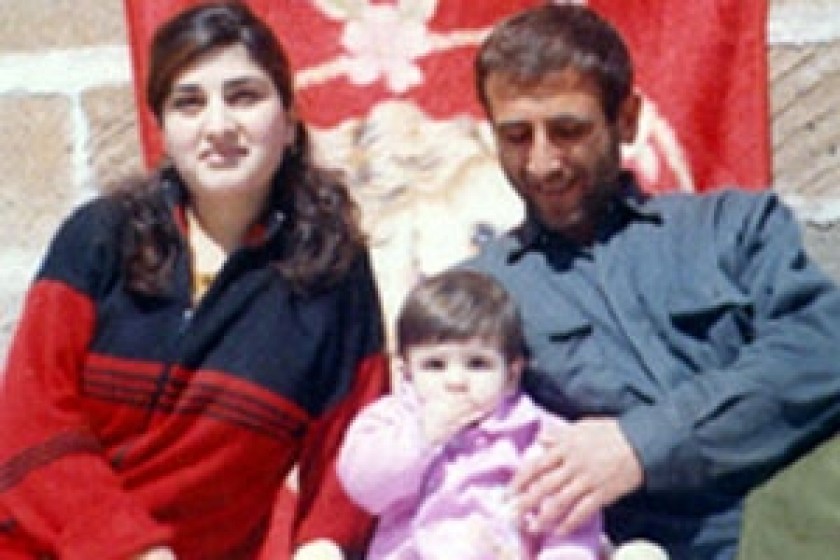
Young Woman Falls Victim to Medical Negligence
Tragedy the Armenian Way
Farmer Sasun Ghazaryan from the village of Dian in the Aragatsotn Marz had a twenty-year-old wife, Anush, and one-and-a-half-year-old baby girl, Siranush, named after his mother. The young family was happy, as is usually the case in traditional hearths founded on love and hard work. They were impatiently expecting a second child to complete their happiness. But fortune didn't smile on them.
The name of their village, Dian, comes from a Turkish word meaning beyond the road. And what happened on June 26, 2006 in the Talin Hospital, 35 miles away, where Anush was taken when she went into labor (babies from all small villages like this one in the neighborhood are delivered in the Talin maternity hospital) is beyond understanding in the modern world. Anush never came home from the maternity hospital.
So many people attended Anush's funeral that her family had to slaughter several animals to feed them all. The silent, dismal funeral procession stretched from one edge of the village to the other. The tragedy shocked everyone in the neighboring villages. “The obstetrician-gynecologist was an old woman who didn't make up her mind in time to provide help…there was no blood for transfusion…” were some of the villagers' murmured speculations at the funeral. Others, unable to grasp the complex circumstances of the case, blamed fate: “It was her sorry lot,” they said.
According to Silva Tadevosyan, the chief specialist in the Aragatsotn Marz' Department of Health and later confirmed by our conversation with Anush's mother-in-law, the girl had made regular visits to the prenatal center and nothing unusual had been diagnosed. “Everything should have been done more promptly; they should have oriented themselves better, ” Tadevosyan said. According to her mother-in-law, “Anush's level of hemoglobin was only a bit low, but she had taken the medicine prescribed by doctors.” Medical regulations dictate that if complications are discovered during the pregnancy, the delivery must be performed in Yerevan. Anush had regular check-ups with Doctor Ruzan Muradyan, who was very compassionate. “If only she had been in a Yerevan hospital that day, but everything went wrong that night,” Anush's mother-in-law Siranush wept.
What act of heartlessness cut the thread of Anush's life?
Siranush will be condemned to reliving every moment of that day for a long time to come. Anush's one-and-a-half-year-old daughter walks from room to room in the house looking for her mother. As the child grandmother tells the story, it is doctors who handled the delivery that are to blame. “I'm not a specialist but it's one hundred percent the doctor's fault.”
Anush was taken to the Talin Hospital at 11:30 p.m. Her baby boy was delivered without complications, within minutes. The confined woman felt well, and her mother-in-law had time to deliver the good news to her husband and son: “Sasun, my dear, we had a baby boy, now give me money to take upstairs as a gratuity.”
Then suddenly her daughter-in-law felt bad. When they went upstairs Anush, still lying in bed, was dashing her head against the wall in severe pain. Her mother-in-law immediately summoned Nazeli Aynajyan, the doctor who had performed the delivery. Dr. Aynajyan responded, “She is just carrying on. She delivered the baby but wants others to take the pain.” Half an hour passed with Anush begging for help, but she was given no attention. Her mother-in-law asked that the head of the obstetrics-gynecology department, Tsolak Khachatryan, be called in but, she told us, “That godless doctor didn't make a move. She said, ‘I have been practicing for 46 years, why should we call Tsolak Khachatryan?'”. Meanwhile Anush was bleeding. We heard an interesting point made about 73-year-old Nazeli Aynadjyan amid the villagers' accusations: “She should have been pensioned off a long time ago, especially after the so-called optimization, but she has a powerful son-in-law in Yerevan.”
The family succeeded in bringing Tsolak Khachatryan to the hospital when Anush's condition became critical: “Her eyes rolled up into her head and her blood pressure fell.” Only then did the doctor immediately call for a blood transfusion. “We paid 50,000 drams and Anushik's uncle and cousin brought blood from Yerevan, but it was already too late; we didn't have time to give blood to my girl.” Dr. Khachatryan began a hysterectomy and called in a special team from Yerevan for help, but to no avail. At 4:30 a.m. Anush died.
“They destroyed our home for the sake of their money,” said Anush's father-in-law, Tonakan, pointedly. “They didn't do anything to deserve any money, but I told them, ‘Save Anushik and you'll get your fill,'” Siranush continued her husband's thought. Perhaps with a second doctor present Nazeli Aynadjyan would not have gotten to keep all the money, or, perhaps, she hadn't wanted to lose face, with all her 46 years' experience, by calling in another doctor to help. But all this is guesswork; the preliminary investigation is still in process.
One other thing shocked Anush's relatives: “They didn't take care of the baby, they just gave him to us, didn't even wait for two days for us to bury Anush.”
“If everything had been done in time…”
There is a fixed horror in the old doctor's eyes; perhaps she actually didn't realize what the consequences might be. “From twelve o'clock I tried to call Tsolak Khachatryan but he didn't answer his cell phone.” But it doesn't seem that she was very preoccupied with trying to locate Tsolak Khachatryan. She didn't sit around twiddling her thumbs, either. She gave Anush injections to increase her blood pressure and coagulation and contract her uterus. Aynadjyan explains that Anush bled to death. “She had anemia; during the pregnancy, she was treated for it.”
The chief physician at the Talin Hospital didn't attend the meeting at the Aragatsotn Marz Department of Health, although according to the chief specialist he had been specially invited to report on the case. The preliminary investigation is still going on and every one avoids making comments. Nevertheless, we arranged for a meeting with the head physician.
At first he tried to persuade us that there was no need to report on the case in the press since every published sentence could open the door to speculation. “If a medical error was made, those responsible will be punished. I have no intention of covering for any of my employees,” he said. He explained, “A woman in childbirth is not ill. If she has given birth it means she is a healthy person. If she dies it means there was some mistake.”
And in Anush's case, one mistake leads to another. Tsolak Khachatryan's late arrival at the hospital in its turn caused the vital delay in the blood transfusion.
Why was the blood transfusion late?
We also met with the director of the Republican Hematology Center, Smbat Daghbashyan. We learned that there are five regional blood transfusion centers – in Gyumri, Vanadzor, Goris, Armavir, and Hrazdan. In those marzes where there are no such centers their function, by Order #1381 of the Minister of Health (January 2006) in carried out by the hospitals in the former regional administrative centers. They, including the Talin hospital, are supposed to collect fresh whole blood from donors in the marzes. According to Daghbashyan, thanks to financial support provided by the World Bank, blood can be screened in administrative centers in every marz. Work is now underway to abolish the practice in which orders for blood are given to the patients' relatives and they are supposed to go get the blood. From now on, hospitals, not family members, are in charge of acquiring and transporting blood, to ensure that the blood is not rendered useless by mishandling before it reaches the patients.
For patient who has no relatives or money, the hospital is required to have a certain amount of stored blood. According to the ministerial order, if a medical institution has surgery, gynecology, and resuscitation departments it must have in storage two blood pack units for every ten beds. “If a maternity ward doesn't have stored blood, it is unacceptable to handle deliveries,” the order states.
But apparently the minister signed his order for some other reality, since according to the chief physician at the Talin Hospital: “Today neither we nor any other regional hospital has stored blood, since it's a problem to handle blood.” That day, by pure accident, there were two or three blood pack units in the hospital; usually it is not the case. Whole blood has a shelf life of 30 days and one blood pack unit is worth 15,000-20,000 drams (about $37-$50). If there is a need, patients' families or doctors go to Yerevan to fetch blood. There are four blood groups, and the Rh factor makes for eight types of blood – two blood pack units for each type make up 16 envelopes, which multiplied by 15,000 drams amounts to 200,000 drams (about $500). “So it doesn't make sense to store blood; if it's not used in one month it will be thrown away, but it might be needed in other places for other patients,” the doctor said. It takes an hour-and-a-half to drive to Yerevan and back, and during this period of time they say they are able to temporarily compensate for a patient's loss blood.
Perhaps this ministerial order, like dozens of other laws and regulations, needs to be amended. This may be something that has only been realized in the process of its practical implementation, but has not yet been addressed. And this tragedy is one of the consequences.
At the end of our conversation the chief physician concluded, “Before organizing the blood transfusion our staff had already doomed the patient. Anush died from acute internal hemorrhage. If everything had been done in time, if she had been diagnosed and operated on in time – some three hours earlier, perhaps, Anush would be alive now.”
Last year for the first time, the state budget envisaged 150 million drams for solving the problems associated with blood transfusion and safety. This year 170 million drams will be allocated. But this increased spending alone will not solve the safety problems of patients in need of blood transfusion. Radical measures must be taken.
The circumstances of Anush's death are being investigated by the Aragatsotn Marz prosecutor's office. Case investigator Armen Shahazizyan has refrained from providing us with any information or expressing any opinion until the investigation is over, as the law stipulates.
Karine Danielyan
Maternal death rates by marz
|
Marzes
|
2001
|
2002
|
2003
|
2004
|
2005
|
| Ararat | 1 | ||||
| Aragatsotn | 1 (at home) | ||||
| Armavir | 1 | 1 (at home) | 1 | 1 | 1 |
| Gegharkunik | 2 (at home) | 1 (at home) | |||
| Vayots Dzor | |||||
| Tavush | 1 | 2 | |||
| Lori | 2 | 2 | 1 | 1 | |
| Shirak | 1 | ||||
| Syunik | 1 | ||||
| Kotayk | 1 (at home) | 3 | 1 | 2 | |
| Yerevan | 2 | 1 | 4 | 7 | 3 |
| Total | 8 | 6 | 7 | 14 | 10 |
Write a comment