 Videos
 Photos


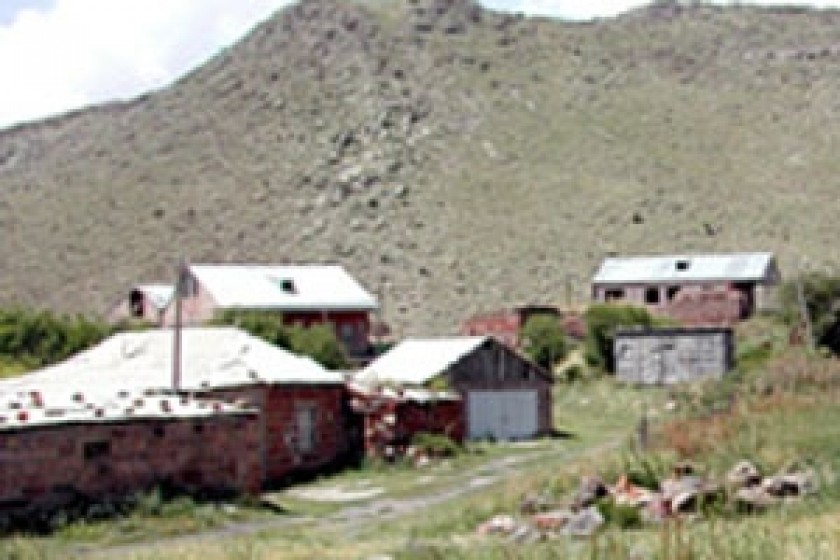
A Hard Life in Isolation
There was silence in Dzoragyugh, and our noisy efforts to entice people out of their homes seemed to be in vain. We had already decided to come back later when near the entrance to the village we met a woman seeking to quench her thirst. She was not a local – she was on a long journey by foot from the neighboring village and had decided to rest awhile in Dzoragyugh. She wanted to be helpful to us and tried to find someone from the village. We met two men outside one of the houses, who were working together to try and start a grass-cutting machine.
Their first question was how we had ended up in that “forgotten corner of the world”, where only four houses had people living in them. They could not believe that their village was marked on the map. “Dzoragyugh is populated by four old men and three old women; another old woman died three months ago. The only young family is my son's – he lives here with his wife and three children,” said Arevhat Heboyan, “I am the youngest of the elderly women, my brother-in-law's wife is past 80, as is the third woman.”
Dzoragyugh, in the Talin administrative region, is one of the mountaintop villages from where the government had tried to relocate all the elderly residents to areas at a lower altitude. There was even a construction program, building new houses for the relocated residents, but some of the locals would not leave at any price. The village was originally founded by immigrants from Western Armenia, and used to be an administrative region in itself. However, the difficulties of 1968-70 forced some residents to leave their homes and seek a living elsewhere. Only four families remain, stubbornly clinging on to their soil and water. “We have nothing – only light and water,” said Arevhat.
“You ask – where will the children go to school? That's a very difficult question. There is no school, no prospects and no hope for the future,” said Arevhat. They regret having stayed, but it is too late. “Did you stay so that you could claim all the land when everybody left?” we joked. “I received five hectares of land during the privatization process, as well as two cows and this tractor. I would give it all and leave – let them take it!” said the young man, a machine operator. “I have land, but all that's left on it is grass.” The spring floods, hailstorms, and subsequent drought destroyed their grain and hay.
The villagers said that the soil was very infertile; you hit the first layer of tuff stone just 30 cm below the surface. “They came and ran a soil assessment a few years ago and called it 3 rd degree soil. The taxes were normal then. This year, they've given it the status of 2 nd degree soil. How has this soil changed in these few years? What have they done to it? There's nothing we can do but sit and wait. If the rains come then maybe everything will work out; if they're ten days late then the drought will ruin everything,” said Seyran with anger once again turning to satire, “You saw the wonderful state of the roads, didn't you? Only an airplane could get here. Schools and kindergartens are out of the question. We are willing prisoners; nobody knows that this village exists.” When we asked if the village had a mayor or administrator, Seyran Heboyan answered with humor, “Whoever opens his eyes first in the morning is the village head.” He then explained that the village is considered an adjunct of Mastara, which is located three kilometers away.
Stubbornly heading towards the light
In the 150-strong village of Tzaghkasar, getting an education has always been impossible. There has never been a regular school at the village; the closest they had were a few elementary classes organized for a short period of time. The children of this village have studied either in Mastara or Talin, usually staying there with relatives or friends. In cases where parents were financially more secure they would rent houses there so that children could go to school. There have also been cases where families had no other choice but to resign their children to illiteracy or be forced to manage with a few years of elementary education. “I have three children – my eldest son is serving in the Armenian Army. I decided a few years ago that I wouldn't allow my children to serve in the army, because this state has done nothing for them. My eldest son managed to go to school until the 6 th grade, staying with different people at different times. The same happened with my younger son. But I've sent my daughter to the Tavush Marz to stay with her grandmother, so that she can complete her schooling,” said Tzaghkasar resident Radik Gasparyan. He considered feeding, clothing and tending to the other needs of his children as his own responsibility, but felt that he owed nothing to a state which had deprived his children of the right to an education.
 |
Arevshat Mkrtchyan, the community leader of Tzaghkasar, confirmed that their greatest problem since the village was founded had been the lack of a school. But the past years had not provided a solution of any sort. Transport has not existed in the village since Soviet times. Even then, children would either walk to Talin, or a seven- or eight- year-old would be sent away from his family and grow up apart from his siblings in some relative's or family friend's house. Today, however, even that is not an option as the tough economic conditions make it difficult for locals to ask their relatives for help. The community leader said that there were children in this village today who had been unable to get an education due to poverty. For example, a nine-year old child had only started first grade last year in Talin. “This is the second year my child is being held back in class, but what can I do? I can't afford to send him anywhere else. We hope that the school in our village will soon start to function – they've finally constructed the building this year – and I'll be able to send him with my younger child. He's turning 6 this year,” said Amalya Galstyan, mother of eight-year old Koryun.
Mkrtchyan said happily that he had succeeded, after banging on many doors, in having a school built in the village, which was completed this year. But there was a strong desire to avoid past mistakes and seek more than just elementary education. “We have asked the education department of the provincial administration, as well as the Ministry of Education and Science, to give the school at least eight grades. Maybe education specialists will come here to teach – we do whatever we have to, just let the school work!” Mkrtchyan said hopefully.
I bear these hardships to feel human
The population of Tzaghkasar makes a living by rearing animals, and cultivating potatoes and grain. The village lives cut off from the rest of the world, and the world has cut itself off as well. A woman we met on an incline said she was returning from work. “I work at the hospital in Talin - I'm on duty there three days a week. I walk seven kilometers and back again– I bear these hardships so that I can venture outside my house and feel human. Life is very difficult in isolation, on this hilltop,” said Roza, a nurse at the Talin hospital. She said that she was also the village nurse, and being the only one who regularly commutes to Talin, she often helped her fellow villagers, stopping by the pharmacy for one, entering the social security office for another. “Nothing has grown here for three years; there has been no harvest. The soil is infertile, there have been hailstorms, it doesn't rain at the right time, and it gets too cold. The people have even been deprived of grain,” she said, summarizing the extreme poverty in the village.
After the last hailstorm on June 19, the only road connecting Tzaghkasar with the outside world was all but destroyed. Only bits and pieces of asphalt remain, making it nearly impossible to get any means of transport all the way to the village. “This year no cars have come up to the village, so we can't even trade cheese or other dairy products with anyone. The only case when someone would come here is if, for example, watermelons turn seven drams per kilogram at the market and excess supplies starting to rot. Then someone who come here to try and sell off their rotting products to us – why else would anyone climb this hill?” said Radik. The community leader said that they could not overcome these difficulties without state support. However, low-interest and long-term loans could help the villagers make a living; animal rearing is developing here and clover fields grow quite well.
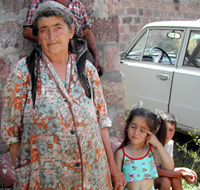 |
According to the community leader's wife there had not been a birth in the village for six years. She cited the main reasons as the difficult economic situation and the fact that the roads are inaccessible for most of the year. “The women feel ashamed too. In the horrible years of 1992-96, when pregnant women approached labor, their husbands would load them on a cart and take them through the village, down the hill to the main road, from where they would try to find a way to reach the hospital in Talin. The situation is the same now, which is why nobody wants to have children,” said Arev.
Arevshat Mkrtchyan stated that they had already appealed to the provincial administration to renovate the road, but had received the following reply in writing: “The roads of community importance in the province have been included in a community development program. These roads will be renovated when finances permit.” The village does not have irrigation water, natural gas, or telephone lines. The soil cannot be utilized to its full potential. The villagers have received four hectares per capita, but as they themselves stated, what's the use of all that land without any water? The community leader found it appropriate to remind us of the president's promise that no corner of Armenia would remain without natural gas in 2006, but the blue flame has not been lit anywhere in that region, not just in their village.
Metakse Petrosyan
Write a comment