 Videos
 Photos


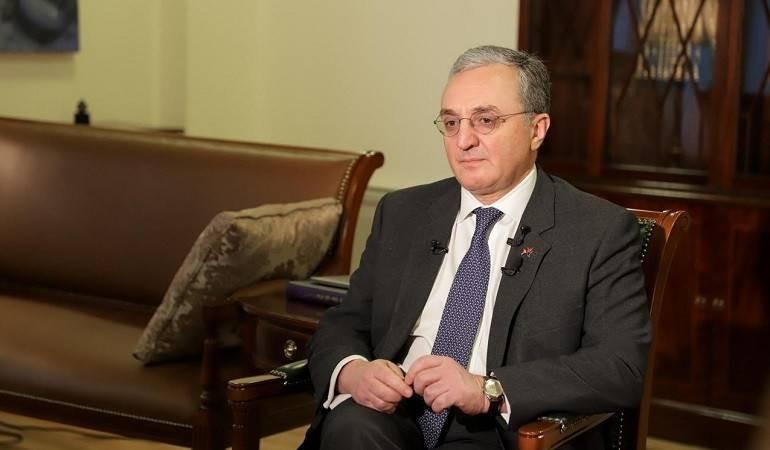
Armenian Foreign Minister to Interfax: People of Artsakh Have Right to Self-Determination; Russian Gyumri Military Base to Stay
On August 31, Armenian Foreign Minister Zohrab Mnatsakanyan gave an interview to Interfax correspondent Ksenia Baigarova. He talked about resolving the Karabakh issue, the protests in Belarus, and assessed Russia's military-technical cooperation with Armenia and Azerbaijan. (The following translation of the interview, in Russian, is non-official. The Armenian Foreign Ministry, at the time of this posting, still hadn't published an official translation.)
The recent exacerbation on the Armenian-Azerbaijani border is not the first in history, but it seems for the first time it is accompanied by ethnic clashes between Armenians and Azerbaijanis in different cities of the world, including Moscow. How do you explain this? And what should be done to avoid such incidents in the future?
It is regrettable to observe the incitement of an atmosphere of hatred not only in our region, but also an attempt to transfer it outside the region. An important principle for Armenia in the process of peaceful settlement is to make every effort to create an atmosphere conducive to peace. It is impossible to conduct a peaceful negotiation process in the presence of an atmosphere of hatred, rhetoric of war and the threat of the use of force. It makes no sense to expect progress in the negotiations when Azerbaijan, on the one hand, incites hatred, and on the other hand, in words, strives for peace. It is impossible in the conditions of "Armenophobia", militant rhetoric, to assume that we can have real progress in the negotiations.
So, what must be done to avoid such clashes in the future?
First, there must be an awareness of the need for a peace process. There must be political will and there must be concrete measures. We are negotiating, including on various concrete steps that will help reduce this rhetoric and the escalation of hatred. This block has concrete content, there are a lot of proposals from our side, from the side of the OSCE Minsk Group co-chairs. All these ideas must be implemented.
We have a good example, when last year we were able to implement a project to exchange journalists from Baku, Yerevan and Stepanakert. The results may have been modest, but very important. This is an important part of the entire peace process.
But the recent exacerbation seems to be the most intense in the last 30 years. Why do you think the Madrid principles do not work? What is the reason for continual exacerbations?
What happened on July 12 was actually a repeated attempt after April 2016 to use force, and through military action to impose unilateral concessions on Armenia and Artsakh (Nagorno-Karabakh - IF). On July 12, an attack was made on our border posts in the north-east of Armenia, in the Tavush region. A significant number of weapons and equipment was used, including shelling of civilians and civilian infrastructure. Armenia resolutely rebuffed this aggression, reaffirming that there is no military solution to this conflict. Both Armenia and Nagorno-Karabakh have enough forces, enough resources to ensure their defense and security, and the crushing rebuff of Azerbaijan's July aggression has confirmed this once again.
The viewpoint exists that Armenia, in principle, does not really need to settle the Nagorno-Karabakh issue. They say, the lands have been taken, and the status quo is beneficial. How would you comment on this?
I cannot agree with this opinion. Both Armenia and Nagorno-Karabakh are interested in stable peace in the region. This is possible by reaching a peace agreement based on compromises. Unilateral concessions are ruled out, they cannot have prospects. And we cannot be interested in a situation where peace and security in the region do not have stable long-term foundations. In this sense, the peace negotiation process has been and remains an important priority for us to resolve this conflict.
How do you assess the role of the OSCE Minsk Group? It has been around for a long time. But the conflict has not been resolved for 30 years. What do you think about the role of Russia as the co-chair of the OSCE Minsk Group? Do you agree that the format of the negotiations should be changed?
Since the mid-90s, the format of the OSCE Minsk Group co-chairs, which includes Russia, the United States and France, has been and remains the only format of the negotiation process. And it has concrete results. It is a format recognized by the international community and includes three permanent members of the UN Security Council. Three countries that have a sufficiently strong resource - political, diplomatic, in order to implement the function of mediation. The engagement of these countries remains very strong.
Over the years, a whole mechanism has been developed, a whole catalog of various parameters and approaches that provide the framework where it is possible to work out a compromise. A tangible and real compromise. In this sense, we continue and will continue to support this mediation format. The Russian Federation is one of the co-chairs of the Minsk Group. The efforts of the Russian side were very effective, this was manifested both during the events in July and before them. I am confident that Russia's involvement at all levels underlines the seriousness that Russia has regarding this process and the important contribution that Russia is making, together with the other co-chairs, in the work towards a peaceful settlement. Here we have no questions, and any attempts to question the work of the co-chairs, which, among other things,
The Russian Foreign Minister said that the Minsk Group co-chairs are working to organize a meeting between the Foreign Ministers of Armenia and Azerbaijan. Are you ready to meet with the Foreign Minister of Azerbaijan?
Over the past period, including the last two years, a lot of work has been done by the co-chairs in various directions. This included directly issues of settlement, issues related to the fundamental parameters of reaching a compromise, as well as issues related to an atmosphere conducive to peace, in particular, projects that can help prepare peoples for peace. Strengthening the ceasefire and introducing permanent international monitoring mechanisms remains a very important area of work. We remain committed to the continuation of the entire spectrum of work and, naturally, I, for my part, are ready to continue this work.
Are you ready, let's say tomorrow, without any conditions, to meet with your Azerbaijani counterpart?
Of course, we are ready to meet, and of course we are ready to continue this work. And here again I want to stress once again that the importance of our work lies in the need to find compromises, ensure security, renounce the use of force and maximalist approaches. There are specific and important priorities for Armenia. For us, the issue of the status of Nagorno-Karabakh is an absolute priority. The realization of the right of the people of Artsakh to self-determination without any restrictions, ensuring real, tangible security for Artsakh is an important priority. And we are ready to work both with the co-chairs and with the Azerbaijani side to define formulas that will allow us to compare and measure the measure of a possible compromise.
Another important issue that concerns Nagorno-Karabakh: over all these thirty years, it has shown an absolute ability to organize its social life, ensure its security, and assume international obligations. The full involvement of Artsakh in the negotiation process is a very important issue and, among other things, is of a practical nature. Because this will strengthen the sense of ownership in relation to the negotiation process on the part of the leadership of Nagorno-Karabakh, which, being elected by the people of Nagorno-Karabakh, has a corresponding mandate to represent their interests.
How do you feel about the idea of holding a referendum in Nagorno-Karabakh?
As for Armenia, the right of Artsakh - the people of Nagorno-Karabakh - to self-determination without any restrictions is one of the main approaches of Armenia to a peaceful settlement.
Russia is actively cooperating in the field of military-technical cooperation with both Armenia and Azerbaijan. Do you see some ambiguity in this given the recent aggravation of the Armenian-Azerbaijani relations?
Armenia and Russia are allies. Our relationship is broad enough. Our interview is limited within its framework to outline the entire range of issues of the Armenian-Russian interaction, which concerns all areas of life, including interaction in security matters. The military-technical cooperation between Armenia and Russia is an allied interaction. So, there can be no questions or limitations here.
But is it true that military cooperation began to build up after the July escalation?
Our interaction in the military-technical field is based on mutual security interests and is carried out on the basis of existing agreements, understandings and work plans between Russia and Armenia. Russia does not upset the balance in the region. Armenia is a responsible participant in regional security. And our military-technical cooperation is not directed in any way against third countries.
Aren't you embarrassed that Russia is cooperating in the military-technical sphere with Azerbaijan?
Military-technical cooperation between Armenia and Russia has its own logic of interaction, it is built on solid allied foundations. As for Azerbaijan and cooperation in this area, I note that Azerbaijan is building up its military potential in every possible way, trying to convince its own population and the world community that it has the potential to resolve the conflict in Nagorno-Karabakh by military means. And this was brought up in the vein that Azerbaijan makes a "concession" to Armenia and Nagorno-Karabakh, without starting hostilities, instead counting on "unilateral concessions" of the Armenian parties in the negotiation process. The Azerbaijani logic of building up its military potential is aimed at a military solution to the conflict, which poses a threat to the security of Armenia and Nagorno-Karabakh.
Are you discussing this with the Russian side?
Of course, we openly and frankly discuss all issues with the Russian side: we have allied relations.
Do you agree with the opinion that Turkey's active position, Ankara's unequivocal support for Baku, "adds fuel to the fire" and postpones the possibility of resolving the conflict?
After July 12, the international community made numerous calls for de-escalation and an end to the violence. The only country that tried not to reduce tensions, but to bring even greater instability to the region, was Turkey. The policy of destabilization and aggression on the part of Turkey is a threat to all neighboring regions, including the eastern Mediterranean, northern Africa and the Middle East. Today Turkey is trying to export this policy of destabilization to the South Caucasus region. This is a serious concern. Turkey is pursuing an unconstructive and dangerous policy. And Turkey continues to demonstrate by its actions a threat to the security of Armenia. In this regard, Armenia will work to further strengthen its security, including through cooperation with its partners.
Does Armenia plan to apply for a new arms loan to Russia? And in what year is Armenia ready to repay the loan for the purchase of weapons and equipment?
We have appropriate formats and platforms for discussing issues of military-technical cooperation between Armenia and Russia, where all issues of our interaction are resolved. I will not go into details. In general, this is an area that has its own established platform.
But are you going to buy new combat aircraft and helicopters?
We are going to do everything in order to consistently strengthen the defense capability of our country. I have already told you that Armenia and Russia are allies.
Is Yerevan interested in maintaining the Russian military base in Gyumri?
Armenia is not a threat to anyone in the region. Armenia and Russia have common security interests, and it is on the basis of these mutual interests that we pursue a common goal of ensuring security. The military base also helps to achieve this goal.
In connection with the internal political situation in Belarus, there is a lot of talk about providing assistance to this country through the CSTO, which includes Armenia. Do you think such a scenario is acceptable and likely?
As for the CSTO and allied mutual assistance within the CSTO, all these issues are governed by the legal framework, which fixes a clear regulation of interaction between member states, including all issues related to security and mutual assistance. Here we rely on the CSTO legal framework.
Let's say tomorrow the CSTO votes on whether Belarus needs help? Will Armenia vote for or against?
To initiate such an issue, the main role is played by the country, which raises the issue of mutual assistance. But this question did not arise from Belarus.
Belarus and Armenia are allies within the framework of the CSTO and have a fairly rich bilateral agenda. We work together in a variety of multilateral formats. In particular, we are participating in integration processes within the framework of the Eurasian Economic Union.
There is a strong friendship between the peoples of Armenia and Belarus. This is expressed in human relationships. And of course, we are not indifferent to what is happening in Belarus.
Prime Minister Pashinyan came to power after a "velvet", bloodless revolution. Now, it turns out that Armenia supports the Belarusian leader.
There can be no doubt that the key to resolving the current situation is in the hands of the people of Belarus. Armenia has gone its own way, and it is not entirely correct to draw parallels on this basis. Yes, there may be some general parameters, but in general these are different situations. The most important thing is to accept and acknowledge that the resolution of the issue is the prerogative of the people of Belarus. We very much hope that this situation will be resolved peacefully.
Does Armenia officially recognize Lukashenko as the legitimate leader of Belarus?
Prime Minister Pashinyan congratulated the President of Belarus. We will keep an eye on how the people of Belarus can resolve this problem. We intend to continue working with Belarus in all areas, both within the framework of bilateral relations and in international formats.
Armenia turned to Russia with a request to reduce the gas price. Do you think that the "gas" issue can damage the allied relations between Armenia and Russia?
Energy issues, issues of gas supplies are the most important issue of bilateral relations between our two allied states, which have a broad agenda. We have a common agenda - both on security and on economic development, and we are working on this together. We have good potential to negotiate and negotiate. The most important thing is to negotiate!
So, there is mutual understanding today? What were the results of the negotiations?
We are working on it. I am sure that we can reach an agreement. This is happening at the level of intergovernmental commissions, and I think that the probability is very high that we will be able to agree.
In June, the Russian Ambassador to Armenia stated that Moscow and Yerevan continue to discuss the issue of extending the loan for the modernization of the Metzamor NPP. Are there any such discussions now, how do you assess their success?
We intend to re-equip the NPP at the expense of our budget funds. And in this sense, the possibility of new loans is considered taking into account the fact that we are doing this at the expense of our own resources.
Discussions are ongoing. Our two states have certain interests, deep relations, they have the potential to negotiate.
Write a comment