 Videos
 Photos


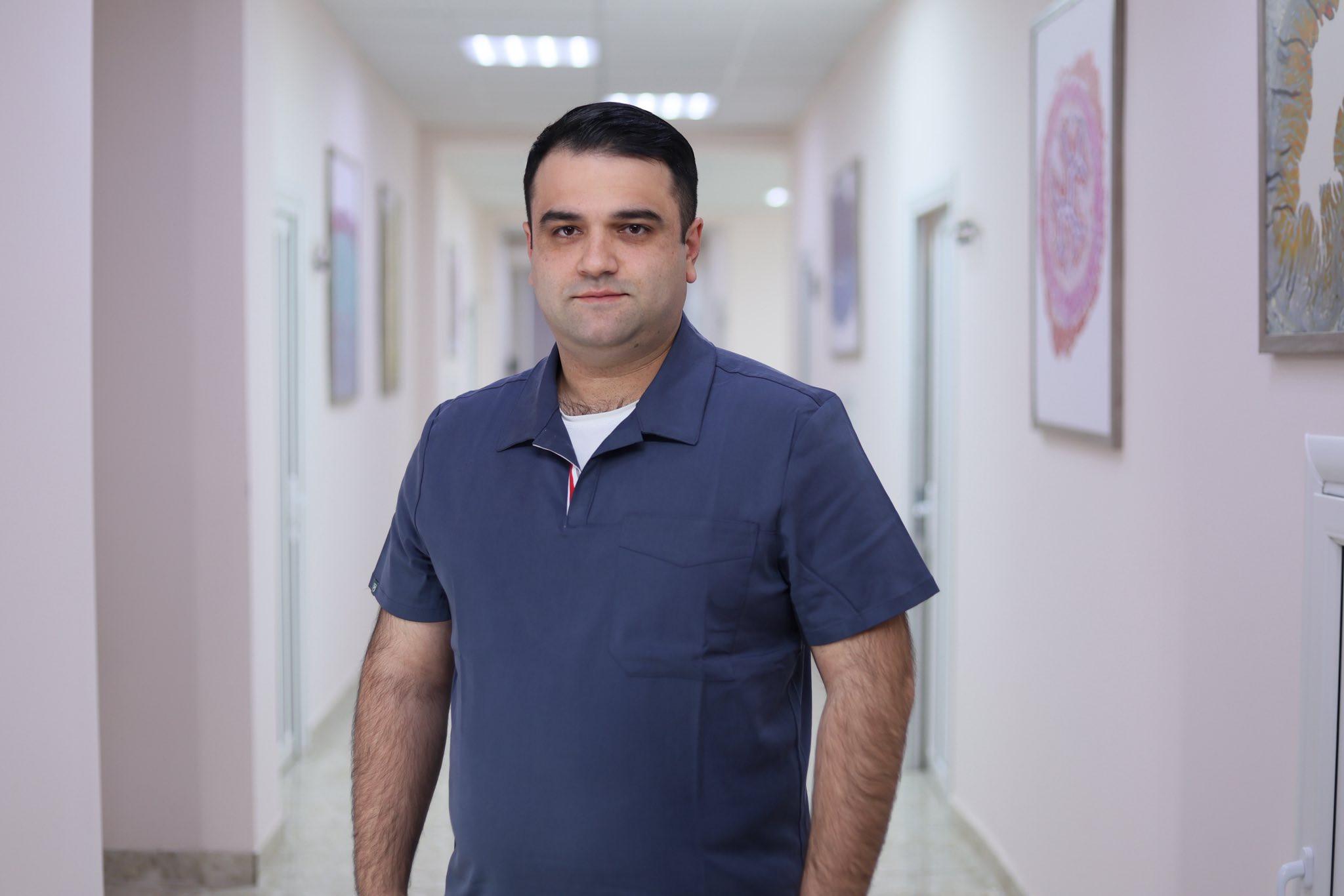
Cancer Treatment Has Improved in Armenia, Says Oncology Surgeon
Cancer detection rates in Armenia are increasing year by year. According to experts, this increase means that people are getting cancer more often, but it is also a result of medical progress and cancer patients living longer. Hetq spoke to Tigran Byuzandyan, a surgeon at the National Oncology Center and head of the Department of Thoracic Surgery and Interventional Pulmonology, about these issues, as well as the development and treatment of cancer.
Can you explain in simple terms how cancer develops in the human body?
The cells of the human body are constantly growing and dying. Detectors work in the process of dying. They tell which cells are dead. These signals are transmitted to special cells that are engaged in the destruction of dead cells. In parallel with this process, tumor cells are also constantly forming in the body. The body also destroys tumor cells, which arise because of various mutations, using the same mechanism. There are cases when a tumor cell can hide under a healthy cell, and the body does not recognize it as a tumor. And there are cases when a tumor cell is there, it is not hidden, but the system that eliminates them simply cannot recognize the tumor cell, due to being weak or simply not working. As a result, tumor cells can survive, grow and multiply. As a result, tumor tissue is formed, which we see when it is much larger.
In other words, can all this happen independently of external influences?
Yes.
And what external factors contribute to or cause the development of cancer?
We are talking about carcinogens. This is a substance that increases the likelihood of the development of cancer cells. There are both specific substances and environmental factors. Environmental factors include polluted air, radiation, etc. There are many of them. At the same time, each tumor has its own factor. For example, there are about 70 risk factors for lung cancer, one of which is smoking, radon, asbestos dust, etc.
How do we learn about these factors?
We have learned about these factors over the years. Over time, they may increase or decrease. For example, when the harmful effects of asbestos were not yet known, they assumed this since lung cancer most often occurred in construction workers. They assumed that the cause was construction dust, which also contained asbestos dust. Now asbestos is not used, that is, one factor has disappeared, but in the future factors may or have already appeared that we cannot even guess.
Is it true that there are organisms that are more prone to cancer, or is this a myth?
For a person not to develop cancer, a person should not be born. Any person develops cancer cells; mechanisms simply eliminate them. So, all organisms are below the target in this regard.
A smoker eventually gets cancer. Is this a true statement?
No, it is not necessary. Not all smokers develop cancer. But those who do develop lung cancer are mostly smokers. There are more than 70 risk factors that affect the development of lung cancer. It depends on which organism is affected.
In the last 35 years, the number of cancer patients in Armenia has increased 3.3 times. Is this a consequence of the increase in the duration of living with cancer, early detection, or a real increase in the incidence.
A cancer patient is never considered non-cancerous, even 10 years after detection and even after treatment. He is always registered. The longer our patients live, the more the number you mentioned increases. We have begun to treat better. After 30 years, approaches have changed, technologies have changed, and medications have changed. Everything changes every year. To understand whether we are on the right track in terms of treatment, the average survival rate for a given disease should increase, and now the number of cancer patients who live for five or more years has increased. We also need to understand that with each new year, the absolute number of new cases increases, and how many of them have a negative outcome is important.
Cancer treatment is difficult and long. What is the attitude of people towards treatment after it is detected?
In just five years, the psychological perception and approach of patients to the disease has changed. People's fear of malignant neoplasms has been broken. Previously, cancer was perceived as a death sentence. But now people understand better what awaits them. Trust in doctors has also increased. The number of people who did not receive treatment for various reasons has decreased. People understand what awaits them and consciously go for treatment.
What is the reason for not seeking treatment?
People, in general, do not have either the financial means for treatment, or the cancer is detected at a late stage. In recent years, the number of people diagnosed at stage four has decreased, and the number of people diagnosed at an early stage has increased.
The number of people with cancer, on the contrary, has increased.
Which method of cancer treatment is the most prevalent in Armenia: surgery, radiation, or drug treatment?
All of them are prevalent. It depends on the patient's condition, type, and stage of the disease. For example, during the treatment of lung cancer, in one case the patient is operated on and remains under control, in another case he receives chemotherapy, and then surgery occurs. Sometimes a person has severe pain due to metastases, for example, in the spine. In this case, he receives radiation treatment to alleviate the pain in that part.
That is, the surgical method is not predominant.
Even if it is predominant, it is due to the corresponding state of cancer treatment. In the past, the surgical method prevailed due to misconceptions about cancer. Then they realized that there are tumors that do not need surgery at all, then that there are stages of the tumor, for example, in the first stage you need to have surgery, in the second you need to think about it, in the fourth you do not need it at all. Then it turned out that, for example, in the second stage, you need to be careful during surgery, because surgery can cause greater progression in tumor cells. Later they realized that it is possible to “impoverish” tumor cells with chemotherapy, after which you can only have surgery.
In which areas of cancer treatment do we have progress and more active use of innovative methods?
In this sense, we cannot move parallel with the USA or Germany. For this, we need to compare ourselves, for example, what we had a few years ago and what we have now. The healthcare system of Armenia is making great strides forward. Now new specialists, centers, and specialized departments are appearing that did not exist a few years ago. New treatment methods are emerging that Armenia simply could not afford at the time.
What are the dynamics of trips abroad for cancer treatment?
If ten years ago, half of people diagnosed with cancer were wondering where to go abroad for treatment, now the majority are receiving treatment here in Armenia. What we are doing in Armenia today corresponds to today's global data in terms of standards. If any medical or research center, or individual is successful in this or that examination, laboratory research, they talk about it, and everyone learns about it, including us. In this regard, we are not isolated.
Why do people in Armenia travel abroad for treatment today?
The need for treatment abroad arises in case of need for some equipment that is not available in Armenia. The patient must go to another country only because there is a device that he needs in that country. Today, Armenia has an arsenal of three methods of cancer treatment. If there is a medication that is not available in Armenia, but the patient needs to take it, we suggest that people order it in some form or have it brought to Armenia through someone. It is desirable that the patient be at home, with his family, and not have the tension that he may have when traveling to another country.
What methods are there in international practice that are not yet available in Armenia?
There are many things in the world that are not yet available in Armenia. But we need to understand how much Armenia needs them. For example, if we talk about surgical equipment, then there cannot be a case in Armenia that we do not have equipment of strategic importance. Conventionally, if we have 1,000-1,500 patients with the same type of cancer in a year, there cannot be and has not been a case that we do not have the necessary equipment to treat these patients. Those that are not available in Armenia are due to that problem or the rare detection of the type of cancer. These devices are extremely expensive, which is why the question of cost-effectiveness arises.
If a person has been cured of cancer, what is the probability that the disease will recur?
Any cancer can recur. But for each type of cancer and for each person, it is a unique indicator, and it is not quantifiable. In general, when we talk about cancer, it is predictable that the patient will develop metastases and enter the relapse phase eventually. But to determine whether the patient will have cancer again or not, unfortunately, it is still not quantifiable. Cancer and its treatment are not dogmas. Even the simplest tumor can spread surprisingly quickly and cause metastases, but the tumor that seemed hopeless can have the opposite effect - stabilize and not recur.
What cancer detection programs are there that are funded by the state and medical centers?
Free screenings are conducted with state funding to detect breast, cervical, and colorectal cancer.
What steps should individuals take to detect cancer early? What common warning signs might the body show that could indicate an early or precancerous stage of cancer?
It is specific for each organ. For example, if we are talking about lung cancer, then its signs are cough, chest pain, sputum production, and hemoptysis; in the case of women's cancers, of course, there are other complaints. But we must remember that if there is a complaint, it mostly means that the cancer is already in an advanced stage, not in the first or second stage. At the same time, a person may have complaints, but the cause may be metastases. For example, when metastases occur in the brain, the head starts to hurt, but a person is diagnosed with lung cancer.
According to 2024 data, there were 70,961 patients with cancer registered in the Republic of Armenia. And although almost half of the newly detected cases in 2024, 48.4 percent, were detected in the 1st-2nd stage of the disease, which increases the likelihood of cancer treatment, cancer is the second leading cause of death in Armenia. It should be remembered that the first step in the fight against cancer is to get assessed on time.
Write a comment