 Videos
 Photos


Armenia to Designate 20% of Its Territory as Specially Protected Nature Areas by 2030
Armenia plans to expand its coverage of Specially Protected Nature Areas (SPNAs), increasing their area to at least 20% of the country’s territory.
The country’s ambitious plan is in line with guidelines adopted at the UN Convention on Biological Diversity’s 2022 COP15 summit held in Montreal.
The guidelines, known as the Kunming-Montreal Global Biodiversity Framework, set four goals related to biodiversity at the global level and 23 targets to achieve them, which should be implemented by 2030.
Armenia, as a signatory to the UN Convention on Biological Diversity (CBD), a legally binding international treaty aimed at conserving Earth’s ecosystems and wildlife, is obligated to implement the above goals.
Experts consider the third of the 23 targets to be one of the most ambitious, if not the most ambitious. This target is known as “30X30”, which means that by 2030 at least 30% of the world’s land, water, and marine areas should be conserved and effectively managed.
Armenia’s Law on Specially Protected Nature Areas has recently undergone amendments, which environmental experts generally assess positively. The law enshrines new concepts that already existed in international practice and real life but were not described in the law.
Armenia’s SPNA law was adopted in 2006 and has been amended and supplemented four times until its redrafting this year. It is planned that the coverage of specially protected areas of nature (SPNA) in Armenia will be expanded within the framework of the updated legislation.
Breakdown of Armenia’s SPNAs
According to the old law, specially protected nature areas in Armenia had four statuses: state reserve, national park, state sanctuary, and natural monument.
Today, there are 3 state reserves, 27 state sanctuaries, 4 national parks, and 233 natural monuments in Armenia.
Protected areas in Armenia now occupy 386,355 ha or 3,863 sq km, which is equal to 13% of the territory of the country. Since 2012, the total coverage of protected areas has expanded by 88,600 ha or 886 sq km, which is equal to 3% of the territory of Armenia.
Protected landscapes have been added to the list of protected areas
Aram Aghasyan, a senior researcher at the Scientific Center for Zoology and Hydroecology at Armenia’s National Academy of Sciences, notes that the International Union for Conservation of Nature (IUCN) has identified six categories of specially protected areas, four of which, as we mentioned, exist in Armenia. From now on, the law also defines a fifth - protected landscapes.
|
Armenia’s Law On Specially Protected Areas of Nature; Article 2 Protected landscape — an area of environmental, cultural, and aesthetic value shaped by the interaction of people and nature, actively managed for research, monitoring, education, ecotourism, recreation, restoration of historical and cultural sites, traditional land use, and subject to a special protection regime. |
Whereas, if reserves, sanctuaries, national parks and natural monuments are protected areas of state significance, they are established by the government's decision, on lands that are state property, and their management is carried out by the SNCOs subordinate to the Ministry of Environment, and in cases provided for by law, by a local self-government body (LSG) or a legal entity (for example, the Aragats Alpine State Sanctuary is managed by the Alikhanyan National Scientific Laboratory (Yerevan Physics Institute) Foundation), then protected landscapes are protected areas of local significance, which are established by the decision of the council of elders of a given community, are located within the administrative boundaries of one or more communities, on lands that are community property, and are managed by the local self-government body to protect ecosystems, plant species and for the conservation of animal species.
Tsovinar Hovhannisyan, head of environmental programs at the Foundation for the Preservation of Wildlife and Cultural Assets (FPWC), believes that Armenia corresponds to both IUCN categories 5 and 6, and it was necessary to include category 6 in the draft law. This refers to Managed resource protected areas.
Protection regime for sanctuaries and natural monuments is also defined by law
Previously, Armenia’s Law On Specially Protected Nature Areas only defined the protection regimes for state reserves and national parks. Regarding state reserves and natural monuments, it was stated that their protection regimes are defined by statute (in the case of reserves) and by passport (in the case of natural monuments).
Now, the law clearly defines a protection regime for both. The same applies to protected landscapes.
Aghasyan believes the definition of a protection regime for sanctuaries is one of the important changes to the law.
The law now defines the rights and restrictions that apply to all protected areas, including Armenia’s most numerous categories: sanctuaries (27) and natural monuments (233).
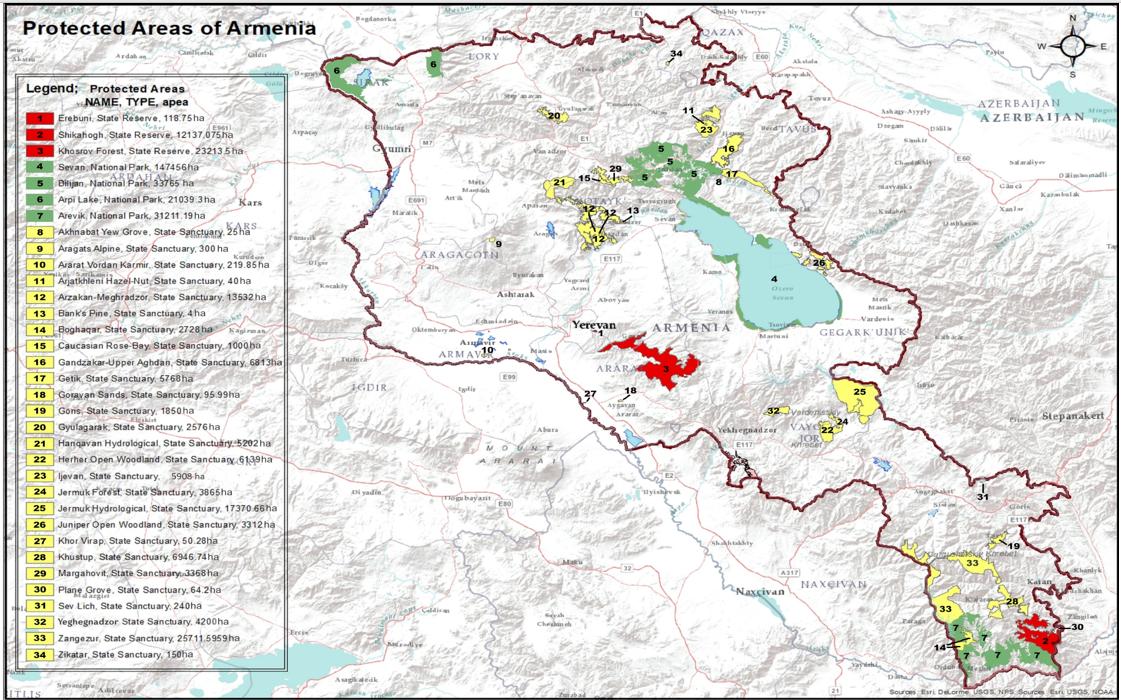
Compiled by Karen Manvelyan, an employee of the Armenian branch of the World Wildlife Fund
How do sanctuaries differ from reserves?
Unlike reserves, sanctuaries have a weaker protection regime, where human activity and intervention are not excluded. There are sanctuaries that are designed to preserve complex species and there are those designed for specific species, such as the Plane Grove in the Kapan region, which is designed to preserve a natural grove of two tree species: the Oriental plane and the Greek walnut, or the Vordan Kamir State Reserve, which was created to preserve the saline habitats and salt-loving plants of one species, the Ararat (Armenian) cochineal (vordan karmir).
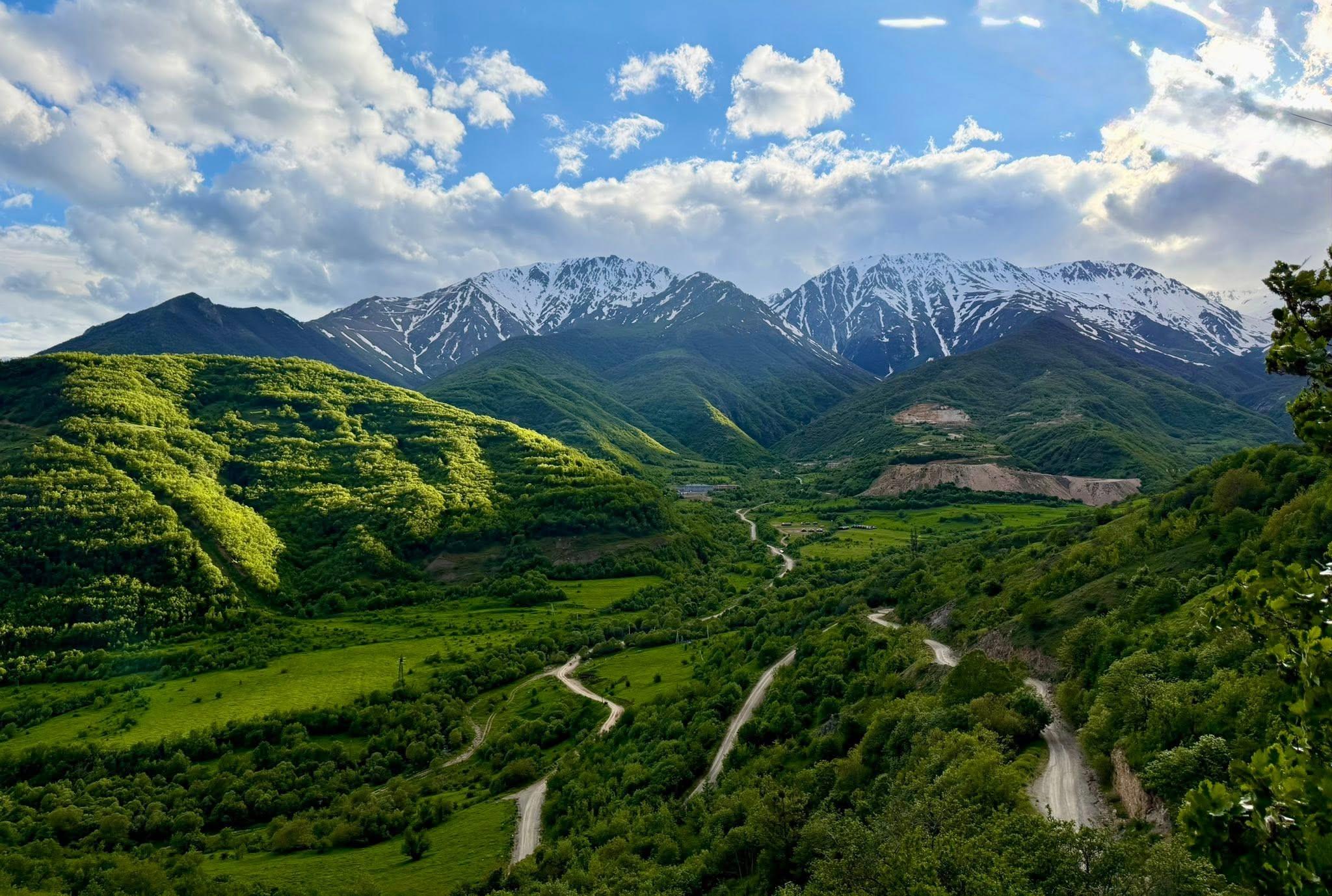
Top photo: Areviq National Park (Facebook page of park manager Zangezur Biosphere Reserve SNCO)
Write a comment