 Videos
 Photos


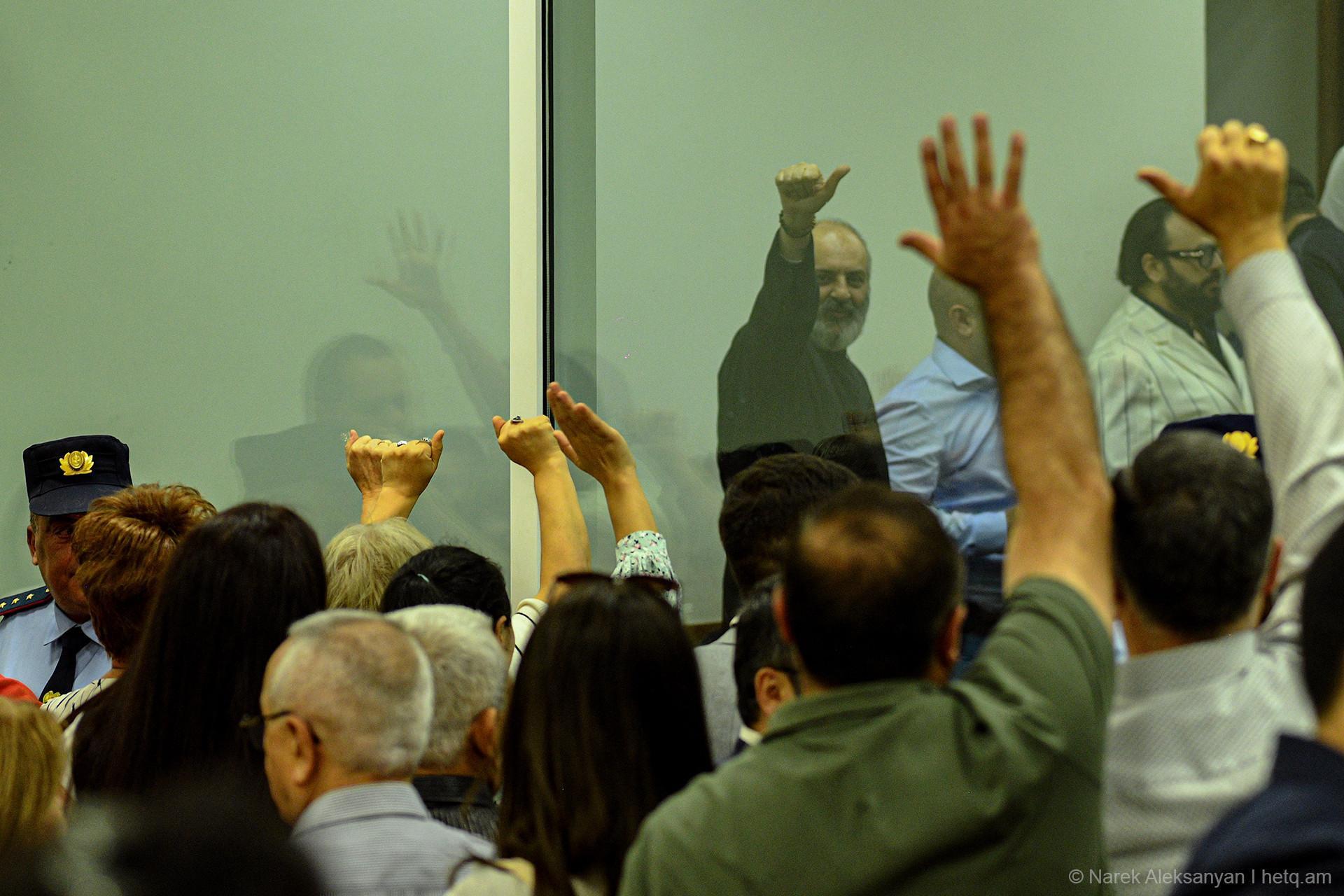
UN Following “Holy Struggle” Case in Armenia; Does the Government’s Terrorism Charges Meet International Standards?
Six UN Special Procedures mandate holders sent an official letter to the Armenian government on May 11 of this year expressing their concerns regarding the “Holy Struggle” (Srbazan Paykar) case that revolves around Archbishop Bagrat Galstanyan who launched an Armenian opposition movement in the spring of 2024 to oppose the government's border delimitation process with Azerbaijan.
The letter stated that there were reports of disproportionate use of force against members and supporters of the “Holy Struggle” movement, inadequate investigation of counter-terrorism and national security allegations, as well as administrative restrictions.
In June 2025, Armenian authorities launched criminal proceedings against Galstanyan and seventeen others, detaining movement leaders on charges of preparing terrorism and attempting to seize power.
Special procedures mandate-holders are either an individual (called a Special Rapporteur (SR) or Independent Expert (IE)) or a Working Group (WG) of five members. Mandate holders serve in their personal capacities; they are not UN staff. The term ‘special procedures’ refers to the list of mechanisms established by the Human Rights Council to report and advise on human rights from a thematic and country-specific perspective.
The mandate holders noted that they were concerned that the measures taken appeared to be inconsistent with Armenia’s obligations under international human rights law.
They also referred to the statements of Armenian PM Nikol Pashinyan and the country’s Investigative Committee in June 2025, which stated that they had evidence that the “Holy Struggle” movement and Archbishop Bagrat Galstanyan had planned to seize state power through terrorism in an unconstitutional manner. However, according to the information received, this evidence refers to political opposition activities, protests and acts of civil disobedience, and the objects found were of domestic, festive or construction significance. There is no information about violence or threats of violence, intention to use weapons or actual terrorism, or any indication that could indicate their existence.
The letter also reported that Armenia’s Investigative Committee has published recordings of wiretaps of the Archbishop’s private conversations, presenting them fragmentarily, selectively, and out of context as evidence of terrorism in the absence of any indicators of violence.
At the same time, the materials of wiretaps openly denying violence by the “Holy Struggle” movement have not been published, and the defense lawyers have not been allowed to publish them. It is also reported that the authorities have criticized the Armenian Apostolic Church for participating in political processes.
The letter to the Armenian government states that the apparent inappropriate application of restrictions related to bail or preventive measures (such as house arrest, administrative supervision, ban on leaving the country, and bail) against members of the “Holy Struggle” movement for the legitimate exercise of the freedoms of peaceful assembly, association, and expression, as well as the right to participate in public life, may also be contrary to international law.
The letter also addresses the public statements by officials of a derogatory or prejudicial nature regarding the alleged guilt of criminal defendants, made before the final determination of guilt by a competent court following a fair trial. This may also violate the presumption of innocence guaranteed by Article 14 of the International Covenant on Civil and Political Rights.
“This is particularly concerning in cases where defense lawyers are not permitted to disclose evidence that could exonerate or prove the innocence of the accused,” the letter notes.
How do the terrorism charges meet the international definition of terrorism? Eight questions to the government
The UN mandate holders have sent eight questions to the Armenian government, requesting additional information and comments. They asked for information on the factual and legal grounds for the arrest, detention, and indictment of individuals and to clarify how the terrorism charges against members of the “Holy Struggle” movement meet the international definition of terrorism, including the requirement of legality.
They asked the government to clarify how the restrictions on bail or detention comply with the requirements of due process, fair trial, and the presumption of innocence. They also asked what measures will be taken to prevent repression and criminalization of the legitimate exercise of the right to peaceful assembly, freedom of expression and participation in public affairs.
The mandate holders also requested to indicate what measures have been taken or are planned to be taken to conduct an effective investigation into the above-mentioned alleged violations, to provide victims with effective remedies and adequate compensation, and to hold those responsible accountable in accordance with international law.
Archbishop Galstanyan and other criminal group members planned to conduct a terrorist act. The Armenian government’s response.
On July 9, the Armenian government sent a 31-page response letter to the UN. The government’s response states that the arrests, criminal prosecutions, and preventive measures applied within the framework of the criminal proceedings on the preparation of a terrorist act and the preparation to seize state power were based exclusively on evidence obtained as a result of lawful investigative actions (operational-intelligence and secret investigative measures, in particular, data from internal surveillance and wiretapping of telephone conversations) and were carried out in accordance with the requirements of the Constitution of the Republic of Armenia, the Criminal Code, the Criminal Procedure Code, as well as the Republic of Armenia’s international human rights obligations.
The government claims that to carry out their criminal goal of seizing power, Galstanyan and other members of the criminal group planned to commit terrorism, that is, socially dangerous acts that include the threat of depriving civilians of their lives, causing serious or moderate harm to health, causing significant property damage, and causing other grave consequences.
“By the above actions, they aimed to create a state of intimidation among the population, create an uncontrollable situation among the population, disrupt the activities of state power bodies, and force those exercising state power in the Republic of Armenia in accordance with the procedure established by the Constitution to relinquish that power. The alleged crimes with the aim of terrorizing the population, disrupting the activities of state power bodies, and illegally seizing constitutional power were prevented in the preparatory stage because of operational measures conducted by the National Security Service, in particular, internal surveillance and wiretapping of telephone conversations,” the government’s letter states.
The Armenian government declared that the criminal charges do not concern the political, religious, or ideological views of the defendants, as well as their participation in peaceful assemblies, public discussions, or legitimate political activities.
The motions submitted by the investigator were examined by the competent courts, which independently assessed the existence of the grounds provided for by law, including the procedural risks and the gravity of the alleged crimes. Referring to the application of preventive measures during the proceedings, the letter noted that they were changed in line with changes in procedural risks.
“The preventive measures were not punitive in nature but were constantly reviewed and adjusted in accordance with the principle of proportionality. Armenia has reaffirmed that the principle of the presumption of innocence is fully applicable to all accused,” the letter states.
The criminal proceedings are currently under examination by the competent courts, and any conclusion on the admissibility of evidence, the factual basis of the charges, or the criminal liability of the accused can only be made by an independent and impartial court in a final judicial act that has entered into legal force.
Turning to the question of how the terrorism charges comply with international standards, the government responded that the crime requires the commission of an explosion, arson, or other acts dangerous to the public, as well as the seizure or occupation of buildings, means of transport, means of communication, or other infrastructure, if such acts create a risk of causing death or serious bodily injury to a person, causing significant property damage, or other serious consequences.
The Armenian government, in its response, claimed that criminal proceedings against members of the “Holy Struggle” movement were not initiated due to the movement’s political stance, religious affiliation, criticism of government policy, or the organization of peaceful assemblies. Instead, the criminal prosecution was initiated as a result of a lengthy preliminary investigation, during which evidence was obtained.
Write a comment