 Videos
 Photos


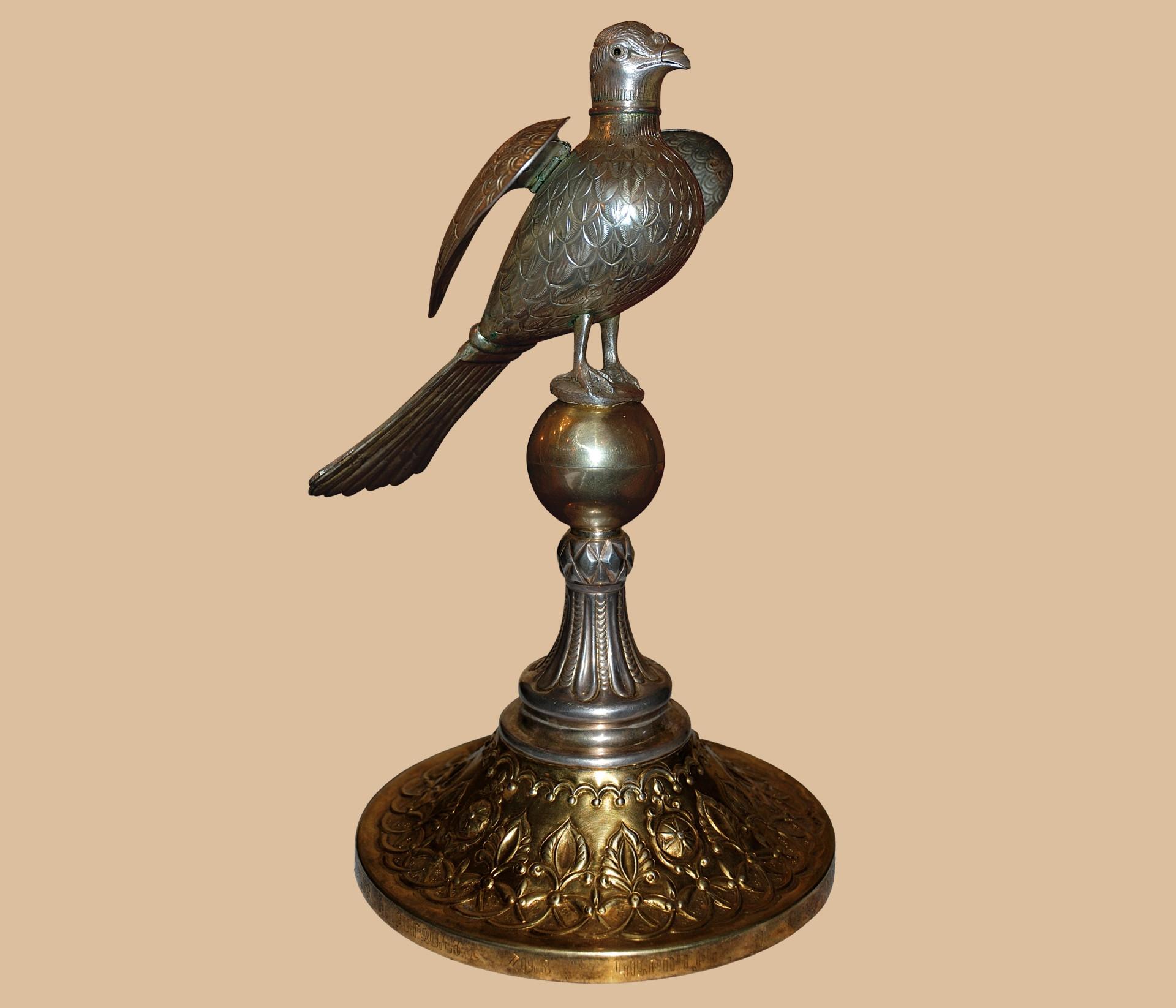
Treasured Museum Pieces: The Handiwork of Syrian-Armenian Coppersmiths
Among the various anvils—part of the collection of tools used by Syrian Armenian coppersmiths currently on display at the Yerevan Museum of Folk Art—one stands out due to its inscription: “Ilimkit for deep vessels; made from Zeytun iron”.
"This anvil is called an Ilimkit; it was forged from iron sourced from the mines near the town of Zeytun in Cilicia. Large anvils like this were used to craft large cauldrons, or ghaza," explains Hrazdan Tokmajyan, the creator of the exhibition titled "Tools and Masters", as he catches my inquisitive glance.
The exhibition also features another remarkable artifact from the historical Armenian homeland: a bellows made in the late 19th century.
Following the deportation of Armenians from the Ottoman Empire, it ended up in Syria before eventually making its way to Armenia.
"It's a bellows crafted by Master Melkon from Ayntab. Every workshop had to have that bellows to heat the metal until it glowed and to work it," says Hrazdan Tokmajyan, a painter, art historian, and ethnographer who holds the collection of tools belonging to Syrian Armenian coppersmith masters.
These tools belonged to the collection of Hovhannes—a resident of Aleppo and the last master craftsman of the renowned Kalemkerian coppersmith family from Ayntab.
Painter Hrazdan Tokmajyan, who had moved from Armenia to Aleppo in 1993 to teach, lived next door to him. "We had planned that he would come to Armenia and open a craft school here so that the trade could continue in the country," the artist recounts. The tools, weighing approximately two tons, were transported to Armenia in 2013.
Hovhannes Kalemkerian passed away in 2015, leaving their shared dream unfulfilled.
"I didn't think we would be able to bring the tools to Armenia because the load was so heavy. That is why Hovhannes and I photographed, measured, and dated everything in his workshop. Later, we managed to transport them; we brought over 200 anvils alone. It is an immense treasure—each anvil has its own name, and they are all cataloged; among them are some on which the master himself inscribed notes by hand," the painter recounts.
Tokmajyan says Master Hovhannes’s collection is remarkable not only because it includes tools passed down through three or four generations of his own family, but also tools belonging to other Aleppo-Armenian craftsmen.
Starting in the 1950s, as elderly masters in Aleppo passed away, their family members either sold their tools or entrusted them to Master Hovhannes.
Tools belonging to other craftsmen in his circle also found their way into his collection. The tools were on display for over two months at the Hovhannes Sharambeyan Museum of Folk Art in Yerevan.
For this exhibition, the organizer chose to showcase the tools used by several generations of Syrian Armenian coppersmiths: 140 anvils of various sizes, 100 assorted hammers, calipers, and both small and large chisels designed for engraving copper objects. Alongside these, ten copper household items—such as braziers, a pitcher, a tray, and others—were displayed.
Tokmajyan says these were included solely to illustrate the context in which the tools are used and to showcase the artisans' exceptional craftsmanship.
His long-standing friendship and shared interests with Hovhannes Kalemkerian inspired Tokmajyan to research the history of this distinguished family of artisans.
The artist has chronicled the approximately two hundred year history of the Kalemkerian family in a substantial volume. Published in 2016 with the support of patrons, the book commemorates the centennial of the Armenian Genocide.
The family patriarch, Hagop—a tailor by trade—migrated from the city of Julfa to Ayntab. Hakob’s son, Melkon Khalfe, was a tinsmith as well as a church cantor, scribe, and a skilled vocalist and sharakan expert (Armenian liturgical hymns). His son Garabed continued and expanded upon his father’s craft, working as both a tinsmith and a coppersmith. Over the course of their lives, they worked in three different cities: Ayntab, Damascus, and Aleppo.
Following the deportation of Armenians from Cilicia in 1915, the family ended up in Damascus through the intervention of Djemal Pasha. The Allied occupation of Ayntab in 1918 gave many Armenians the opportunity to return to the city. The Kalemkerians also returned to Ayntab but left for good shortly thereafter. They settled in Damascus between 1921 and 1924, and in 1924, they moved permanently to Aleppo, where the environment was Armenian. The Kalemkerian workshop operated in Aleppo until 1961.
In the book, the Tokmajyan tells the story of Melkon Usta, the master craftsman of the Kalemkerian family. His son, Avedis, was his equal in craftsmanship. Avedis was particularly skilled at decorating copper objects. Although he was a brilliant coppersmith, he is remembered in history primarily as a renowned national hero. Avedis Kalemkerian was one of the three organizers of the self-defense battles in Ayntab.
Tokmajyan recounts that Hovhannes Kalemkerian—the last master coppersmith of the lineage—was no longer working as a coppersmith during his years in Aleppo; instead, he focused primarily on silversmithing. He was one of the last master craftsmen not only of his family but of the entire city. He held a distinguished reputation in the marketplace, with religious leaders and local notables visiting his workshop to commission bespoke silver items.
The Catholicosate of the Great House of Cilicia commissioned him to create the silver binding for the copy of Grigor Narekatsi’s Book of Lamentations that was presented to the Pope.
In the museum, Tokmajyan has showcased around two hundred such masters, featuring photographs and detailed biographies that document their origins, the markets where they worked, and more. These artisans crafted both household goods and ecclesiastical items, the latter being made of silver.
Over time, some of the master coppersmiths changed their trade, or the craft itself branched out into different specializations. The last coppersmith active in the market during the 1990s whom Tokmajyan encountered was Sarkis Bedigian.
By the 1920s, automobiles were already being imported from Europe and America. When these vehicles broke down, they required repair, leading some of the craftsmen to transition into sheet-metal workers.
One of Aleppo’s most renowned sheet-metal masters was Jivan Yeramian, originally from Kharpet—who trained many apprentices. The artist notes that, following the war in Syria, the sheet-metal workers who repatriated are considered the best in the field; they work with exceptional meticulousness—a trait rooted in the traditions of copper smithing.
Rupen Barsoumian, a prominent Aleppo intellectual and expert on the craft, compiled a list of approximately 900 Armenian coppersmiths who had worked in the region (Aleppo and neighboring countries).
Later, in the 1990s, he collaborated with jeweler Hagop Momjian to collect photographs of the craftsmen living in Syria. Subsequently, he and Master Hovhannes added the coppersmiths' personal seals to the archive. "More than 70 masters used stamps; some even had two seals—one in Armenian and one in Arabic. The masters of the Aslanian coppersmith family alone used 20 seals," recounts Tokmajyan, pointing to photographs of the stamps on a display panel in the exhibition hall.
Starting in the 1970s, cheap, mass-produced factory goods displaced copperware from everyday life. Nevertheless, people continued to commission custom work from the masters.
"Wealthy Arabs were in the habit of owning complete sets—featuring several serving trays, water pitchers, and the like. Armenians, too, possessed many such items; during Aleppo’s prosperous times, they would place orders for silver pieces weighing up to thirty kilograms." "Unfortunately, after the war, when people were leaving the country, they would sell these items for the price of the silver, and they would be melted down," the artist recalls.
Tokmajyan notes that in the 1990s, while he was living in Aleppo, Armenians still used certain copper items in their daily lives. For instance, confectioners in Syria still sell baklava on copper trays—just as their fathers and grandfathers did a century ago. Compatriotic unions would prepare meals in large copper cauldrons during major events. Braziers were no longer used for heating homes but rather as beautiful decorative objects that complemented the interior.
During his years in Aleppo, Tokmajyan and a group of like-minded individuals managed to bring the legacy of prominent Syrian-Armenian craftsmen—specifically their copper works—to Armenia.
On May 28, 2016—the day marking the proclamation of Armenia's independence—these pieces were exhibited at the Sardarapat National Museum of Armenian Ethnography and History of the Liberation Struggle.
"The works of the Kalemkerians, and of Syrian-Armenian craftsmen in general, hold exceptional cultural value and are also highly prized objects. Some of their works are in our possession, while others are held in various private collections in Turkey, Brazil, the United States, and elsewhere. The Kalemkerians were a cultured family who understood the cultural significance of the items they owned. They had preserved the works of Hovhannes, his father, and his uncle, as well as the creations of his grandfather—Melkon Usta—and his great-grandfather," says Tokmajyan
In his assessment, these are all museum-quality pieces suitable for display in museums of folk art.
However, due to limited space, the museum cannot allocate two or three halls for a permanent exhibition of these items.
"There could be a dedicated museum named after that family, where both the tools and the artworks would be displayed. Now that tourism in Armenia is sufficiently developed, I believe there is a need for specialized museums. This exhibition has generated great interest; several programs have been filmed about it, and many tourists have visited. Since the beginning of September, schoolchildren have been visiting in groups," the artist says.
During the twenty-two years he lived in Aleppo, Tokmajyan authored five books dedicated to the lives and work of Syrian Armenian artisans; all of them were published through the patronage of the local Armenian community. As Tokmajyan notes, people were enthusiastic and provided the funding for the publications. His latest book, titled Armenian Coppersmithing: Syrian Armenian Artisans, showcases these coppersmiths and their finest works.
"It is essentially an encyclopedia of the lives of Syrian Armenian coppersmiths. This 450-page illustrated volume features nearly all the artisans active in Syria—from the second half of the 19th century through the 1970s and up to the recent Syrian war. Their biographies offer insight into the contribution Armenians have made to copper smithing in the region," says Tokmajyan.
He and a designer friend have been working on this illustrated book for the past ten years.
“The Kalemkerian, Rupen Barsoumian, and Jivan Yeramian families have provided us with significant support in terms of materials. The latter allowed us to photograph and publish their entire collection and provided a considerable amount of copperware from the collection—items that remain in Aleppo to this day. Recently, I requested photographs of works by certain masters from a man named Mahmud Tamar in Turkey—likely an antique dealer—and he willingly provided them," the artist says.
The illustrated volume is ready for publication, but the necessary funds are lacking.
Lusineh Toroyan, Director of Armenia's Museum of Folk Art, is currently seeking funding for its publication. The artist laments the fact that national culture is so often neglected, with its importance acknowledged only when others appropriate it. A recent example of this was the registration of Ayntab embroidery on UNESCO’s list of Turkey’s intangible cultural heritage.
This may be an opportunity for Armenians to secure international recognition for the Armenian heritage of Ayntab coppersmithing ahead of Turkey's competing claims.
Write a comment