 Videos
 Photos


Frontline Memories: 2020 Artsakh War Vets Share Untold Stories at Yerevan’s “Soldier’s Home”
Narek Vardanyan volunteered and fought in the 2020 Artsakh War.
On November 7, 2020, he was wounded, sustaining a brain injury caused by multiple shrapnel fragments. After spending several days in a coma, he underwent surgery.
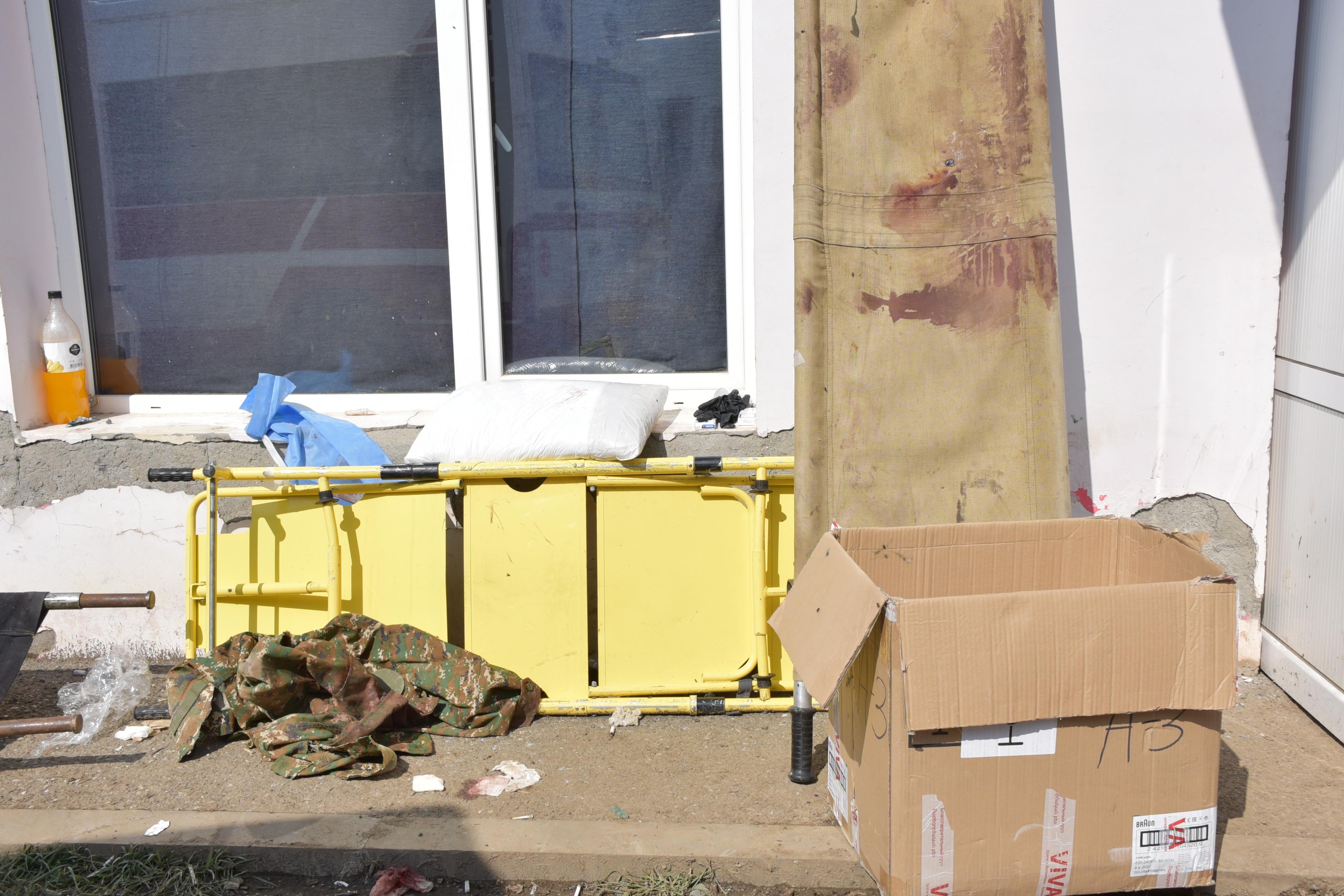
He continues his treatment at Yerevan’s Soldier's Home Rehabilitation Center (also known as Zinvori Tun), a specialized medical facility that provides free healthcare, prosthetics, and social reintegration for soldiers and veterans injured during military service or combat.
At Hetq's suggestion, Vardanyan is collecting and recording the accounts of soldiers undergoing treatment at the ‘Soldier's Home.’ We present the first article in this series. It’s based on a talk Vardanyan had with Artsakh War vet Norayr Avagyan.
Norayr Avagyan sustained a severe spinal cord injury on the outskirts of Shushi, near a gas station. He lay on the road, semi-conscious, for hours.
"Before the war, I was a furniture maker and lived in the city of Abovyan. On September 27, when the war began, I was at work. I heard about the casualties of the first day on the workplace radio․ I still remember—there were sixteen. I asked my colleague to inform the workshop[ management that I was going to war, and I hurried to volunteer," recounts Norayr.
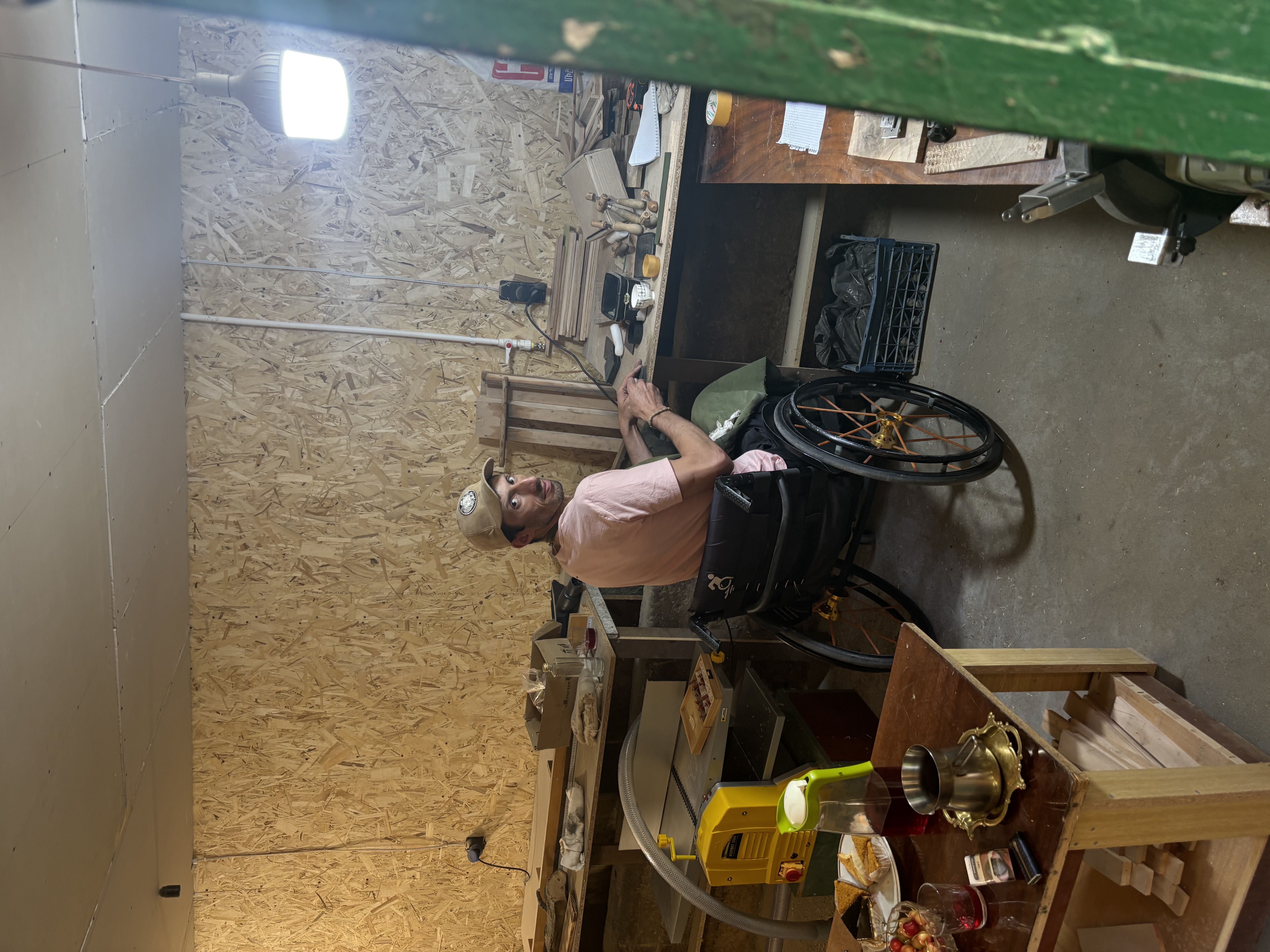
Norayr Avagyan
Norayr’s mother is from the village of Chartar in the Martuni district of Artsakh. The young woman Norayr loved was also from Chartar. Upon volunteering, he was determined to reach Chartar at any cost and be at the side of his relatives and the woman he loved.
When the volunteers presented their military service booklets, Norayr handed over his passport instead, as he had previously been exempted from mandatory military service due to a medical condition. It was only through sheer persistence that he managed to enlist as a volunteer.
On September 28, he left for Artsakh as part of a volunteer detachment formed in Armenia’s Abovyan city.
The 45-member detachment arrived in Stepanakert, the Artsakh capital, on the night of September 28. At the military commissariat, they were simply told that their destination was the Talish-Mataghis sector, and a former fedayi (whose name and military rank Norayr does not recall) was appointed as the detachment's commander. After much arguing (the volunteers wanted to reach their positions quickly), the detachment received military uniforms, AKM assault rifles, ammunition, canteens, and mess tins at one of the military units in Stepanakert. However, at that point, the detachment commander, and his associates—four men in total—disappeared.
(Fedayi refers to Armenian irregular self-defense militias that formed during the late 19th and early 20th centuries to protect Armenian villagers from Ottoman oppression and massacres.)
Maghavuz and Varankatagh Incidents
On the night of September 29, the detachment traveled by bus from Stepanakert to the village of Maghavuz in the Martakert district and was stationed at the village school. The school had become a camp for numerous detachments, with around four hundred men waiting for their orders.
During that time, a high-ranking military officer arrived and delivered an inspiring speech. Norayr says he realized the man was a general based on his shoulder epaulets. Vardanyan assumes that it was the man nicknamed "Chechen"—another former fedayi who had appointed him commander of their detachment.
On October 2, the detachment assumed positions on the Varankatagh (Lulasaz) heights, located on the route from Martakert to Talish.
Chaos, Disorganization, Drone Strikes
Norayr recounts that the morale of the troops stationed at the school was low.
"People there were saying they were being led to the slaughter—like sacrificial lambs—so that the international community would recognize Azerbaijan as the aggressor. Others claimed the territories had already been sold off and that fighting was pointless."
They finally reached the fighting position, only to realize their commander, "Chechen," had vanished somewhere along the way. The grueling overnight march to the high ground had taken them through dense forests and rugged mountains. Upon arrival, it also became clear that Norayr’s combat boots had severely blistered and injured his feet, leaving him barely able to walk.
The squad lacked a commander, a map, and a combat mission. They did not even know from which direction to expect the enemy, which prevented them from taking up proper positions or digging trenches. Soldiers already entrenched at the position guided them to quickly dig in and take cover.
Lacking engineering implements, they began digging trenches with bayonets—or, for those without them, with helmets or even their bare hands—as the veterans urged them on, warning, "Soon, not a stone will be left standing here," says Norayr.
The warning proved accurate; the shelling began before they could even finish digging their trenches.
They came under fire from artillery, military aircraft, and drones, while Norayr and his comrades were armed only with assault rifles. The squad suffered numerous casualties and injuries. Norayr says he saw three or four wounded men and just as many killed in his immediate vicinity—within his field of vision—but is convinced the actual number was far higher.
"Countless screams and cries for help could be heard from a distance. We never even found out what combat mission we were conducting; we didn't see the enemy—there were only planes and bombs," he recounts. Hours later, the survivors were ordered to retreat. Norayr believes the squads were ordered to pull back, though he did not hear the order himself, and the unit withdrew to the Maghavuz village school.
Commander Gegham: Inspiring the Troops and Providing Medical Aid
Norayr was at a remote position, along with three fellow soldiers, and learned about the retreat extremely late. Realizing that remaining there as a group of four was pointless, they too began to withdraw. During their retreat, they encountered Gegham, the commander of the Byureghavan detachment, who advised them to assume positions near the road.
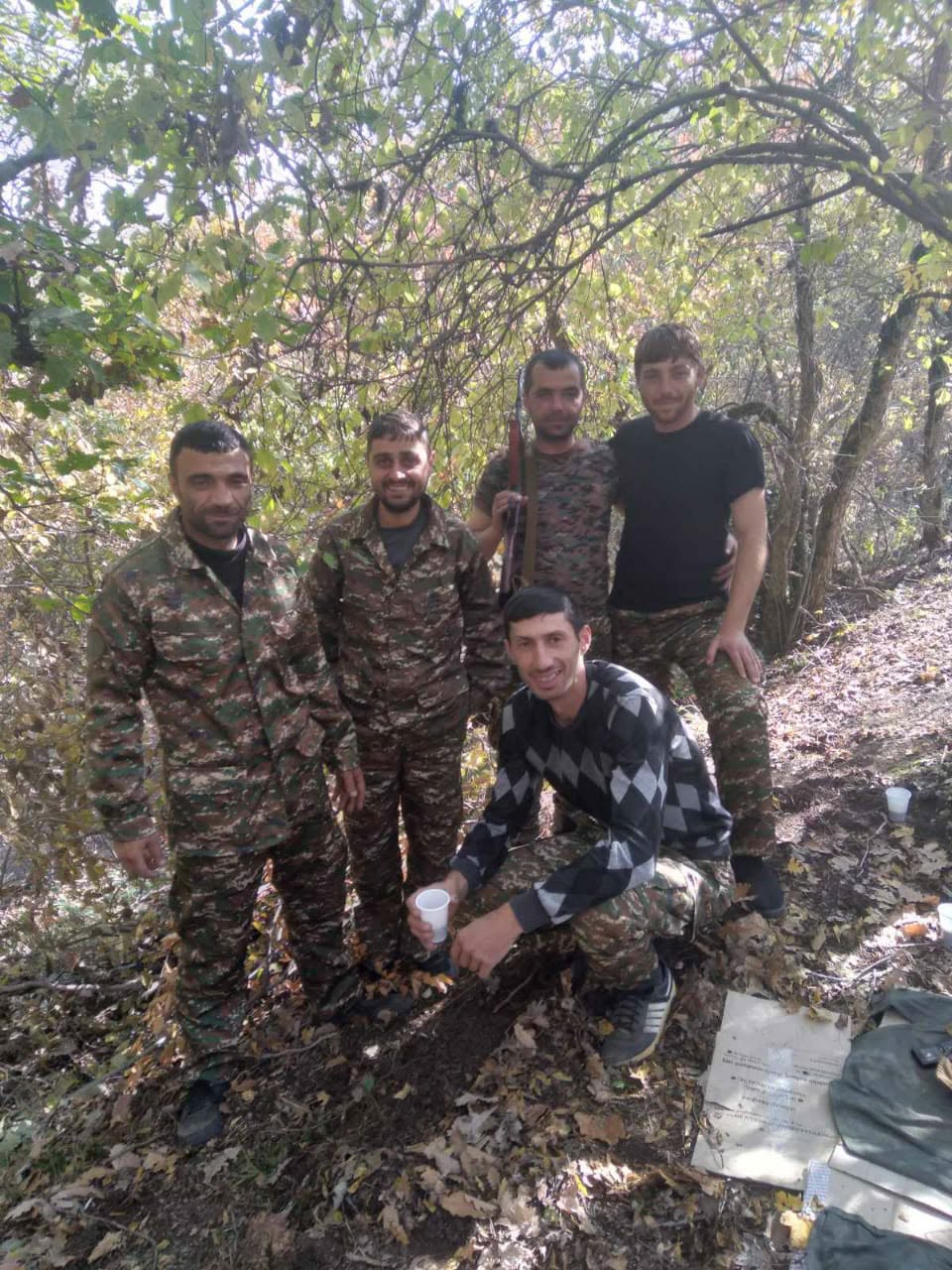
Commander Gegham earned their trust because, during the shelling, he ordered the troops to spread out and dig in quickly. He kept morale high and attempted to move the wounded to a safe zone while administering first aid.
By midday on October 3, they had taken up positions near the road. There, too, they tried to dig trenches and wait for the enemy forces, but once again, they encountered only drones and aircraft. Two of his comrades soon left, leaving just the two of them from the squad.
His remaining comrade constantly complained that Norayr’s stubbornness might cost him his life, preventing him from ever seeing his children again. Norayr persuaded him to retreat and remained behind alone.
Seeking to find the main road and determine his next move, Norayr made his way through forests, thickets, and fields, sustaining various minor injuries along the way.
His combat boots had completely fallen apart, leaving his feet severely lacerated. Swapping them for a pair of slippers he salvaged from an abandoned backpack along the trail, he pressed on. Retreating soldiers soon flooded the same path. Spotting his agony, a sympathetic conscript stopped to help, tearing fabric from Norayr’s military jacket to fashion improvised foot wraps and dull the pain. As the retreat quickened, the soldiers exchanged hurried words with him before rushing toward the rear. Left to crawl on all fours due to his agonizingly slow pace, Norayr rapidly fell behind. Yet, the retreating men ahead of him left a trail of white cloth fragments along the path, cutting through the dark to guide him back to safety. He was suffering from hunger and thirst when he encountered another retreating soldier who gave him some biscuits and a few sips of water.
On the evening of October 3, Norayr reached the Maghavuz school with great difficulty. He managed to have a quick bite at the school, and just as he was getting ready to rest, he was told that the troops were being withdrawn from the school and taken to an artillery unit in the Martakert village of Horatagh.
"For about three or four days in Horatagh, we just idled away the time," says Norayr. While in Horatagh, conscripts bandaged and cared for his feet. One soldier gave him his military coat, and they even found a pair of boots at the unit that fit him.
Alashan Weapons Handover
On October 7, Norayr and several other soldiers were transferred to Alashan. It served as a command post - a hub for food supplies destined for the front lines, a medical station, and a rest area for soldiers returning from their positions.
In Alashan, the newly formed group of volunteers and militia members led by Norayr was attached to the local regular troops, specifically the 12th Company of the 4th Battalion, 6th Defense District. Over time, however, the militia group gradually dispersed and departed. In the end, only a few individuals remained behind alongside the conscript soldiers.
"Those leaving were causing panic among the soldiers. Instead of helping, the volunteers were harming the troops," says Norayr.
In Alashan, the volunteers in Norayr's group handed over their weapons since they intended to leave. They no longer needed their weapons.
During those chaotic days, the remaining regular soldiers also broke ranks, scattering into the surrounding forests and fleeing in all directions. Amid the confusion, only a small handful of militia members and three close comrades-in-arms—Norayr, Karlen, and Nzhdeh—chose to stay behind in Alashan. Seeking a way to remain useful, Vardanyan and Karlen soon set out toward Karvatchar, determined to find an active unit and a new commander to serve under, while Nzhdeh stayed to hold the line in Alashan.
Along the road, the two men chanced upon a high-ranking officer who knew Norayr. Recognizing their plight, the officer ordered his staff to give them a hot meal, supply them with proper clothing and fresh combat boots, and arrange transport to the Ditaket (Observation Point) command post in the Martakert region. By October 12, both Norayr and Karlen had successfully reached the Ditaket post, ready to resume duty.
"After spending a week at that post, we realized we couldn't be of any help. I asked for a few days' leave so we could go home, recover, gather our thoughts, prepare ourselves psychologically, and then return. We went on leave on October 20. I bathed and went to the hospital, where an examination revealed I had bilateral pneumonia," recounts Norayr.
On October 27, Norayr, along with Nzhdeh and Karlen—who were also on leave—drove to Alashan in Norayr’s car. By that time, some of the soldiers who had been scattered in the forest had voluntarily returned to their deployment site, while the Military Police had taken others back.
"At Alashan, we requested to be assigned once again to the same 12th Company, because the company commander, Tigran Vanyan, was a conscientious and organized officer who did everything possible for his soldiers," says Norayr.
Throughout that entire time, Norayr wanted to go to Chartar to see the girl he loved and his relatives, but military orders always directed him elsewhere.
Towards Shushi
On the night of November 5, heading into the morning of the 6th, Norayr’s company was mobilized and transported to Shushi in Ural trucks. This time, Norayr had a proper pair of military boots—his family had sent them. "It’s a shame; I only managed to wear them for two days," Norayr jokes ruefully.
En route—near Shushi, close to a gas station—they came under fire; they disembarked from the Ural trucks, and the battle began.
There was gunfire coming from all directions, so he took cover behind some bushes. He remained lying there until the moment the men from his company shouted from a short distance away that Frunz had been wounded.
Because Frunz had been a vital source of support during the conflict, Norayr immediately went to his aid when he was hit, helping another soldier load him into an ambulance for evacuation. Norayr then returned to the battlefield to assist the overwhelming number of wounded troops, many of whom were bleeding to death from otherwise survivable injuries.
After successfully bringing several more casualties to safety, he was struck down by a sniper while transporting his fifth soldier. Norayr fell in the center of the road, pinned beneath the wounded man. He remained trapped there for several hours with a shoulder dislocated from the impact, finally managing to push the weight off with one hand and crawl free.
The injury was severe; he suffered a spinal cord contusion, and his legs immediately went limp below the waist, leaving him unable to move them. The crew of a passing armored personnel carrier noticed that Norayr was alive and picked him up.
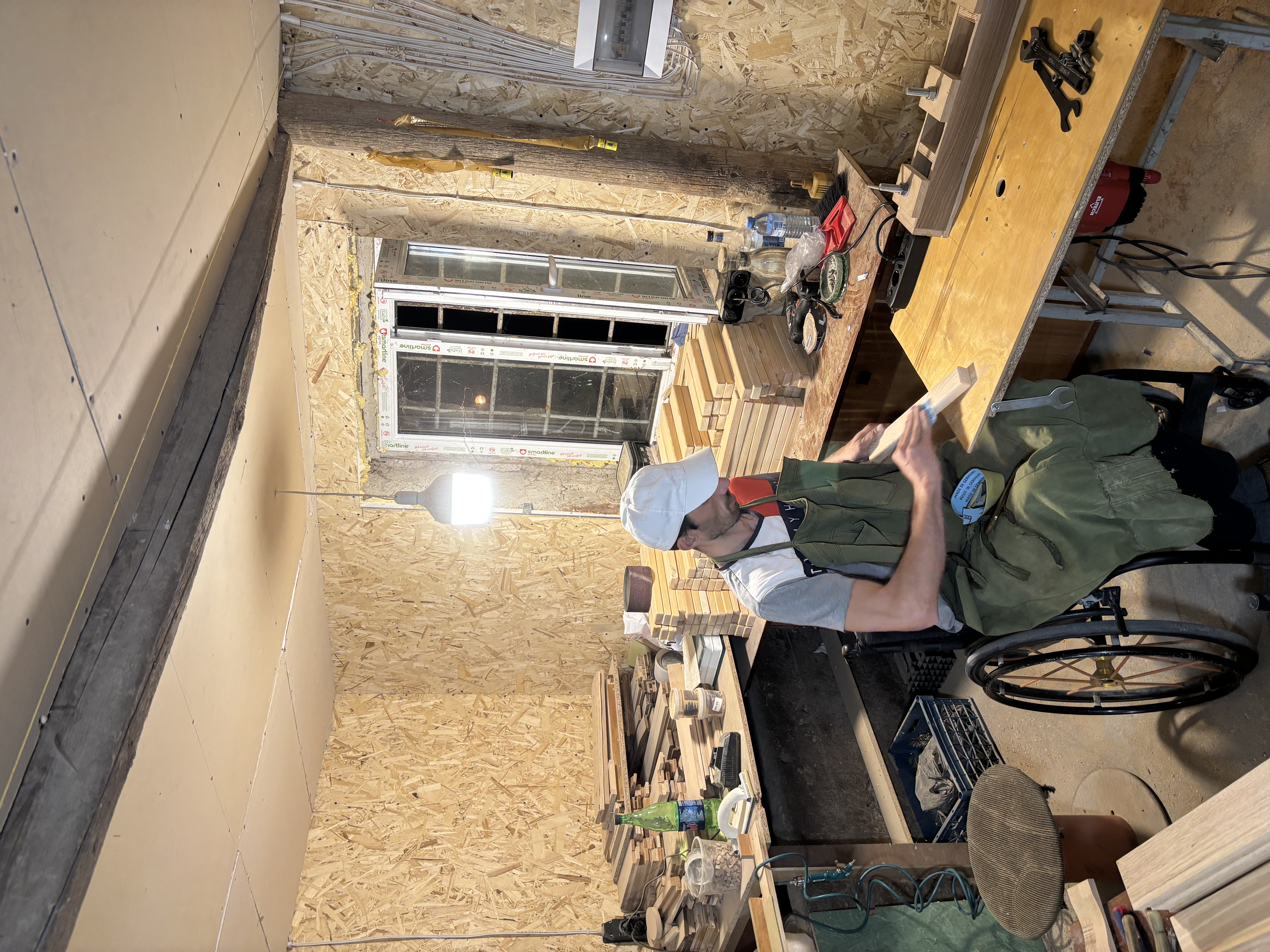
For the past six years, Norayr has adapted to life in a wheelchair, never letting it stall his passion for woodworking.
Write a comment