 Videos
 Photos


Veolia’s Nine Years in Armenia: A Legacy of Chronic Water Outages and Criminal Investigations
By Mattis Choquart (Hetq intern)
Veolia Jur’s Nine-Year Monopoly
Since January 1, 2017, the French-owned subsidiary Veolia Jur (Veolia Water) has held an absolute monopoly over Armenia's drinking water, serving roughly 75% of the population. Under a fifteen-year lease contract with the Armenia’s Water Committee, Veolia consolidated five previously independent regional operators into a single national network.
Dozens of rural communities remain entirely outside of Veolia's service infrastructure. No household, business, or public institution within the service zone can legally turn to an alternative supplier. One fact, however, escapes most users. This contract does not guarantee continuous supply.
Asked in April 2026 about the switch to a restricted regime of seventeen hours of water per day, Veolia Jur Managing Director Marine Shaghinyan confirmed it without hesitation: neither the lease signed with the state nor the licence issued by Armenia’sPublic Services Regulatory Commission requires the company to provide a 24-hour water supply. The continuous service that residents have taken for granted for decades was, in reality, never a contractual obligation, only with that Veolia may, at its discretion, restrict.
Nubarashen’s Water Issues
In her grocery store on 11th Street in the Yerevan district of Nubarashen, a resident talks about the outages without paying them much attention, as if she were talking about the weather.
"Well, there was some, but like this, or…" she begins, before clarifying: "sometimes there isn't any, sometimes there isn't any at all." Since when? She shrugs. "I don't know, they say there was an accident." She repeats the word: "Accident, accident, accident, accident."
It's not just her street, she points out: "The whole city is in this state. The water came back for a while, then went off again the very next day." She laughs as she tells it. "Now there's water, but it comes back, it goes off, it's never very precise. It's always the same, we've gotten used to it, it's a lottery." She adds, as one last example to prove she isn't exaggerating: "There's one street that didn't even have water for a whole week."
Besides the problems with water arriving and being distributed, total outages are also part of the problem. The most recent one lasted 24 hours and affected Nubarashen and three other Yerevan districts, following a failure on the same Yerevan-Garni line. For years, Nubarashen has come up, breakdown after breakdown, in the same Veolia Jur statements, always for the same cause: an incident on the Garni-Yerevan main pipeline, which also supplies Erebuni and Shengavit.
Neither “Veolia”, nor the Water Committee, publicly explains why this same section fails so regularly, year after year.
The Restricted Regime
At the end of February 2026, Veolia Jur published the schedule for the restricted regime, 17 hours of water per day from May 1 to September 16, in twelve “Yerevan” districts of Yerevan and in all regions of the country. The reaction was immediate on social media and in the local press.
Faced with the media outcry and social media uproar, Armenia’sMinister of Territorial Administration announced on February 25 that the government was suspending the change while the Water Committee, the Public Services Regulatory Commission and Veolia carried out further studies to address this crisis.
In a sudden reversal, Veolia Jur implemented a severe 17-hour daily water restriction for selected subscribers in early July, scheduled to last for 2.5 months.
Unfortunately, on paper, the law never promised continuous service, but several decades of habit have created a public expectation that no one has formally guaranteed. This is exactly the gap between legality and legitimacy when it comes to access to water.
Water Starts Flowing Again
At the entrance of the Aeration wastewater treatment plant, 64 hectares in the southwest of Yerevan on the banks of the Hrazdan, a Soviet slogan still clings on beneath the peeling paint: "Let the water of the Hrazdan be clean." This fading promise dates from the time when the plant was operating. It was built in 1972 and ran until the early 1990s.
Every day, 177,000 cubic meters of completely untreated wastewater flow directly from Yerevan into the 141-kilometer Hrazdan River. This environmental degradation reflects a nationwide crisis, with 92% of Armenia's wastewater discharged directly into nature without treatment. Consequently, the Hrazdan River's water quality has plummeted to Class 5, the lowest possible rating before total ecological death.
10.4M Euro French-Funded Treatment Plant Sits Idle Since 2016
A state-of-the-art wastewater facility, funded by a 10.4 million euro loan from the French government, built to resolve Yerevan’s environmental crisis has never operated for a single day. Completed between 2015 and 2016, the plant boasts a 400,000-cubic-meter daily capacity, the exact volume needed to manage Yerevan’s entire wastewater output. It was built by SADE, a French subsidiary of the Veolia group. The plant has sat totally idle for a decade solely because it lacks a compliance certificate and State registration.
Who is supposed to switch it on? HETQ asked all concerned. Veolia Water says it is not the tenant of the plant and refers all inquiries to the Water Committee. The Water Committee says it is not a party to the contract. The Territorial Development Fund, to which the files were transferred in 2019, says the plant does not appear anywhere in its records. The 2017 lease does cover the site's 64 hectares, but not the plant located on it.
While everyone passes the buck, the tally is simple. The plant was built. It never started up. The money is gone. France lost nothing in the affair. It is Armenia that is repaying the 29.9 million euros owed to the French government, interest included, of which 4.2 million have already been paid, The Armenian government provided these numbers in response to Hetq’s written request
A criminal investigation was opened, indeed launched in May 2020, for embezzlement and pollution of the Hrazdan. Questioned by Hetq, the prosecutor's office said the investigation is ongoing. No one has been formally charged.
The situation raises a critical question: how can a nation still burdened by debt from a failed Franco-Armenian project hold the very same French company accountable for its widespread operational failures?
Armenia’s Debt to France Leaves Government with Weak Leverage Over Veolia
During his last visit to Armenia, French PresidentEmmanuel Macron declared: "We are also proud to work in the water sector, which is crucial for Armenia, with the company Veolia Jur."
On August 26, 2018, the Armenian police launched a case against Veolia Jur, accusing it of paying bribes amounting to US$27,000 to senior water regulation officials. The company firmly denied the allegation and even threatened to leave Armenia.
Nineteen days later, Armenian PM Nikol Pashinyan was in Paris.
On September 14, between a lunch at the Élysée with Emmanuel Macron and a reception at the Hôtel de Ville, he addressed the MEDEF, a federation of 7,200 French companies, including Veolia. He spoke about the contracts between the Armenian government and foreign companies. Pashinyan minced no words.
"In most cases, the interests of the Republic of Armenia and its people were not taken into account in the transactions between companies and the government. And I see no fault on the part of these companies, because they acted in their own interest, whereas the interests of the State and the people should have been protected by the officials negotiating on behalf of Armenia." He added that his government had "a number of issues to settle with foreign companies," but that his goal was "not to destroy anything."
Speaking before French employers, Pashinyan noticeably refrained from naming Veolia directly, despite an ongoing criminal investigation targeting the French company's operations. Instead, the head of the Armenian government exonerated the corporate entities, placing the entire burden of responsibility onto local Armenian officials.
On October 4, 2018, Garegin Baghramyan, one of the alleged bribe recipients, was appointed Armenia’s Deputy Minister Energy and Natural Resources, while the investigation was ongoing.
The timing of the decree was highly strategic. On that specific day, Armenia was in deep mourning following the passing of legendary singer Charles Aznavour three days prior, prompting Pashinyan to fly to Paris for the national funeral.
With the entire country’s attention transfixed on France, and the media dominated by funeral headlines, the government quietly slipped the presidential decree through without public scrutiny. In political strategy, this tactic mirrors the French mechanism of a "49.3" forcing an unpopular executive measure through under the radar on the night of a major French national football match.
Baghramyan remained deputy minister for only a few months before being nominated Minister of Energy and Natural Resources. In April 2019, Pashinyan nominated him to chair the Public Services Regulatory Commission, the authority in charge of regulating Veolia. He stayed on the job for five years.
Questioned later about the affair, Baghramyan explained that wherever Veolia operates, it facilitates exchanges of experience; that the trip to Paris also included journalists and representatives of public organizations and that his expenses were not passed on to the water tariff and therefore could not have influenced it. The police, for their part, maintained that this trip was a bribe in exchange for which the commission had raised the tariff and Veolia's revenues.
Gray Areas
On October 10 and 12, 2018, Emmanuel Macron traveled to Armenia for the Francophonie Summit. Veolia was under full-blown criminal investigation, and the French president chose that moment to express his pride in working with it. Several sources confirm that the criminal case concerning the embezzlement of funds at Veolia was settled out of court during that period.
Since then, no judicial outcome of the criminal case opened in August 2018 has been made public: no trial, no conviction, no officially announced dismissal. Yet in Armenia, the law provides for up to ten years in prison for corruption in a public matter.
In response to Hetqs’ written request, Armenia’s Anti-Corruption Committee indicated that the preliminary investigation in this criminal case has been ongoing since 2018. No one has been named as a defendant..
The police revealed a second controversy involving Veolia Jur in the very same press release. On November 7, 2018, the Competition and Consumer Protection Commission fined the operator a mere $41,000. The commission accused the company of actively pushing out Arazen, the sole Armenian manufacturer of water meters. Veolia Jur allegedly bypassed public procurement procedures to import over 30,000 foreign water meters at two to three times the standard market price, a move that ultimately forced Arazen to close its domestic operations.
With Veolia Jur locked into its management contract until December 2031, this incident raises fundamental questions about accountability.
Given that numerous aspects of the country's water sector and Veolia’s day-to-day operations remain entirely opaque, the next few years leave the future of Armenia's water infrastructure highly uncertain.
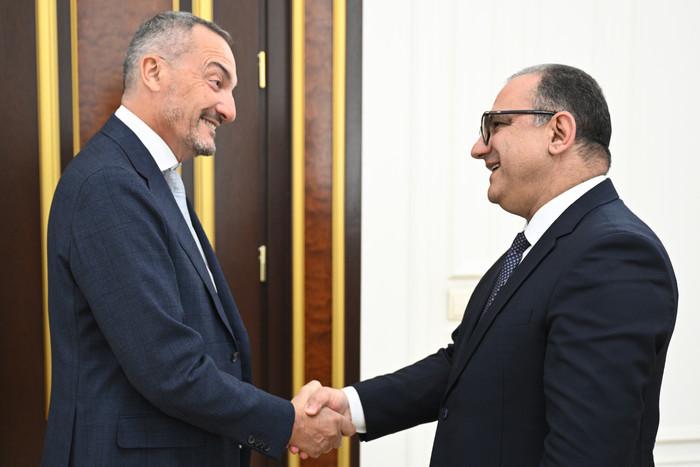
Photo: Armenian Deputy PM Tigran Khachatryan and Philippe Guitard, Senior Executive Vice President for Central and Eastern Europe met at Veolia's Yerevan office; 7.04.2026/gov.am
Write a comment