 Videos
 Photos


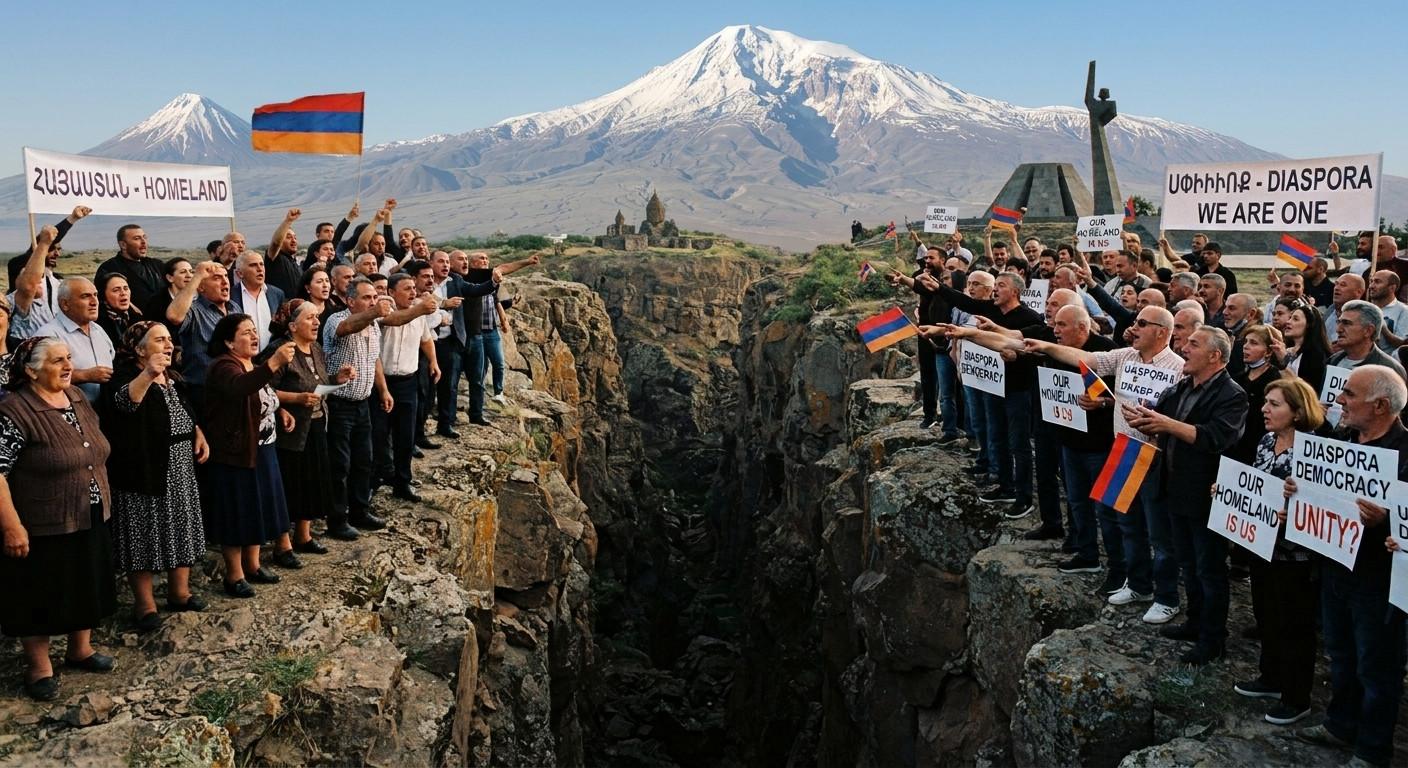
Rhetorical Unity, Practical Detachment: The Eternal Homeland-Diaspora Dance
By Zabelle Kaynakjian
From the macro-illusions of the $500M Firebird deal to the micro-scale of iGorts, the state-diaspora relationship remains trapped in a cycle of outdated institutions and mutual disappointment.
For decades, standard political rhetoric has relied on comforting maxim: the homeland and its global community are two halves of an invincible whole. But structural realities reveal a harsher truth. The institutional global Armenian diaspora, in its current form, is structurally incapable of serving as a primary catalyst for systemic progress in Armenia. Worse yet, successive governments in Yerevan have consistently failed to provide the strategic outreach and precise blueprints necessary to alter this trajectory. The result is a relationship frozen in mutual disappointment, built on outdated structures that serve neither the security of the state nor the longevity of the nation.
The Fiction of a Unified Global Voice
The institutional diaspora's primary constraint is the fiction of its own unity. It is a fragmented constellation of communities split by geography, history, and culture. The traditional "old" diaspora, shaped by the post-1915 trauma, operates in a completely different socio-political reality than the post-Soviet wave. Without a central authority or global governing body, it lacks a unified voice, paralyzing large-scale collective action. Upon independence in 1991, the community split along pre-existing partisan lines, creating a scattershot approach where geographic hubs competed for influence rather than executing a unified national development strategy.
Compounding this fragmentation is the fact that the largest pocket of the global population—the massive Russian-Armenian diaspora, numbering between two and three million—remains an absolute enigma. While Western hubs dominate English- and Armenian-language discourse, the community in Russia is largely invisible. As observed on digital analytical platforms, it operates on separate, Russian-speaking networks and lacks a vocal lobbying apparatus. Bound by the constraints of Russia's authoritarian landscape, its massive capital and human potential remain depoliticized and restricted to localized economic networks, completely cut off from mainstream pan-Armenian discourse.
Legacy Parties and the Philanthropy Trap
Instead of evolving to meet the demands of a 21st-century sovereign state, legacy diaspora institutions remain trapped in the mid-20th century. Traditional pan-Armenian political parties have devolved. Lacking a day-to-day constituency or real skin in the game inside the Republic of Armenia, these entities function less like modern political movements and more like localized lobbying firms or fraternal charitable groupings. They are highly effective at cultural preservation and historical justice advocacy abroad, but they lack the dynamic capabilities required to foster forward-looking domestic progress.
This institutional stagnation has left the diaspora completely devoid of financially sustainable, pan-diaspora investment organizations. For thirty years, economic engagement has been treated as a charity case defined by emotional philanthropy and crisis-driven handouts, rather than market-driven venture capital or sovereign wealth funds. Historical attempts to build institutional bridges, such as the Armenia Fund (Hayastan All-Armenian Fund), have frequently suffered from transparency crises and political tugs-of-war, dissolving into tools of state patronage rather than independent engines of industrial growth.
Defenders of the status quo often point to high-profile economic wins as proof of constructive collaboration, citing projects like the newly opened $500 million Firebird AI data center in Hrazdan. Built as a public-private venture utilizing advanced NVIDIA and Dell infrastructure, the facility is lauded as a triumph of diaspora-led innovation. However, labeling the Firebird deal as an institutional success is fundamentally inaccurate. Firebird is a localized, elite corporate venture driven by specific venture capital partners and multinational technology ties. It is a transactional, tech-sector business deal—not the product of structured, sustainable pan-diaspora organizations or community-wide resource mobilization. Relying on isolated, multi-millionaire tech founders obscures the systemic problem: the broader global diaspora still lacks any scalable mechanism to pool national capital for macroeconomic security.
The Reciprocal Failure of Yerevan’s Outreach
Yet, this failure is entirely reciprocal. Successive governments of Armenia have historically treated the diaspora either as an ATM during peace or a reserve army during war, failing to execute any sustained campaign of strategic outreach. Tentative, short-term talent integration programs, like the iGorts fellowship program, which places diaspora professionals into one-year public administration stints, operate on a micro-scale. Attracting only a few dozen specialists annually, they fail to address the macro-institutional deficit.
Yerevan has never presented a comprehensive ledger specifying exactly what the state requires: 500 cybersecurity experts for the defense ministry; targeted venture capital for micro-electronics in Syunik; or structured legal frameworks to integrate diaspora professionals into state bureaucracy. If Armenia were to articulately define its precise technical, intellectual, and financial needs, it would strip the diaspora of its ability to hide behind generic philanthropy. An explicit mandate from a sovereign government would effectively force the diaspora’s hand, compelling it to dismantle its fragmented silos and build the professional, pan-diasporan structures needed to deliver on those exact demands.
An Institutional Collapse from Within
Ultimately, the institutional diaspora cannot catalyze progress in Armenia when it cannot face its own compounding internal crises. Across Western and Middle Eastern enclaves, legacy organizations are suffering from a severe crisis of relevance and a widening generational disconnect. Century-old partisan lines fail to engage a highly mobile, digitally native younger generation. Assimilation is accelerating, civic participation is dwindling, and institutions are consumed by self-preservation and memory-keeping. A diaspora actively losing its grip on its own cultural continuity lacks the stability to secure its own future—let alone anchor the security of a besieged homeland.
The Counter-Argument: An Underutilized Strategic Asset
To dismiss the institutional diaspora entirely, however, is to ignore a vital counter-perspective. Proponents argue that the primary bottleneck is a toxic culture of mutual distrust fostered by Yerevan itself. Historically, diaspora professionals who attempted to build large-scale projects were burned by local corruption, judicial volatility, and oligarchic market monopolies. From this viewpoint, the diaspora remains an irreplaceable asset whose strategic depth and vast intellectual capital are actively being underutilized or undermined by the homeland's defensive political elite. Legacy organizations have preserved the concept of Armenian identity globally for over a century; expecting them to seamlessly transition into economic engines without reciprocal legal protections, dual-citizenship integration, and tax incentives is an unrealistic abdication of state responsibility. Progress, they contend, requires modernizing these legacy structures through collaborative legal frameworks that treat the diaspora as a co-equal stakeholder.
Beyond Sentimentalism: Why True Synergy Remains a Fairytale
Ultimately, expecting these two fundamentally distinct entities to build a harmonious, integrated partnership is more of a fairytale than a real-world probability.
The harsh truth is that neither side genuinely wishes to cede the control required to make such an alliance work. Governments in Yerevan, defensive of their state sovereignty and domestic political power, will always look upon large, organized diaspora institutions with suspicion, viewing them as unpredictable foreign actors with agendas detached from domestic reality.
Conversely, legacy diaspora elites—deeply protective of their century-old fiefdoms, financial endowments, and political autonomy—are fiercely resistant to the radical consolidation and modernization required to serve the state. They prefer the soft comfort of long-distance patriotism and consequence-free criticism over the strict accountability of statecraft.
Bound by this deep-seated, systemic egoism and a mutual, historic distrust, the two sides are destined to remain locked in an eternal dance of rhetorical unity and practical detachment.
(Zabelle Kaynakjian is a cultural commentator with roots in the diaspora and Armenia)
Write a comment