 Videos
 Photos


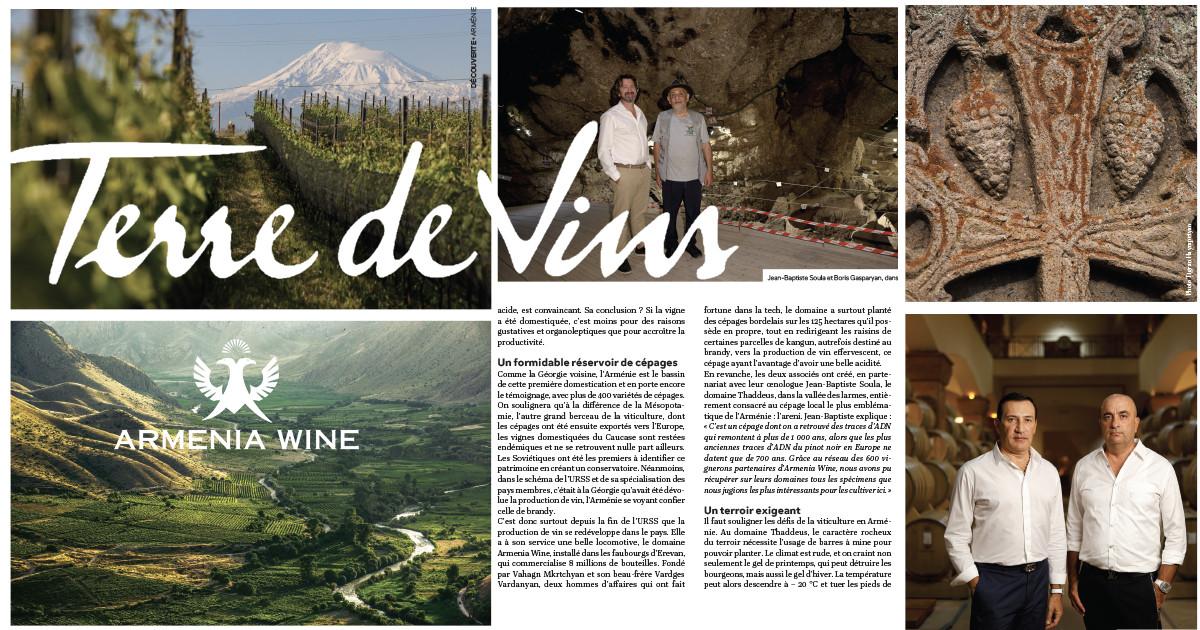
Armenia Wine Continues to Attract International Media Attention: French Magazine Terre de Vins Features the Company
Paid content
French wine magazine Terre de Vins has published an extensive feature on Armenia, highlighting the country’s remarkable heritage as one of the world’s oldest cradles of winemaking.
Written by French journalist Yves Tesson, the article, titled “Aux origines du vin” (“At the Origins of Wine”), explores Armenia’s millennia-old winemaking traditions, the distinctive character of its indigenous grape varieties, and the resurgence of its wine industry.
As Tesson observes, “Armenia is indeed one of the cradles of grapevine domestication and early winemaking. It is a tradition the country continues to uphold today, producing wines that are poised to regain their former prestige.”
The feature places particular emphasis on Armenia Wine, the vision and achievements of its founders, Vahagn Mkrtchyan and Vardges Vardanyan, and ambitious new projects designed to strengthen the international presence and recognition of Armenian wines.
Armenia: Where Winemaking Began
The article opens with the biblical account of Noah and Mount Ararat, establishing Armenia’s profound connection to the origins of winemaking and its unique place in global wine history.
Tesson takes readers to the Areni Cave in Armenia’s Vayots Dzor region, where archaeologists uncovered one of the world’s oldest known winemaking facilities, dating back approximately 6,100 years.
The feature also draws attention to Armenia’s extraordinary viticultural biodiversity. With more than 400 grape varieties, the country possesses a remarkable collection of indigenous vines, many of which have retained their distinctive characteristics over centuries.
Armenia Wine: A Driving Force Behind the Revival of Armenian Winemaking
Turning to Armenia’s contemporary wine industry, Terre de Vins identifies Armenia Wine as a major driving force behind the country’s winemaking renaissance.
Founded by Vahagn Mkrtchyan and Vardges Vardanyan, the company has established itself as a significant producer, bringing approximately 8 million bottles to market.
Tesson also highlights Armenia Wine’s Tariri collection, praising the red wine’s vibrant freshness, refined tannins, seamlessly integrated oak, and expressive red-fruit aromas. He attributes its distinctive character in part to Armenia’s high-altitude vineyards, where cool summer nights help preserve the grapes’ natural freshness and acidity.
The initiative reflects a broader commitment to preserving Armenia’s native grape varieties while unlocking their potential to produce wines of international distinction.
Wine as Armenia’s Cultural Ambassador
One of the article’s most compelling themes is the vision shared by Armenia Wine’s founders, whose ambitions extend well beyond the production of fine wines.
As Tesson emphasizes, Vahagn Mkrtchyan and Vardges Vardanyan see wine as a cultural ambassador—a powerful means of introducing Armenia’s history, heritage, and identity to audiences around the world.
This philosophy finds expression in the company’s cultural and heritage initiatives.
The article offers particular praise for the Armenia Wine Museum, drawing a comparison with Bordeaux’s celebrated Cité du Vin.
Through its collection and exhibitions, the museum brings Armenia’s ancient winemaking traditions to life, tracing their evolution from the sophisticated irrigation systems of the Urartian Kingdom to the ingenious techniques once used to produce, filter, and transport wine.
Together, these initiatives demonstrate an approach to winemaking that reaches beyond the vineyard, positioning wine as an expression of national identity and a bridge between Armenia’s past and its future.
Armenian Winemaking Gains International Recognition
The feature in Terre de Vins offers further recognition of Armenia’s historical significance and growing potential on the international wine scene.
Rather than portraying Armenia solely as an ancient birthplace of winemaking, the article presents a country actively reclaiming its place in the global wine landscape, combining centuries-old traditions with contemporary expertise and ambition.
Source: Terre de Vins, “Aux origines du vin,” pp. 117–119.
Author: Yves Tesson
Write a comment