HY RU EN
Asset 3

Loading

End of content No more pages to load

Your search did not match any articles

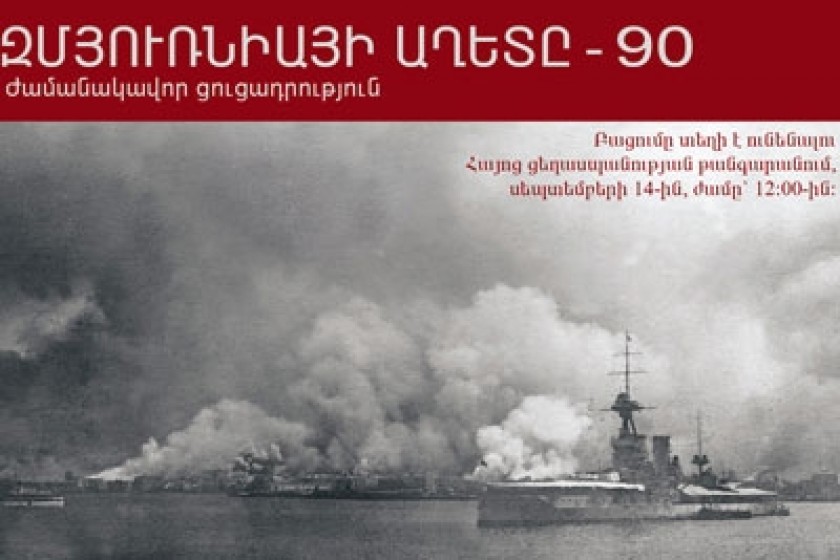
Exhibition to Mark 90th Anniversary of Smyrna Disaster

On September 14, 2012, at 12: 00 p.m., a temporary exhibition dedicated to the 90th anniversary of Smyrna disaster will be opened in the Armenian Genocide Museum.

Documents, photos, postcards concerning the life of the Armenians of Smyrna as well as unique photos, papers from the AGMI collection which present the fire of Smyrna, one of the major sea ports of Asia Minor and Kemalist massacres of tens of thousands of Armenians and Greeks in September, 1922, are included in this exhibition.

After the opening of the exhibition, an academic session dedicated to this event will take place in the Armenian Genocide Museum-Institute's Komitas hall. The director of the Armenian Genocide Museum and Institute Hayk Demoyan, Verjine Svazlyan, researchers of AGMI Tehmine Martoyan and Gevorg Vardanyan will present their papers. 

Comments (2)

tim
Remember; First Prime Minister of the Independent Armenian Republic, Hovhannes Katchaznouni’s own manifesto under the name of “Dashnagtzoutiun has nothing to do anymore” in Bucharest in April 1923 (was found in Russian arhives) is saying that there was no genocide took place. The Armenian volunteer units were unconditionally allied with Russia, they massecred the Muslim population , Turkey had acted with an instict of self-defence and Turks have no reason to regret today..This is the manifesto of the first Armenian Prime Minister in 1923. (Translated from the original by Mathew A.Callender,Edited by John Roy Carlson (Arthur A.Derounian) ,published by the Armenian Information Service, suite 7D, 471 Park Avenue, New York 22. 1955) (Note: its copies were removed from the libraries in Europe by the Dashnagziun members, this document was found in Lenin Library in Moscow.)
tim
Genocide is the greatest crime of humanity and International Court of Justice or domestic courts are the only authorities reserved to prosecute and proclaim genocide according to the 1948 UN Convention. Therefore, accusing a whole nation and its generations as criminals of genocide requires strong historical and legal proofs and supports. Turkish historians, Turkish prime minister and Turkish Assembly several times suggested Armenia to discuss the events which occured in the WWI together with historians from both sides and even historians from other countries. The Armenians have neither applied to international courts nor accepted to discuss these events in joint commissions made up of historians from Armenia, Turkey and other countries. The other reason why the Turks and Turkish governments do not accept the label of genocide is that the Turkish documents and family stories the Turkish people heard from their own grandparents do not comply with an Armenian genocide. The Turkish Archives demostrate that the Armenians inflicted massacres upon Turks/Muslims from the beginning of 1890’s; that when the deportation were under way, the Armenians of the big cities (and Katholic and Protestan Armenians) were exempted; that officials who were found faulty during the deportations were court marshalled in early 1916 (out of 1673 who stood in court, 67 were given death sentences, 524 jail term, 68 row boat and monetary punishments by Talat Pasha government, before WWI ended) that in December 1918, a new law letting the Armenians return their homes and claim their properties was issued and that many of them returned their homes (1,2), that those who returned their homes cooperated with the French and English armies and fought in these armies individually wearing their uniforms during the Turkish Freedom War and that the documents presented by the Armenians to support their views are full of forgeries. 1) According to Armenian Church in Istanbul a total of 644,000 people returned back from exhile. There was a breakdown by cities. Children were returned to their parents.2) In a report presented by Aneurin Williams, chief of English-Armenian Committee, to Lord Curzon it was reported that many immigrants who were forced to migrate in 1915 returned to Cilicia from Syria, Palastine and Egypt after the Mondros Armistice (UK ARCHIVES, FO 608/278).

Write a comment

Hetq does not publish comments containing offensive language or personal attacks. Please criticize content, not people. And please use "real" names, not monikers. Thanks again for following Hetq.
If you found a typo you can notify us by selecting the text area and pressing CTRL+Enter