 Videos
 Photos


A Prison on the Lakeshore
The Ninotsminda Prison - the first-ever jail to be built in Samtskhe-Javakheti, a region dominated by ethnic Armenian population - occupies 10 hectares of land, a standard project, on the shores of Lake Sagamo. It is designed for 3,000 inmates and due to open at the end of next year.
Only nine people have been convicted in Ninotsminda in the first nine months of 2007. All of them received probationary sentences, i.e. none of them was actually imprisoned. According to available statistical data, Ninotsminda has the lowest number of convictions in Georgia. Only Chiatura region can boast of the same low figure - nine convictions in the nine months. Much more people have been sentenced in other regions of the country.
If these data are credible - and if information of law-enforcement bodies can be trusted - Ninotsminda (as well as Chiatura) is the most secure place in Georgia. Moreover, authorities are planning to set up a national park here. But why has the Ministry of Justice of Georgia decided to build a new jail right in Ninotsminda?
Prisons < prisoners => new prisons and even more prisoners
“It’s common knowledge - the system is overloaded. Building a new prison with imprisonment conditions, meeting the minimal level of international standards, is the quickest solution to the problem. It is a piecemeal process and part of the national strategy,” Givi Mikanadze, Deputy Minister of Justice, explained.
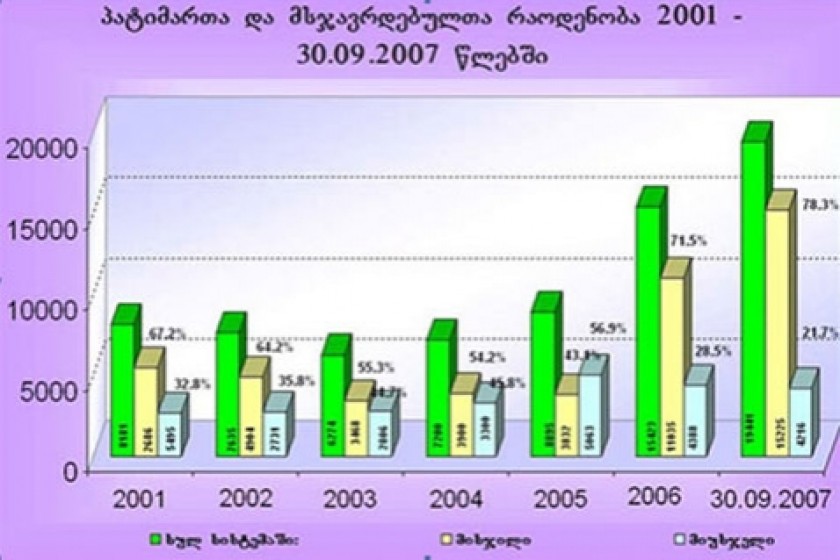
Source: Ministry of Justice of Georgia
The Ministry’s problem is the dramatic escalation of the incarceration rate in Georgia. In 2003, for instance, some 6,300 people were behind bars in Georgian penitentiary institutions - serving their sentences or awaiting trial. In the first nine months this year this number has soared to 19,500. It means that the number of prisoners has tripled in Georgia in the last five years. Indeed, the number of inmates in Pre-Trial Detention Centre No. 5 is three times its available capacity. To put it another way, three prisoners have to share a single bed there. Although the year has not ended yet, target figures set forth by the Prime Minister have been already reached. Namely, the Prime Minister Zurab Nogaideli said earlier this year that Georgia’s prisons would house some 18 thousand inmates by the end of 2007. At the time of his statement there were slightly fewer than 16 thousand.
Obviously, the number of prisons has not tripled in the country over these years. In fact, the three-time expansion of the penitentiary system is just under way:
- Pre-Trial Detention Centre No. 6 in Rustavi - a new jail designed for 600-800 inmates - is due to begin functioning early in November
- Geguti Colony (with high and low security sectors) is under repair at present; it is designed for 1,500-2,000 inmates and will enter service stage by stage - part of the colony will become operational later this year, while the rest will start to function in 2008
- A new building is under construction in Geguti Colony; when complete in 2008, it will house 1,000 inmates
- A new building, with the capacity of 1,000 inmates, will be soon opened in Colony No. 1 of Rustavi
- Pre-Trial Detention Centre No. 2 in Rustavi (with high and low security sectors), currently being overhauled, will open its doors to 1,000 inmates in 2008
- Prison No. 4 for female and underage convicts: a new building designed for 300-400 women prisoners will soon be built there
- A new pre-trial detention centre, designed for 4,000 inmates, is due to begin functioning in Gldani later this year
- A new colony - for 3,000 inmates - will open in the village of Liaturi (not far from Zestaphoni) in 2008
- Another new colony, also for 3,000 inmates, will enter service in Ninotsminda in late 2008
- A new pre-trial detention centre is planned in Zugdidi: the project has not started yet and its capacity remains unknown.
Added together, these figures suggest that the number of inmates in Georgian prisons will have increased approximately by 16 thousand by 2009. Let’s look at the present statistics again. More than 19,500 people - convicts and suspects - are held in Georgian prisons and pre-trial detention centres nowadays. If the current trend continues, their number will exceed 20 thousand by the end of the year. According to the State Penitentiary Department, Georgia needs to build new prisons in order to bring its national penitentiary system into line with “international standards and norms.”
By design, the high security Ninotsminda colony is similar to that of Ozurgeti - they cost taxpayers 40 million GEL (about $25 - Editorial comment) each.
Why Ninotsminda?
The Ministry of Justice and its subdivision, State Penitentiary Department - two bodies responsible for the field - gave mutually contradictory answers to this question.
Answer No. 1
“It’s a matter of money. We have never had penitentiary institutions in southern Georgia. This project aims at balancing the penitentiary system at the regional level. Local residents (inhabitants of Samtskhe-Javakheti) are kept in pre-trial detention wards in Tbilisi and it is a social problem, as their relatives and family members have to travel long distances. The social aspect of the problem is the most important one - prisoners should serve their sentences as close to home as possible. Respectively, this measure will help streamline trial procedures and investigation. It is an integral part of the penitentiary reform,” Givi Mikanadze, Deputy Minister of Justice, said.
Balancing the penitentiary system at the regional level seems quite a logical option. Just to this end, a new pre-trial detention centre is currently being built in Guria region. However, the Justice Ministry’s second, and the main, argument is flying in the face of the explanation put forward by its subdivision, State Penitentiary Department.
Answer No.2
According to Rezo Charbadze, Deputy Chairman of the Penitentiary Department, there are no obvious reasons for building a new prison in Ninotsminda. In his words, there are no plans to single out residents of Samtskhe-Javakheti for imprisonment in the Ninotsminda colony. “Today the choice of prison is determined by the sentence. People convicted of serious crimes are usually kept in high-security prisons,” Mr. Charbadze said, adding that the Ninotsminda colony will be quite secure: its outer wall will be five metres high, and it will have even higher watch towers and other “international standards”. The colony will comprise low-security and high-security wards. Any Georgian resident, no matter where he comes from, can be imprisoned there. From this viewpoint, the Ninotsminda colony is similar to the Rustavi one, which houses residents from different regions of the country.
Besides, only convicted criminals are supposed to enter the Ninotsminda colony, while those awaiting trial cannot be held there. This aspect contradicts the above-mentioned Deputy Justice Minister’s claim that once the Ninotsminda colony is up and running, relatives of the residents of Samtskhe-Javakheti confined in pre-trial detention wards in Tbilisi will no longer have to travel long distances to visit their loved ones.
Objectives and statements of the penitentiary department are apparently out of line with those of the Justice Ministry. As a result, there are two mutually contradictory explanations why Ninotsminda was chosen as the place for a new prison.
“What is striking is not the sheer number of prisoners in Georgia but its rapid rise,” Sozar Subari, the ombudsman, emphasised. He admitted, at the same time, that the government had decided to take a tougher line on crime: “I’m not quite sure that it is a wrong approach.” Mr. Subari believes that the growing number of prisoners is a valid reason for building new prisons in the country. But he does not have any specific information about the Ninotsminda colony.
The Ninotsminda prison will be located in the vicinity of the village of Sagamo, on the shore of Lake Sagamo, one of the saltiest lakes in Georgia. The place was selected by the Ministry of Justice in coordination with the local government. However, penitentiary authorities appeared unaware that large territories of Ninotsminda and Akhalkalaki regions, including Lake Sagamo, would be soon transformed into a national park. The Caucasus Office of the World Wildlife Fund has won the tender to develop the park, which was organised by the Ministry of Environmental Security and Natural Resources. According to Nugzar Zazanashvili, the local director of WWF conservation programs, although a large infrastructure on the lakeshore can adversely affect the local ecosystem, proper policies may reduce the negative effect to the minimum. He assured that as long as the national park had not been mapped yet, measures would be taken to ensure that the new prison remained outside the protected territory.
The Ministry of Justice and the Penitentiary Department both promise that local residents will have a chance to get jobs at the construction of the jail and will be employed as warders or other personnel after the prison is complete. “We will make the most of local resources - from manpower to food,” Mr. Charbadze claimed. Applicants must be of respective age, have a valid military ID card, and complete the Ministry’s special training program to become eligible for a warder position. The Deputy Chairman of the Penitentiary Department proudly emphasised that the Ninotsminda prison would be a “different experience” for the staff and prisoners: the latter would be confined in well-ventilated and well-lit wards - 4, 6, 8, or 12 inmates in each - with adequate sanitation and heating, and the number of square metres per prisoner would satisfy all international norms. In other words, “Have you seen American movies?”
Special to Hetq
The article was made by the order of the Samkhretys Karibche (
Salome Djashi
Write a comment