 Videos
 Photos


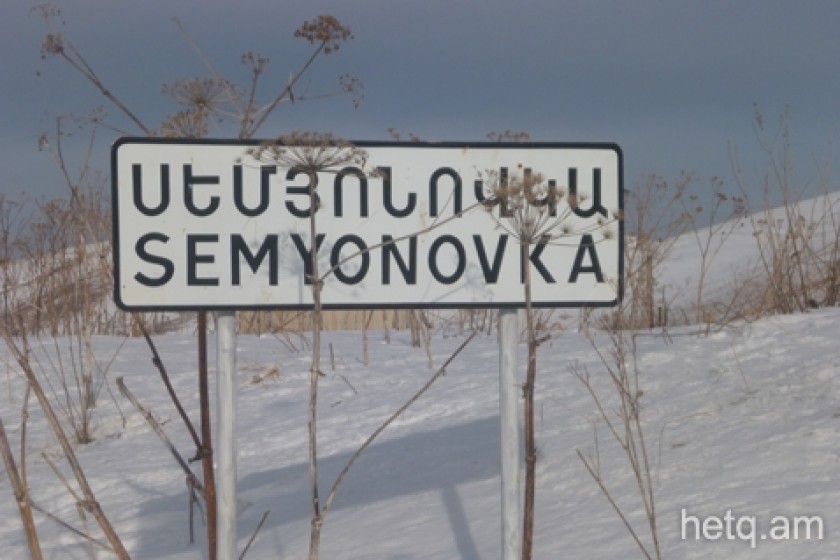
Desolate Armenian Village: Decades Later, Gas and Water Supply Remain Problem in Semyonovka
Semyonovka's wooden houses with their felt roofs recall little of the Molokans who used to live here.
Resident Khajak Kocharyan's grandfather was one of the first Armenians who came to this village in the eastern Armenian province of Gegharkunik when Molokan settlers still lived here. He worked at the village bakery, which, by 55-year-old Khajak's account, provided bread to not only Semyonovka, but also neighboring Tsovagyugh and Sevan. Seryozha Avetisyan, 80, says that there were 3 milk processing plants in the 1920s, one of which was in Semyonovka. He says that if the sovkhoz (state-owned farm) and kolkhoz (collective farm) weren't destroyed, no one would leave the village.
The dairy plant and bakery closed over time and the village become desolate. Semyonovka today is a single street with 300 residents and various problems. The village has not been equipped with gas lines: residents heat their homes with wood and dung. The village school with 32 students is heated with diesel fuel. Winters in Semyonovka are severe and full of heavy snowstorms.
The nine-member Kocharyan family has stored 20 cubic meters of wood for the winter. Khajak Kocharyan says the house is heated from the end of September till the middle of May, but not sufficiently. One cubic meter of wood is sold in the village for 15,000 AMD (about $37 USD). The village head, David Mnatsakanyan, says that the village was equipped with gas in the 1990s; however, over time, the pipes eroded and have become unusable.
"We've been dealing with this issue for 4 years. In 2012, gas pipes were installed with the 19 million 100 dram [a little less than $47 thousand USD] from the state budget. The length of the gas pipeline from Tsovaghyugh to Semyonovka is 4,300 meters; in the village, 2,760 [meters]," informed Mnatsakanyan. According to him, work costing around 30 million AMD (about $74 thousand USD) to install the gas line throughout the village began in November. But the majority of residents will use the gas only for cooking, saying the gas won't heat homes, and besides, gas is expensive.
Installing gas and water lines in the village is one of the priorities of Semyonovka's 2013–2016 socioeconomic program. The village is located between the Areguni and Geghama hills, 2,114 meters above lake level. Though there are cold springs in the village, only 30–40% of the village has drinking water. The water supply system built in the 1970s is in a dismal state, the pipes are worn-out and rotted. "It's very difficult; we carry water to use for our everyday [needs]. There are days in the winter when the spring freezes. The houses at the top of the lane, which are higher up, their water pressure is insufficient; the water doesn't go up," say residents.
"Armenian Water Sewerage CJSC Director Patrick Lorin has been invited several times to the village. He came and saw the state of the village and verbally promised to solve the village water supply problem," said the village head. At a public discussion at Sevan city hall in November 2013, Jinj CSJS, a consulting engineering firm, presented plans to improve the quality of Sevan's water supply, including running a 1.7-km-long water pipeline 5 km above the Sevan-Dilijan tunnel. Semyonovka village head David Mnatsakanyan, present at the discussion, opposed the plan.
"We won't allow the construction of a water line on our community lands, as long as the issue of Semyonovka's water supply is not resolved," Mnatsakanyan informed Sevan's deputy mayor, Jinj, and civil society and media representatives. According to the section on provincial and village infrastructures in Gegharkunik's 2012–2015 socioeconomic development program, water supply and sanitation in the province is implemented jointly by Armenian Water Sewerage CJSC and self-government bodies. One of the priorities in this sector is installing water supply and sanitation systems and establishing drinking water and sanitation treatment plants for 5 cities and 17 village communities.
Apart from water and gas supply issues, another priority of Semyonovka's four-year development program is repairing the 1 km stretch of road to the Sevan-Dilijan tunnel, renovating the cultural and community center, improving the village roads and road lighting, developing agriculture and animal husbandry, and so on.
The rural community currently doesn't harvest wheat and barley as weather conditions don't permit it. The main source of the community's income comes from animal husbandry and outdoor work. Villagers earn 130 AMD (about $0.32 USD) for each 1 liter of milk they produce. "It's a low price, but what to do; if we take it to Sevan to sell, it will only be extra trouble, considering the transportation fare."
There are few children born in the village. According to the nurse at Semyonovoka's medical-obstetrical center, 4 children were born in 2009 (3 were moved); 5 in 2010 (2 were moved); 1 in 2011 (who was moved); 3 in 2012; and 3 in 2013.
Staff Secretary at Semyonovoka's village administration Karine Petrosyan says there are no jobs in the village and the opening of the Sevan-Dilijan tunnel changed many things in the village. Many families left the village and the population growth rate dropped. "In the village in 2013, 2 boys got married and there were 2 deaths. And the girls get married and leave the village," she says.
The road in this sparsely populated village is often closed in the winter. And when it does, neither the teachers nor the students are able to get to Semyonovoka's school.
Comments (1)
Write a comment