 Videos
 Photos


IMF responses to questions about the exchange rate adjustment
What is the IMF’s view about the exchange rate adjustment announced by the CBA?
The IMF strongly supports the decision of the Central Bank of Armenia to return to a floating exchange rate regime. In recent days and weeks, the CBA has had to sell large amounts of dollars almost every day in its attempt to keep the exchange rate stable at around 305 dram per dollar. This policy has proved to be unsustainable. Moreover, maintaining a dram that is too strong is bad for Armenia’s competitiveness. A weaker, cheaper dram will help to make Armenian exports more attractive.
Why is a floating exchange rate necessary? Why not just move to a new, depreciated, fixed rate?
The IMF has for many years been of the opinion that a floating exchange rate regime is the best choice for the Armenian economy, because Armenia has a small, open economy that is dependent on what happens in the rest of the world. The problem with a fixed exchange rate is that it is very difficult for any central bank to correctly choose the optimal level of the exchange rate, and in fact, the optimal level is constantly changing, depending on what happens to international prices, the economies of trade partner countries, etc. If the exchange rate is fixed at a level that is too strong, like we believe was recently the case in Armenia, this means that Armenian exports become too expensive, which negatively affects economic growth, and could lead to a loss of jobs and an increase in poverty. On the other hand, if the exchange rate is fixed at a level that is too weak, this means that the economy can overheat, which can lead to high inflation. Therefore, it is best to let the exchange rate float and let the market find the optimal level at any time.
Why was the rate previously appreciating?
For the last several years, there were large inflows of foreign currency, mostly dollars, into Armenia (in the form of remittances, foreign direct investment, exports, and foreign aid). Expected appreciation also led to dedollarization, which further increased the supply of dollars. More supply of dollars meant that the price of the dollar was falling, which is why the dram was previously appreciating against the dollar.
Why does the rate need to depreciate now?
Because of the global financial crisis, there is a significant reduction of foreign currency inflows into Armenia. In particular:
-Export prices have fallen significantly (copper and molybdenum prices lost about 2/3 of their value), leading to lower export revenues for exporters.
-Global demand for Armenian exports has fallen, meaning a further reduction in export revenues.
-The Russian economy is experiencing serious problems, meaning a reduction in remittances (money transfers) from Russia to Armenia, as well as in foreign direct investment from Russia
In short, there are now significantly less dollars coming into Armenia than before. Now that the CBA has decided to let the exchange rate float and to let the market determine the equilibrium level for the dram, fewer dollars means that the price of the dollar should go up, which means that the dram should depreciate.
By how much will the dram depreciate?
Neither the CBA nor the IMF can tell you exactly by how much the dram will depreciate, because under a floating exchange rate regime, it is the market that will determine what is the optimal level of the dram, and this depends on the total demand and supply of dram and dollar in the economy.
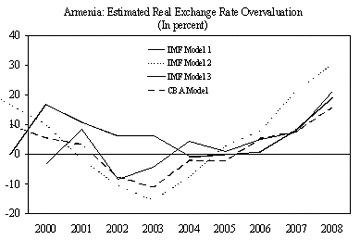
However, we have tried to estimate the so-called equilibrium exchange rate for the dram, and based on these estimations, we expect that the dram will depreciate by about 20 to 30 percent. We in fact used three different models for estimating the equilibrium exchange rate, and each model gave a similar result, which was that the dram is currently overvalued by 20 to 30 percent (see chart). We will soon publish a paper on our website where we explain the details behind these estimates. The CBA has also made similar estimations, posted on its website, which are within the same range.
Note that Armenia is only just catching up with other countries in the region: Belarus and Kazakhstan both recently devalued their currencies by 20 percent, and Georgia devalued by 11 percent. The Russian economy has been the most seriously affected, due to the large fall in oil prices, as a result of which the ruble has gradually lost 35 percent of its value. For Armenia, we expect less depreciation than in Russia, but more depreciation than in Georgia. Probably it will be something similar as in Belarus and Kazakhstan. However, from now on, it will be the foreign exchange market that will determine what the new dram rate is going to be on any given day.
 Will the central bank continue to intervene, and if so, when?
The authorities’ program will allow for some, but only very limited central bank interventions. The fact that the CBA has decided to return to a floating exchange rate does not mean that the CBA will not intervene at all. Our recommendation for Armenia is that central bank interventions should be used only to reduce excessive exchange rate volatility (that is, to avoid large changes from one day to the next), and the central bank should not target a specific level or specific path for the exchange rate. By the way, the CBA can use these limited interventions also to purchase foreign exchange, not just to sell it.
What will you (or the CBA) do if the exchange rate overshoots?
We are not concerned about a temporary “overshoot”. In fact, it is quite normal for exchange rates to overshoot, that is, to temporarily go above the expected equilibrium level. It is therefore possible that we will see first a fairly large depreciation, followed by some appreciation. If this happens, there may not be any need for the CBA to intervene, because if the exchange rate overshoots sufficiently, people will start using this opportunity to sell their dollars for a very good rate, and as a result, the exchange rate will come back down to its equilibrium level.
Is there a risk of bank failures? Should we take our money out of the banks?
There is no reason why Armenians should take their money out of the banks. In fact, the banking system is very liquid, very well capitalized, and very well prepared for this depreciation. In particular, banks’ liquid assets to total short-term liabilities are above 100 percent, and their average capital adequacy ratio (CAR) is well above the CBA requirement of 12 percent (it was 27.5 percent at the end of 2008). In addition, there is a good deposit protection system in place. And finally, the CBA stands ready to inject more money into the banking system if needed.
Why is there a need for an increase in the refinancing rate?
A temporary increase in interest rates is needed for several reasons. First, it will help to increase confidence in the banking system, by rewarding Armenians for keeping their money in the banks. Second, it can help to reduce the inflationary pressures that are likely to result from the depreciation, and sends a signal that the central bank is still serious about inflation. Finally, it will help to reduce incentives for banks to engage in speculative behavior, because it will become more expensive for banks to borrow dram from the central bank.
Will the central bank continue to intervene, and if so, when?
The authorities’ program will allow for some, but only very limited central bank interventions. The fact that the CBA has decided to return to a floating exchange rate does not mean that the CBA will not intervene at all. Our recommendation for Armenia is that central bank interventions should be used only to reduce excessive exchange rate volatility (that is, to avoid large changes from one day to the next), and the central bank should not target a specific level or specific path for the exchange rate. By the way, the CBA can use these limited interventions also to purchase foreign exchange, not just to sell it.
What will you (or the CBA) do if the exchange rate overshoots?
We are not concerned about a temporary “overshoot”. In fact, it is quite normal for exchange rates to overshoot, that is, to temporarily go above the expected equilibrium level. It is therefore possible that we will see first a fairly large depreciation, followed by some appreciation. If this happens, there may not be any need for the CBA to intervene, because if the exchange rate overshoots sufficiently, people will start using this opportunity to sell their dollars for a very good rate, and as a result, the exchange rate will come back down to its equilibrium level.
Is there a risk of bank failures? Should we take our money out of the banks?
There is no reason why Armenians should take their money out of the banks. In fact, the banking system is very liquid, very well capitalized, and very well prepared for this depreciation. In particular, banks’ liquid assets to total short-term liabilities are above 100 percent, and their average capital adequacy ratio (CAR) is well above the CBA requirement of 12 percent (it was 27.5 percent at the end of 2008). In addition, there is a good deposit protection system in place. And finally, the CBA stands ready to inject more money into the banking system if needed.
Why is there a need for an increase in the refinancing rate?
A temporary increase in interest rates is needed for several reasons. First, it will help to increase confidence in the banking system, by rewarding Armenians for keeping their money in the banks. Second, it can help to reduce the inflationary pressures that are likely to result from the depreciation, and sends a signal that the central bank is still serious about inflation. Finally, it will help to reduce incentives for banks to engage in speculative behavior, because it will become more expensive for banks to borrow dram from the central bank.
If you found a typo you can notify us by selecting the text area and pressing CTRL+Enter
Write a comment