 Videos
 Photos


Marzpetaran Websites: Empty Pages Translate into Public Mistrust
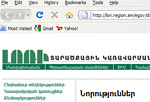 The websites of Armenia’s Marzpetarans (Regional Authority) went online about four years ago. They were set up but never maintained. To be more precise, only certain sections were filled in with a few sentences while the rest were left blank. From day one, visitors to these sites are met with empty white pages.
Ten regional websites were set up according to a fairly uniform scheme, for example, lori.region.am, kotayk.region.am, etc. The most frequently updated section of the sites is the “news” column which mostly focuses on educational-cultural events taking place in the region or within the authority, particularly those events in which the regional governor has participated. Visitors to these sites who are unfamiliar with the various regions of Armenia might get the impression that local residents lead a fairly active and rich cultural life.
In essence, the sites display a fairly successful format and possess great potential to impart a wide spectrum of news and information regarding the workings of the regional authorities to the public at large. Recently, the sites were overhauled and outfitted with new sections, especially one focusing on local community budgets. Sadly, under these sectional headings what awaits the reader, in the best of circumstances, is a cut and dry presentation of the authorities mandated functions and jurisdictional purviews, and not one word of the work being carried out to fulfill those responsibilities.
Specifically, the regional authorities are charged with carrying out yearly administrative and financial oversight of the local communities in their jurisdiction, reviewing their activities in a number of sectors, cultural, environmental, construction, community council irregularities, etc. We wrote to six regional governors, requesting that they provide us with information as to which communities they reviewed for the year 2007 – 2008, what sectors of community life were included in the review, and the conclusions that were recorded in each case. The Kotayk and Shirak Regional Authorities never responded to our request. The several pages we received from the other four, despite not fully answering our original questions, showed that work was being carried out in this direction nevertheless. No documentation was attached to the letters we received from the Syunik, Gegharkunik, and Lori and Tavoush authorities regarding community oversight. They claimed that there was much too much paperwork involved. The decision by the regional governors to implement such community oversight wasn’t even included in their websites, let alone the conclusions and results of the activities by these oversight committees.
The Syunik Regional Authority informs us that the oversight results were presented to individual community heads and that their work was under review. What happened after these processes took place? Shouldn’t have information been forthcoming regarding the results?
If the oversight committee set up by the regional governor carries out inspections in the communities but the results are never publicized, then it’s fair to say that something is wrong. Isn’t it surprising, that the administrative and financial inspections carried out by the regional oversight committees fail to come up with any irregularities, but that afterwards, law enforcement agencies do register such infringements? In particular, during the past two weeks, the RoA Prosecutor General’s Office proclaimed that the heads of three Lori communities, Hobardzi, Saratovka and Novoseltsov, pocketed monies earmarked for social assistance under false aliases. Shouldn’t the regional governor assume a measure of responsibility for such fraud and impropriety taking place in communities under his jurisdiction, especially when the oversight committee he set up carried out inspections in those same communities at the time?
Naturally, there’s no mention of the criminal cases levied against the community heads in the news pages of the regional website. Understandably, such news isn’t welcome, but it must be accepted as fact, as a part of the life of that region and as such it is a better barometer of reality than the fabricated reports appearing in the same website.
We only are informed about the state resources allocated to the regions via the state government. The regional websites don’t bother with such “non-essential” issues. However, it’s important to remember the investigations of law enforcement during different years surrounding facts of embezzlement of state funds and transfers. The local populace, to which various forms of assistance are directed, only becomes informed on the issue when the state-run press exposes the irregularities as proof of the fine work being done by law enforcement.
Every year the regional governors submit an account of their activities to the state government, but such information isn’t included the regional websites, with the exception of the Kotayk website that included the 2008 report.
The website of the RoA Ministry of Territorial Administration (www.mta.gov.am) reports that the regional authorities of Gegharkunik, Ararat and Syunik have gone to great efforts to clean up the violations cited by National Assembly’s Control Chamber. “Steps are being taken in Syunik, Gegharkunik and Ararat to eradicate the violations as cited by the Control Chamber, but not all sites have kept the Control Chamber informed of these activities.” Here, we don’t find it redundant to state that first and foremost it is the public that must be kept abreast of these corrections so that rank and file citizens will be convinced that all this is more than just show and that the authorities, especially, the regional authorities are truly concerned when it comes to correcting the desolate, dare we say criminal, situation reigning in the local communities. The results of the findings of the Control Chamber for each region should have been included in the individual websites as well, followed up by a summary of the work being carried out to eliminate the violations unearthed.
The two important sections of the Territorial Ministry’s website, “local self-governance” and “communities”, are the most neglected. The information presented within, if you can call it such, is merely of an introductory nature – the community’s geography, topography, a list of cultural monuments, etc. The most that is listed in the LSG section is the name of the community leader and the address and telephone number of the community office. Rarely will one come across a list of names for members of a given community council. This is not by accident and is a reflection of the attitude shown by local authorities towards the institution of the community council; an attitude that hasn’t changed over time. The name of the former regional governor still shows in the Ararat regional website. Curiously, it hasn’t been updated even though the former governor has been serving as the country’s top police chief for over a year now.
In this context, exceptions are to be noted in the Shirak regional website, where newly elected community leaders have been presented to the councils by way of a short biography and where the first decisions passed by the councils have been included. This perhaps can serve as an answer to all those regional authority employees who claim that the format of the websites doesn’t permit them to be updated on a regular basis.
The newly reformatted websites allow for the possibility of downloading the budgets of all the communities. In the “community budget” section there’s even a listing for community expenditures and revenues. One merely has to type the numbers in. Now of the regional websites present their 2009 budgets, while in the past only a few did so. The version for logging in information is of a strictly accounting nature and thus it’s not all that clear to the average reader. Thus, it doesn’t fulfill the need to publicize budget details in an accessible manner as delineated in the RoA Anti-Corruption Strategy Program for 2009-2012.
Clearly, the regional governors haven’t yet come to terms with the concept of open governance and, as a result, their directives and decisions appear in their websites on an ad-hoc basis and what are listed are mere titles, with no detail. To our amazement, in certain websites the titles of such directives are presented as active links, but the texts themselves are missing or else what shows up is just the text of the decision to pass such a directive, which certify the compassion and humanity of the regional governor. For example, the governor allocates 10,000 or 15,000 drams as assistance to a person. This act of charity shows up in the website, but the reasons why a school principal was fired from the job aren’t.
In the social section of the websites, the addresses of various social agencies are given and, in the best of circumstances, one will find copies of the required application forms to be filled out. Furthermore, the regional authorities have demographic figures on employment and poverty levels in their respective jurisdictions, since they are the ones who supply the state bodies with such data. However, there is no reference made to the socio-economic situation in the region, poverty rates, unemployment figures and God forbid, the steps being taken to overcome all these problems.
Officials in various levels of government constantly speak about the need of transparent governance and of having an informed public. The sad state of the regional websites speaks to the fact that the exact opposite is taking place.
Satenik Makaryan
If you found a typo you can notify us by selecting the text area and pressing CTRL+Enter
Write a comment