 Videos
 Photos


Domestic Political Crisis - The Way Out - 3
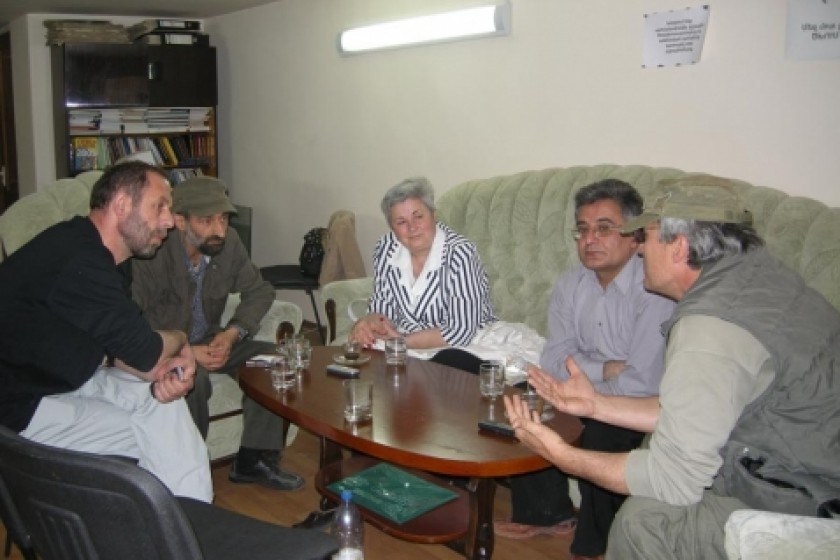
Participating in the third of “Hetq’s” Round Table discussions regarding the current political crisis and possible solutions were Tigran Khzmalyan, film director; Hranush Kharatyan, ethnographer; Hrach Bayadyan, cultural critic; Vardan Djaloyan, cultural critic and Edik Baghdasaryan, “Hetq” Chief Editor.
We ask that our readers participate in these discussions and tell us who they would like to see in future Round Tables.
E. Baghdasaryan - I’d first like to ask all of us to describe the present situation in Armenia. I would evaluate it as a political crisis, but some do not agree. What would you say?
T. Khzmalyan - In my estimation, the first major problem confronting the Armenian society in the past few months is the high level of tension that has manifested. It’s a squabble between on the one hand feudalism and serfdom and on the other capitalism. And a major segment of society that should be naturally inclined to socialist ideals has been left out of the picture. In other words this war isn’t a war of the society. I think that those intellectuals who usually adhere to leftist viewpoints must define this reality and state that what the society needs is a strong socialist set of ideals; I would say a radical leftist theory that can define the real issues confronting the nation (the formation of unions, the issue of the defense of social and human rights, etc). Neither the bureaucracy nor the feudalist system nor capitalism, which are represented by the political actors of today, has even attempted to define these issues. Our major mistake is that we have put off telling the truth and the crisis intensifies at the same time.
H. Bayadyan - I believe that it’s a situation whose extreme manifestation is the direct result of certain political and social phenomena, but these issues have essentially been with us since the collapse of the Soviet Union. The crisis has been with us for quite a long time and Armenian has never been able to broach the matter in any decent manner.
T. Khzmalyan - But who exactly makes up Armenia? Who must define the issues and what is preventing them from doing so? We must all sit down together and formulate the themes involved. There is no other Armenia to speak of.
H. Bayadyan - Of course, in all cases we mustn’t expect anything from the so-called political or party leaders. Essentially it is the intellectuals that must be held accountable in this regard, whether linked to the academe or universities or, in certain cases, or to the margins, that is to say intellectuals not affiliated with those structures. It is a whole other subject to speak about those segments; it’s very complicated in and of itself. To wait for something similar from academic intellectuals is a waste of time. It’s senseless to believe that these issues are ever discussed within any university circles. It is also unrealistic to believe that a handful of intellectuals on the margins can assume to take on such issues and resolve them by themselves, even though on the whole they are better educated and more broadminded than their counterparts in the academic world. Intellectuals don’t have a place in the political system or society in Armenia.
H. Kharatyan - In other words, is the crisis conditioned on the fact that the intelligentsia isn’t self-organized?
H. Bayadyan - Yes, if we were to use your words. I don’t disagree with the evaluation.
H. Kharatyan - It’s my belief that there really is a crisis and I can depict it on a few levels. On the first and deepest level the crisis exists due to a lack of a system of values. We don’t know what those values are that the society can more or less agree to and coalesce around. Since the independence of Armenia our leaders have declared that we are creating a civil society based on a liberal economic model and that our values must be shaped accordingly. However, until today no political system has been formed around such a values system - the economy, social relations, and ideology. The regime itself doesn’t believe in the liberal economic model - an economy where the individual is granted the freedom and possibility to realize his economic potential in the marketplace through competition and to ensure a modicum of prosperity, etc. In our case, it’s the regime that sets the course of the economy, one way or the other. As we speak, state and community lands are being sent to the auction block in the market place, preventing the sale of other lands at market rates.
The regime doesn’t believe in the values implicit in a civil society while it signs a number of international treaties, one after the other, which it doesn’t implement in our daily life. Furthermore, it even hampers their implementation one way or another. In other words, the authorities in the country have adopted a program and course that it generally doesn’t follow itself. Thus, there’s a paradox in the approach within the regime. Society doesn’t know what set of relations it lives in. For example, the regime has told the society that this is a nation where the judicial system holds forth and where members of the society are afforded the possibility to defend their legal rights in court; something of course which isn’t the case. I consider such a paradox to constitute a total crisis. Perhaps the leftist or socialist system of values that Mr. Khzmalyan noted could perhaps serve as a counterbalance to the crisis to a certain degree. But if it is only an ideology that must come up against the civil society centered on a liberal-economic base, then I don’t think that ideology will be able to get us out of the crisis.
I believe that in order to extricate us from the present situation the regime must declare, once and for all, what values it professes to adhere to. Let it be an evil set of values, but at least I’d know what it is and whether I should go along with the regime or not. Currently, there is a contradiction in what the regime says and what it does and I don’t know where I actually stand in all of it. The global crisis is intensifying and it periodically manifests itself in different ways. Let’s say that after every third election a large exodus from the country occurs because people don’t want to reside here given those conditions: they’re looking for other alternatives.
H. Kharatyan - That’s just another variation of how the crisis manifests itself.
V. Djaloyan - If we start looking at things from a distance we must remember that a very good formula existed in the Soviet Union - that the government and the party would provide a modicum of care to the people and in return the people would give up their freedoms. In short, the village mayor would ensure to collect a certain number of votes for a given candidate and in turn the mayor would see to the basic needs of the village. In this manner, such relationships were practically unavoidable in Armenia. In other words, the existence of a system of reciprocal services operated. Today, however, this system is undergoing a grave crisis. A famous Russian institutional economist has labeled this system a “contract of oligarchs” and has shown that in the end it spawns a contradiction within itself.
In other words, it’s the very same contract that we’ve had since 2002. When the economic branches of industry were distributed amongst individuals and where each was granted a position of dominance within the sectors what resulted, of course, was that our economic relations underwent a certain crisis period. I believe that there’s an ideology present with the country today that’s more “domestic and mundane” in nature than philosophical. Berlusconi was the first to come up with this type of system; in fact he devised the slogan “Forward Italy”. It’s a system where famous TV personalities essentially comprise the party and they are the ones who make the party known to the society. The Republican Party here in Armenia is such a TV-driven party in which the main players aren’t Parliamentary Deputies but well-known actors and sportsmen. It’s these individuals who, in reality, represent the party.
At this juncture I also see a political crisis in the fact that we have one dominant party that lacks any political will. This absence of will was clearly made apparent when it called on the services of Tigran Sargsyan, an outsider and a man who is quite far removed from the Republicans both in outlook and ideology.
E. Baghdasaryan - If you ask me, I really don’t see any major difference between Tigran Sargsyan and the Republicans. But I’d like to pose another question. When you talk to the leaders of the regime they will tell you that everything will get better with time. I really think they don’t comprehend the gravity of the situation and that’s why they make such statements. What do you think? Can this government really change anything?
H. Kharatyan - There are two major approaches to economic theory in the world today. Supporters of the World Bank and economists of the IMF conclude that a rise in the GDP of a given nation will result in a rise in the level of overall prosperity as well. However, economic analyses conducted by development researchers at the United Nations have shown that GDP growth doesn’t always lead to a rise in overall prosperity levels. Just the opposite can occur - the social polarization in the country can intensify. I believe that the optimism expressed by the majority of our country’s leaders is conditioned on the hope that the GDP will grow and thus the overall prosperity level will rise as well. In their estimation such a scenario can also serve as a self-regulatory mechanism with which to solve the country’s myriad other problems. I firmly believe that this is an approach leading to a dead-end and that those so inclined do not support their belief with facts or any proof.
E. Baghdasaryan - In other words the regime realizes that a crisis exists in the country and is mulling over what steps to take.
H. Kharatyan - I believe that the regime fully understands that many critical economic and social situations are to be expected down the road, but it remains hopeful that the application of occasional solutions can manage the problem.
T. Khzmalyan - Please allow me to briefly return to the issue of political parties. I’m deeply convinced that in Armenia, and all post-Soviet regions, only one party exists - the Communist Party that has undergone a mutation: a party that in reality has been the regime’s party for the past ten years. In other words, individuals who accept such titles as “Prosperous Armenia”, “Republican” or "Hedinaya Russia” in fact are those individuals inclined to support such a party and wish to stand next to those in power.
E. Baghdasaryan - But it is the same situation the world over.
T. Khzmalyan - No, the entire world isn’t like that since there are other parties in existence. In Armenia there really aren’t any other parties. Both the ARF-D and the Republican Party are fragments of the former Communist Party.
As regards solutions, it seems to me that we’ve undergone a unique experience - the earthquake, the Artsakh War, our survival through the crises of the 1990’s, etc. It’s been an accumulation of a unique social, psychological and physiological experience and I believe that we should be looking for solutions based on that life experience. If you remember how we resolved various critical military transport and supply issues in Armenia and Artsakh you will see it wasn’t done in a systematized manner on the part of the government but rather in a partisan/volunteer manner. That’s to say that certain individuals appeared on the scene that assumed the responsibility to solve those issues and recruited like-minded people to the cause. By using the example of Sardarapat I’d like to claim that the main reason we were victorious there, as opposed to Gharakilisa, was the absence of any strata of leadership. The highest-ranking military officer at Sardarapat was Daniel Bek-Pirumyan, while Silikyan had the foresight not to participate in the battle. The situation was similar in Bash-Aparan where there was the absence of any regular army troops. In fact, the only place with regular army troops wasGharakilisa. During the entire battle a 5000-troop detachment under Andranik remained in Dsegh under order to do so. The troops carried out the next ridiculous order of Nazarbekov and didn’t operate spontaneously or based on popular instinct and thus didn’t gain a victory. While I don’t think that I’m presenting my case in the proper terminology I believe the same thing was repeated in the 1990’s. Of course, I’m not overlooking the major international political currents that collided around Armenia. However, in the end, the people proved to be the major factor; their democratic and volunteer- based actions. Today, the situation is similar and I’m convinced that the solution lies in the same volunteer approach. In other words, the intelligentsia doesn’t know what they are and it has no ideology and probably never will. The intelligentsia, as so defined, will not exist in Armenia for some time to come. There will again be individuals who will proclaim a certain direction to take and they will pay the price to see their ideas realized with their life, their conscience and their moral authority.
E. Baghdasaryan - I don’t agree since we lost western Armenia as a result of that same partisan group action. We have a government and an army. What does stating that we can achieve something through the actions of groups and individuals mean?
T. Khzmalyan - During WWI there were some 200,000-armed Armenian troops. We had political parties and delegates at the time but no government. Right now we have no government. You can’t call what we have today a government.
E. Baghdasaryan - I don’t agree with the situation as described by Tigran.
H. Bayadyan - When we formulate the issue we forget one important point. One of the essential factors for the dead-end situation is that the regime, or those individuals and groups within the regime, have great personal and group interests (business and economic) at stake in the present state of affairs. If they wish to adopt a certain ideal and put it into action they come into conflict with their own personal interests, something that they can never overcome. Thus we can’t state that we have a ruling regime, but rather individual rulers and government personnel, who are said to be thinking about the nation and society.
For continuation see Armenian version.
Comments (1)
Write a comment