 Videos
 Photos


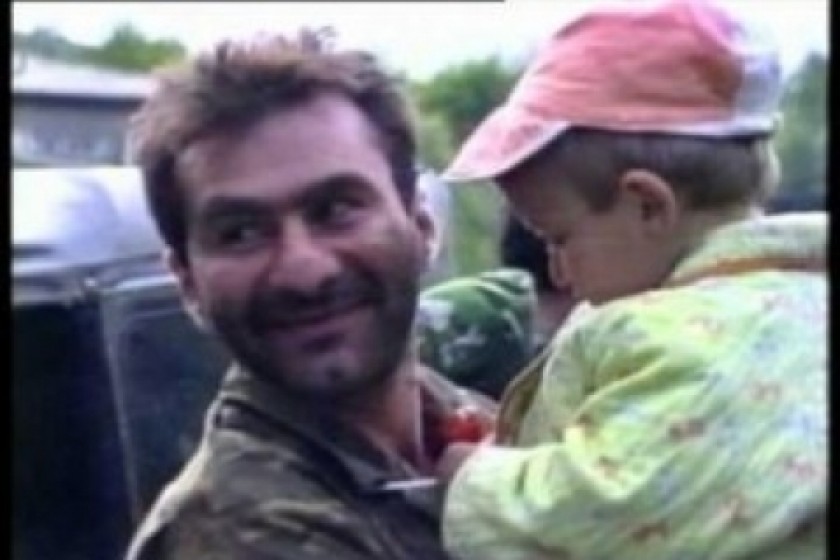
Invincible “Begor” from Artsakh
“If everyone, starting from the army private to the government minister, were to spare no effort in performing their job, all the tasks we undertake would be crowned with success…” These are the words once uttered by Begor, a legendary hero of the Artsakh War and Commander of the First Military Headquarters. For Begor, “patriotism is nothing more than conscientiously fulfilling the responsibilities assigned to you.”
This is the conviction with which Ashot Ghulyan, nicknamed Begor, conducted himself during the Artsakh War years. Everyone who knows at least one excerpt of the war is familiar with this man whose destiny it was to carry a heavy burden of responsibility and to fulfill it all in a short lifespan of 33 years. His widow, Nelly Ghulyan, states, “Ashot’s life was witness to many trials and tribulations. She remembers al the ups and downs during the seven years they spent as husband and wife.
Ashot and Nelly married in 1985, their two families having been friends for many years. One year later their first child, Artur, arrived and in 1989 they were blessed with their second, Hmayak. Sadly, Ashot never got to see his third child who was born in 1993, after Ashot was killed. His mother anointed him with the military name of his father, Begor. Unlike his elder brother, little Begor never got to play with his dad on the family’s living room rug or to wish him success before going into battle. The boy only knows about his father through stories told by his mother, family relatives and friends.
“He loved children a lot. Every time when he’d come home between battles he’d play and joke around with the kids instead of resting up. He’d make it a point to come home before going off to the next battle zone so that the kids could wish him good luck” recounts Nelly, her eyes quickly filling with tears. Armen Danielyan, Ashot’s army buddy, writes in his book, “AS few days after the liberation of Khojalu he went back home for two days. When he returned to the front he told us the games he played with his kids. Ashot worshipped his children and he savored each little expression they made since he rarely got a chance to be with them. Even the most usual of childhood actions was a revelation for Ashot.”
Nelly says that for their family the Artsakh movement began as early as 1987 when signatures for various petitions were secretly being collected. Ashot was one of those involved. Then came the demonstrations but Ashot believed that the matter wouldn’t be resolved by demonstrations alone. From that day onwards he began thinking about obtaining guns. Ashot, who didn’t have a higher education and who had worked as a tailor, in construction, as a locksmith and driver, started to fashion homemade grenades and guns. Nelly says, “He got wounded several times by experimenting with these homemade guns. On the day our second child was born Ashot was laid-up wounded in such a fashion in the Yeghvard Hospital. When he heard the good news he made it all the way back to Karabakh with his hand and neck all bandaged up.” Ashot only stayed in hospitals just long enough for his wounds to heal a bit and then he back off to the front.
Begor fought in a number of battles during the Artsakh War - Askeran, Hadrut, Shahumyan, Krkzhan, Verin Shen, Buzlukh, Manashid, Malibelu, Khojalu, Lesnoy, Qarintak, Shushi, Lachin and several others. His friend, Armen Danielyan, says that as a Commander Ashot was very attentive to the needs of all the men, even to the point of not wanting to send “green” recruits straight into battle arguing that, “I really don’t want to take the risk of putting their lives in danger.”
Armen recounts that, “Before going into battle Ashot would call the men together and explain the task ahead of them. They all were convinced that Begor would return victorious and that he was indeed invincible. The men viewed him as a soldier ready to do anything it took to perform the responsibilities laid upon his shoulders.”
As Nelly puts it, the culmination of the war for Ashot was to realize the liberation of Shushi. “Even at the start of the movement, before the start of military operations, he knew that war was inevitable and that the liberation of Shushi was of vital importance. He was convinced that this goal would be accomplished” she notes. As head of the First Headquarters Begor was the first to enter Shushi in 1992 during the military offensive. They say that on the morning of May 8th at 6:30 Ashot contacted Arkady Ter-Tavevosyan (Commandos) at Central Headquarters by radio and told him to tell the President of the Supreme Council of Karabakh that he was sitting atop the Shushi fortress walls and that he was waiting for his men to climb up to meet him. “In a few minutes we’ll be entering the city” Begor is said to have stated.
Ashot received the military nickname of “Begor” even before the war had started when he and four other guys were transporting weapons from Shahumyan to Stepanakert. Four of the five were all named Ashot. In order to tell one from the other they decided to give themselves nicknames. Ashot, who had already been wounded several times by fragments when fashioning homemade guns was nicknamed “Begor”, which in Armenian means shard or fragment.
On August 24, 1992, Ashot fell during the battle to liberate the village of Drmbon in the Martakert region.
Shaking with emotion Nelly recounts that, “Ashot loved to travel, to see new sights, the sea…During the same month of August he planned to visit Armenian communities in the Diaspora and to study what military techniques and capabilities used in other countries could be integrated into the Karabakh war effort. Sadly, this time the bullet hit home and took his life.”
Hmayak has inherited her father’s love of traveling. She now is studying at the Salonika Military-Medical Academy in Greece. Artur, the eldest son, graduated from the Vazgen Sargsyan Military Institute in Yerevan and is now serving in the Karabakh Defense Army. Begor Junior has jus entered the 10th grade and also wants to enter the building trade.
The wife and children of this Artsakh war hero also have another goal in mind which they’ve spoken openly about for the first time. The family has obtained a plot of land on the street in Shushi named in honor of Begor. There they seek to create a museum to preserve materials and items related to the military service and record of Begor and the men in his Battalion. Nelly is hopeful that others will come to their assistance to realize this project. Someday in the future she also intends to erect a church on the spot where her husband died.
Nelly is certain that her children will carry on with this work if she isn’t able to fulfill all her goals. “The work regarding the museum mustn’t be delayed since there are still men from Begor’s Battalion alive and with unclouded memories of the war” she states.
Years ago, during a respite between battles, Begor told his war buddies, “If we loose Karabakh it will only be because of political games being played. Politics is the most horrific predator around.”
Write a comment