 Videos
 Photos


Imaginal Vision
 Ararat Sargsian
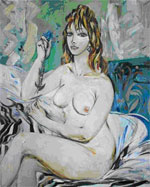
What is, after all, figurative art? The way I see it: this is art that first and foremost represents the human body. What is the body, then? Encyclopaedias may tell us that it constitutes the physical structure of the human being. This includes the head, the neck, the torso and the limbs. The parts are organised in space, they share a common layout, origin and functions. This is the academic approach, but a painter, I think, perceives the body and its image differently from the scholarly and even the routine perception.
In our daily perception we sense qualities: this one’s a good person, and that other a bad one, here’s an obese person, that is a wicked person. A scholar, on the opposite, decomposes the body, performing a kind of mental autopsy. Whereas a painter gets a feeling of the other body, he engages in a modeling exercise, gauges the volume and the composition in their entirety. He acquires awareness of another body through his own. 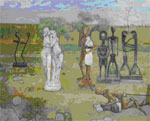 One needs experience to sense the body. It was only after partaking of the forbidden fruit that Adam and Eve developed a feeling of having a body and covered their shame with a fig leaf. One may even claim that this is how the spirit met the body and came to know it. In other words, the spirit sees the body through the feeling of shame. The spirit looks upon the body from the vintage point of immortality, while guilt makes it mortal. There exists another method for feeling and modeling the body, based on sensations of pain and/or pleasure. We all feel pain when a thorn penetrates the epidermis of our finger, and we feel pleasure from a caress. This is our common human experience, more general than the cognizance of the body through shame. In ancient India, for example, the representation of a sexual act was habitual, whereas in modern-day Hinduism it is banned. The sensations of pain and pleasure help us adjust to the environment, the situation at hand. In more general terms they constitute the comprehension of the world through the senses. In nature the human being is reduced to a body that must adjust to the changes in climate; a person feels different while in a palace, and his body seems to be different there as well. In order to represent, or model, the body of a human being sitting in a cafe or cabaret, one needs a method that is different from that required to portray a farmer toiling in the field. This is what reveals the vast innate potential of imaginal art. Abstract art, in contrast, addresses only the immortal, which is why it has no movement or dynamics.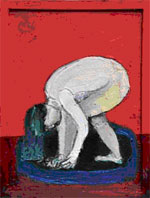
As taught by the legend about Gautama Buddha, man recognises his mortality through pain and pleasure. It is for this very reason that figurative art is not anchored to the model of a perfect body. The human body may be endlessly deformed in figurative art, but we invariably recognize it, over and over again, through our common experience of pain and pleasure. In this respect Picasso’s Demoiselles D’Avignon represented a breakthrough development in figurative art in 1907. This is because what we see, however peculiar the first time, is recognised by us thereafter, and that remains irreversible. Which means that seeing, recognising a figure relates to our visual experience, which is never the same as it was the day before. Our visual experience differs at every point in time, which is why figurative art is the only one that can be contemporary, it expresses the spirit of modernity. Looking back at the figurative art of the past we understand the the human experience of the period in question, the spirit of the age. Contemporary man feels the body differently, hence modern figurative art should differ from the figurative art of the past. Contemporary man ostensibly possess several bodies, up to and including a virtual one, and contemporary figurative art needs multiple ways to represent it. We often come across mirrors in many Renaissance and Baroque paintings. That particular object had a great significance in the process of cognizance of the body by man. For contemporary mankind the photographed or filmed body, that may be observed on screen, has larger implications. I believe this may be the reason why video enjoys such a preponderant place in modern art. 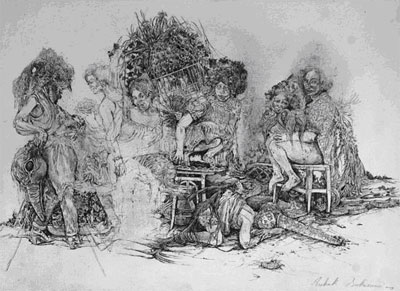 Figurative art is not only contemporary, it is also tied to a location. Armenian imaginal art can not resemble the imaginal art of other countries, since it expresses the bodily experience that is unique to us, our own way of sensing the reality. This Exhibition of ours is presenting visions of the human body in the broadest scope possible, from the classical Armenian fine arts to its avantgarde.
Armenian-English translation by Artashes Emin
Write a comment