 Videos
 Photos


I Know That One Day the World Will Condemn the Genocide
Ani Gasparyan
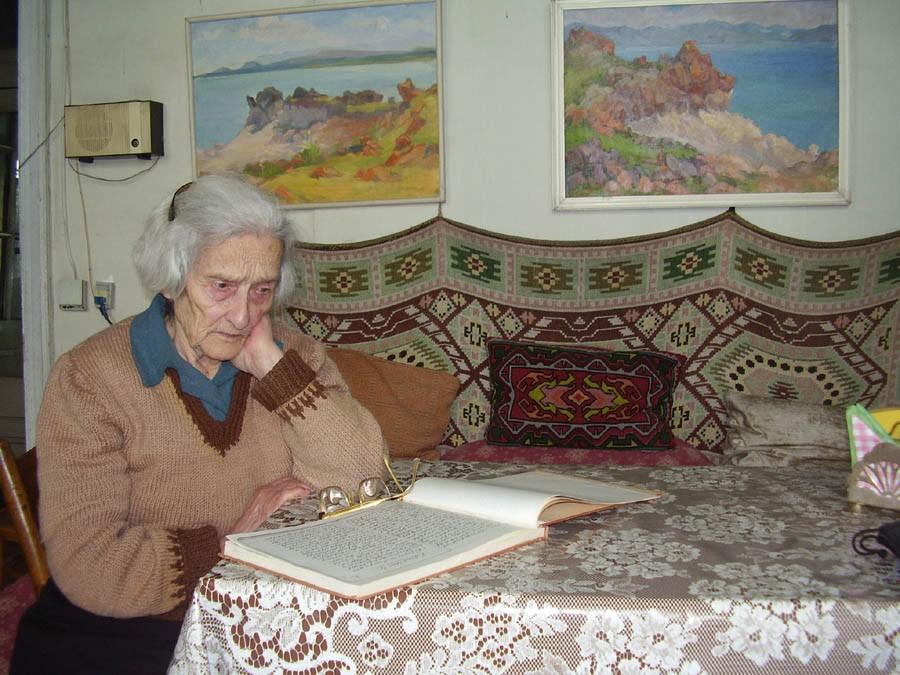
Painter Heghine Abrahamyan is a Genocide survivor.
She is 95 years old, born in Kars. Heghine was a witness to the deportation of Armenians from Ardahan andKars. In 1921, when Heghine was eight years old, her family leftKarsforever, emigrating to Gyumri, and then toYerevan.
“I was three years old when my family was deported for the first time. At the time we were living in Ardahan. My father worked in the military. He was assigned to work as military supplier inYerevan. My father took us with him toYerevan. We rented a house in the area of the current Opera House. Back then, it was an empty place with few houses and gardens. I remember once the neighbor's daughter and I were eating apricots in one of those gardens. My hands got dirty. I wanted to kneel down and wash them in the river, but fell into the river instead. The river took me. I was saved by our landlord's son. In 1918 my mother died and our aunts took me and my brother toKars,” Heghine recounted
Heghine enrolled in the girls' school inKars. But in November 1920,Karswas again attacked by the Turks. “The Turks did not allow Armenians to leave the city. But, my father, as a serviceman in the Russian Army, was given a van so that we could take our belongings and leave. My aunt went to the train station to pack our things. All of a sudden she came back and told us that the Turks had taken the station, and that the train had departed with our things in it. It was the second time since Ardahan that we lost our belongings.”
“At the time my father wasn't with us; maybe he was at the military base. We got into a car and hurried to the canyon road, so we could escape. The canyon was full of frightened people. Everyone was fleeing—some on foot, others with horses, carts, whichever way. After a while, the road was so full of people that it was impossible to move forward. Our car stopped. At that time, the Turks noticed that it was a good excuse to slaughter people; they took positions on either side of the canyon and started shooting people. When I saw the first dead, the scene was unbearable, and I probably lost consciousness. When I woke up, our van was empty, and my relatives had left, leaving me alone. Under the van a Kurdish woman was hiding with a child in her arms. Next to me was lying my uncle's four-year-old daughter, with her hips and pelvis broken. She bled to death before my eyes. The Kurdish woman took me and we walked on together, hoping to find my relatives.
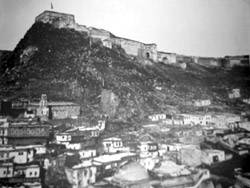 “There was a bridge over the canyon. The locals called it theHairBridge, because it was narrow and not many people could use it at the same time. People had to cross this shaky bridge. The Turks were shooting from the other side, and it was impossible to cross back because of the crowd behind. People were falling into the river; the river was red with blood. In front of me was a man with a big bag on his back. All of a sudden he collapsed from exhaustion. I don't know how I passed him—maybe I walked over him—but I found myself on the other side. I was looking for someone I knew when suddenly the earth underneath me exploded. The Turks were shooting. A man came up to me and hid me in his uniform and started to run. I was hitting him and kicking him, trying to escape. I didn't realize he was my savior. Then he reached a half-ruined building and threw me inside through a broken window.
“In the rooms inside there were groups of people, wounded, with torn clothing. I found my family among them. After some time the gunfire stopped and we found that theKarsroad was open. We returned to the town, leaving in that cursed canyon the bodies of my grandmother and my uncle's daughter.”
In the spring of 1921, the children living in the orphanage were transported by railroad toLeninakan. Heghine and her brother were among them. “The Kars-Leninakan road is not long, but I had the feeling that we were going and going but not getting anywhere. We were loaded like cattle into train compartments, which were locked from outside. There was an epidemic inside. I don't remember, but my aunt told me later that the bodies of dead children had been thrown from the windows so the epidemic wouldn't spread,” Heghine said.
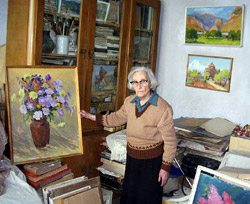 After living in Gyumri for some time, they moved toYerevan. Heghine went to school and discovered a lifelong interest in painting. She went to a local art school, and then toLeningradto continue her studies at theLeningrad'sAcademyofArts.
When she returned toYerevan, Heghine Abrahamyan went to work at thePhanosTerlemezyanSchool, where she taught art for thirty years, passing her knowledge and experience on to her students, among whom were the painters Grigor Khanjyan, Onik Minasyan, Levon Kojoyan, Rafayel Atoyan, and others.
Even today at almost 100-year-old Heghine continues to paint. She has many unfinished pieces, which she has to complete. There is one pain that lingers on– her longing for her lost homeland.
“I know that one day the world will condemn the Genocide, ” Heghine Abrahamyan said. “Europe must know the Turks and their devious politics, because if Turks enter European Union with the weight of the Armenian Genocide weight on their shoulders, they will soon destroyEurope, too. “
Comments (1)
Write a comment