 Videos
 Photos


They Have Homes, But No Jobs
Today Goharik and Albert have guests; their friends have come over. They’ve come together to find a solution. They want to take a loan from a bank, start a business so that they can take care of their families. Ruben, one of their guests, is 60 years old; his wife Gohar has a second-degree disability and receives an 8,000-dram pension. “You go to market once, and the pension is spent,” she said. They don't have jobs, and survive off what ever they manage to earn. “Our kids have long since forgotten what meat is. We don't even have it on New Year’s Eve,” says Ruben, disgruntled. There are many families who live like his in Spitak. They have homes, but no jobs.
Near the entrance to Spitak, on the cemetery hill, is a small church haphazardly built out of from zinc plates. It is the symbol of the town. Seventeen years ago the victims of the terrible disaster were buried here.
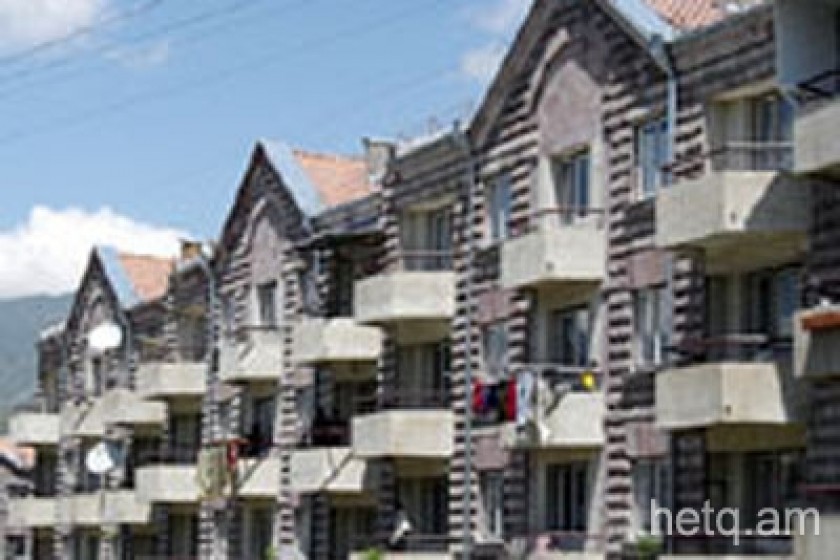
New three and four story buildings are neatly placed shoulder to shoulder. Looking at them, you might think you’re in a Western European city. But the luxurious appearance is deceiving. The living standards in Spitak are very low. To find a job, people leave for other Armenian cities or for Russia. Vahan Khachatryan, the head of Spitak's construction department, tells us that in the last two to three years many have left for Yerevan, where a construction boom is currently underway. They earn money there and help their families here in Spitak.
Our friends Goharik and Albert do not have that opportunity. They live in the center of Spitak, on the first floor of one of the new buildings. They have three children, all of whom are in school. Goharik is Albert's second wife. His first wife died during the earthquake, along with their two children. The couple married one year after the disaster and went to Russia. They stayed there for ten years. In that time, their turn came for the new housing, and they returned to Spitak to take possession of their new apartment. The three-room apartment has a modest interior. There is an old bed in a corner of the room for guests. Next to it stands a homemade cabinet. By the window is an ancient sewing machine, which serves as the main source of income for the family.
Albert works at home sewing linens. “People have no money to order things and pay me. Even though it doesn't cost that much. One sheet for instance is 500 drams,” he said.
Goharik says that many families in Spitak live like hers. Only those who have started their own businesses, such as shops, live well. “If there was a chance I would leave forever,” said Gohar, pulling her eight-month-old daughter closer. “There are no jobs here. We live on a pension for our children (15,000), and on whatever little money my husband makes.”
Vahan Asatryan, the mayor of Spitak, says that the unemployment rate is now at 60%. There is a textile factory in the town that employs 120 people. By an agreement with investors, a bakery is being built, which will produce bread and pastry. At least 100 people will start working there in October.
Investors are also setting up a poultry farm, which according to the mayor, will provide 160 workplaces. “Italians are building a cattle farm. For some time the construction was halted. But now the work has resumed. That means an additional 100 people will have work. We are doing everything to find jobs for people,” the mayor said.
Despite these positive developments, the absence of housing and high unemployment are still major problems in Spitak.
This year the government has not provided any financing for the construction of new buildings. “We're waiting for additional subsidies,” said Vahan Khachatryan. It is hard to say how long Spitak’s residents will have to wait for a place to live, but according to Khachatryan, if they receive sufficient funding, they can solve the problem in a year. There is no lack of labor in this field, since after the earthquake everyone in Spitak became a construction worker.
Before the earthquake, there were more than 5,600 families in Spitak. Half of them lived in government apartments. That number is being restored. “We have 307 families in line to receive apartments. Regarding the private sector, we decided to do the following. Whoever received compensation and did not spend it will be first in line. As soon as we get financing, we'll start building for them too. I am talking about 1,000 families,“ said Vahan Khachatryan. He noted that those who spent the compensation money (there are about 1,500 of them, mostly living in trailers) would have to wait for better times.
In the outskirts of the city, Knarik, a middle-aged woman is working a plot of land next to the trailers. Her family consists of four people. Her older daughter is working in Yerevan. “She lives with my relatives. She makes her living, and sometimes helps us too,” Knarik said with pride. Gagik, Knarik's husband, works as a driver for a communal farm. He makes 30,000 dram a month. Knarik keeps house, and grows cabbages and potatoes. “It's OK, we get by. It's too bad we’ve got no roof over our heads.”
Knarik’s friend Siramarg lives in next trailer with her grandson and his wife. Siramarg's husband and son are in Russia now. "My husband hasn't been in Spitak for over nine years now. He took the compensation money out of the bank account and went to make money. I haven’t heard from him since,” she said. Her son sends money regularly, though. Siramarg has been unemployed for several years now. Before that, worked in a textile factory for thirty years. “Now I can't even find a job as a cleaning woman,” she complained.
Vahan Khachatryan explained, “ From day one we said we don't need help; give us jobs, and people will work and help themselves.”
Roland Jojua
Photograph by Karin Grigoryan
Caucasus Media Institute
Write a comment