 Videos
 Photos


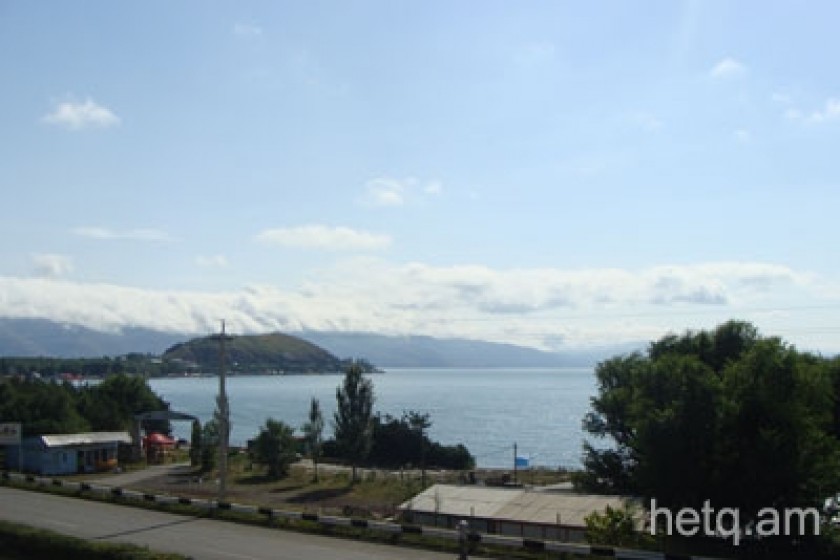
A critical moment for Lake Sevan
Karine Danielyan
The six-meter increase in the water level is not based on science
Lake Sevan was once a reservoir of water fit for drinking, according to physical, chemical, and biological indices. But today, as a result of the intensive exploitation of the lake over the years, its ecological system has been disturbed, with falling water level and resultant swamping bringing about qualitative changes, and the state of its native fish life, the most sensitive index of the health of the lake, has changed. There used to be three kinds of fish native to Sevan - ishkhan (trout), koghak (carp) and beghlu (barbus).
Beghlu is a species peculiar to Lake Sevan . It has never had any economic significance, much less so today. The quantity of Koghak has decreased catastrophically as well, to the point where scientists plan to declare it an endangered species. Of the four types of Ishkhan, two used to spawn in the lake, and two in the rivers. Two of these have disappeared, since their spawning grounds have vanished as the water level has fallen, and the other two are on the verge of extinction.
Today only two kinds of fish of industrial significance remain in Sevan - Sig (whitefish) and lake sazan .
Four years ago a project to restore Lake Gilli , in the southeast of the Sevan basin, was launched, and it was expected to play a vital role in saving the Sevan eco-system. Lake Gilli had dried up as a result of the drop in Sevan's water level. Since then, 110 kinds of birds have disappeared from the basin, and the republic as a whole has been deprived of 35 kinds of birds.
The Gilli project failed, and it is not clear yet what the fate of a second project, recently started with an impressive initial investment of $1 million, will be.
The most striking evidence of the government's mishandling of the Sevan problem is the complete absence of purifying stations on the lake. But even if they were in operation, they would have trouble preventing the damage to Sevan caused by agriculture. Irrigation is not the only problem. The inability of villagers to utilize fertilizers correctly contributes to the free flow of nitrates and phosphates into the lake, the majority of which come from industrial and household wastewater. Twice in the past, a decision was made to build in a purification station in Gavar. Both times, the decisions were reversed and new enterprises were built.
Delays in putting the Vorotan River-Arpa River hydro-system into operation have played a role as well. It has come to light through the 2002 annual report of the Ministry of Ecology that although 1.4 billion drams (about $2.7 million) was allocated for the construction of a tunnel, no work was carried out.
There is another factor threatening the stability of the level of Sevan which is beyond human control, the negative impact of evaporation on the water level over the past few years. The volume of water lost through evaporation has been greater than the volume of water flowing into the lake. And although there has been heavy rainfall in the last two years, scientists predict that in connection with global warming, evaporation will increase in the future. Some even hold the pessimistic view that no matter what is done, the lake will eventually evaporate completely.
But at least this year, unprecedentedly abundant rains have helped revive the beautiful mountainous lake. Today, Sevan seems to be waking up, its dead green color gradually turning healthy and vivid. It is expected that when the Vorotan - Arpa hydro-system goes into operation, 165 million cubic meters of water will flow into Sevan each year. This will be a miracle cure for the lake, now at death's door. The Law on Sevan stipulates that the level of the lake must rise by six meters. Compared to 2000-2001, the water level has already gone up one meter and seventeen centimeters.
But a real battle has begun between ecologists and the government over goals for the lake. Scientists say that emphasizing the six-meter mark not only is unfounded scientifically, but also might have very dangerous consequences for the lake. The chairman of the NGO For Sustainable Human Development ,Karine Danielyan, explains, "The ecological system of the lake will become healthier if the lake water returns to its level in the nineteen-sixties, i.e. 1,908.5 meters, when the processes of decline had not yet begun and the lake was in its natural, balanced state. That's the only way that the water quality will improve, the flora and fauna will revive, and it will become possible to talk about saving Sevan."
"This six meters won't do anything for the lake," says the deputy-director of the Institute of Hydro-ecology and Pisciculture of the Academy of Science , Bartugh Gabrielyan. "Maybe it will hold up the swamping process, but it will not improve the water quality, and Sevan's most important problem is water quality. People were talking about six meters at a time when the lake's water level had fallen by eighteen meters. Since then the water level has kept falling, up to twenty to twenty-two meters, but now the same figure is being mentioned again. "
Minister of Ecology Vardan Aivazyan says that the figure of six meters appeared as a result of a study by experts from the World Bank. The real story is somewhat different. At one time, the Institute of Hydrology of the Academy of Science of Armenia , together with institutes in Moscow and Rostov ( Russia ), developed a mathematical model to find out what would happen in the lake after the water level increased, and what level would be necessary to return the water quality to its previous grade. The mark of six meters was found as a result of applying this model. Accepting these dated findings, without taking the trouble to do new research or ask the opinion of local scientists regarding the current situation, international experts merely reiterated the six-meter mark. The fact that the ecological system of the lake has changed for the worse, with new problems raising their heads, has been completely ignored.
The reason that the government doesn't want to consider raising the level of the lake by more than six meters may simply be that a rising water level will become a real threat to dozens of lakeside vacation houses owned by the nouveaux riches with positions and connections. Waves are lapping at the walls of Gagik Tsarukyan's lakeside "cottage", and dozens of other buildings are already under water. So today, stubborn attempts are being made to reduce even the six-meter mark. The marzpet (governor) of Gegharkiunik, Stepan Barsegyan, says he receives unofficial instructions that the water level should not go up by more than four meters. The director of Sevan National Park , Gagik Martirosyan, employs doubtful arguments to suggest that an increase of even by one meter would be enough for Sevan. This could mean that the quantity of water entering the lake will be controlled, in order to protect the owners of lakeside buildings.
There are 350-400 structures along the coast today, owned by both individuals and organizations, the majority of them illegal. The government will not compensate the owners of illegal constructions if they go under water. But the government will have problems with the landlords whose houses were built with permits from town-planning authorities. These landlords are understandably furious, since none of the local officials or ministers dropped a hint about the water level increase as they handed out these permits. But the strange thing is that construction work is still going on all around the lake, even though local officials now warn builders that their projects might one day be under water.
The fifteen to twenty hectares of lakeside forests that have been planted over the last fourteen years will be absorbed into the lake as well, a sad but unavoidable loss.
Today for the first time in years, there is a real possibility that the lake will be saved. The Vorotan - Arpa hydro-system, the twenty-eight rivers that flow into the lake, and the reconstruction of the Yeghvard Reservoir all hold real promise for Sevan. The unprecedentedly heavy precipitation of the last few years was an unexpected gift. Some ecologists believe that even without the hydro-systems Sevan may come back from the brink of death. If, of course, its salvation is not sacrificed to the interests of the oligarchs.
It's a critical time for Lake Sevan once again. The general public has been deprived of information about what has been going on around Sevan. It has been deprived of the right to participate in deliberations over the fate of the lake that plays such an important role in the life of generations to come. Perhaps this is because both our government and our society are lacking in environmental awareness. People sit by silently, uninformed, as their rights and interests are threatened.
Comments (5)
Write a comment