 Videos
 Photos


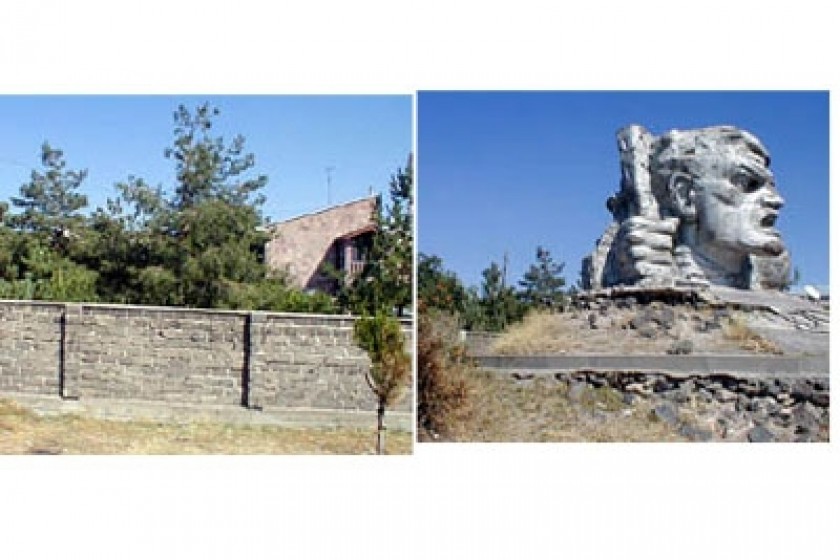
Fir-trees planted in memory of fallen heroes now adorn an official's dacha
Lusine Budaghyan
The fir-trees behind the fence in this photograph were planted in Soviet times, in memory of the forty-one citizens of Ptghni who gave their lives on the battlefields of World War II.
Today, their symbolism forgotten, they decorate the summerhouse of Anatoly Avagyan, head of the Service of Obligatory Execution of Writs of the Ministry of Justice.
The village of Ptghni, two kilometers outside of Yerevan, is a popular spot for dachas. Its World War II memorial, battered by sun and rain over the years, is now surrounded by piles of garbage swarming with rats.
As we walked through the grounds of the memorial, seventy-five-year-old Ilya Poghosyan told us that after the war, a fir-tree was planted in the memory of every villager killed in action. One of these soldiers was Ilya's older brother. His tree, along with all the others, now belongs to Avagyan, or Tolik, as he is referred to here.
The villagers described how Tolik had gotten the OK from the mayor of the village, Arakel Virabyan, and then, "in addition to the fir-trees, privatized the entire grounds of the monument and only relinquished part of the land he had seized after families of the dead rebelled against the mayor's decision."
In response to their protests, Virabyan told the villagers that the land had never formally been allocated for the monument, and thus it was officially ownerless. And now what remains of the former park has been left to the mercy of fate - un-watered, its concrete stairs crumbling, surrounded only by thorn-bushes and thistles.
People in Ptghni believe that the authorities' have neglected the memorial on purpose, because it will give them the excuse to build something else there in the future. The villagers' explanation makes sense, since its location is perfect for a country house.
According to Ilya Poghosyan, the grounds of the memorial are not the only public property that the head of the Service of Obligatory Execution of Writs has seized. "Some five or six years ago Tolik asked me to let him develop land adjacent to the well and reservoir, and plant a garden there, next to the restaurant he owned. Some other villagers and I had dug the well, and seven or eight families irrigated their fields with the water from this pond," he explained.
"I gave him my permission. But Tolik shut off the wellspring and buried the pond, leaving us without water. My garden is drying up before my very eyes, and the mayor says it's all in accordance with the law. What law is it that says that a public well can be privatized?"
Ilya Poghosyan went to the prosecutor's office in the Kotayk Marz, demanding that the well and reservoir be restored, and was referred to the Kotayk Court of First Instance. Avagyan's restaurant has a new owner now. But according to Poghosyan, "He can't do anything because when he bought the restaurant he didn't know that there was a well buried in this territory."
Write a comment