 Videos
 Photos


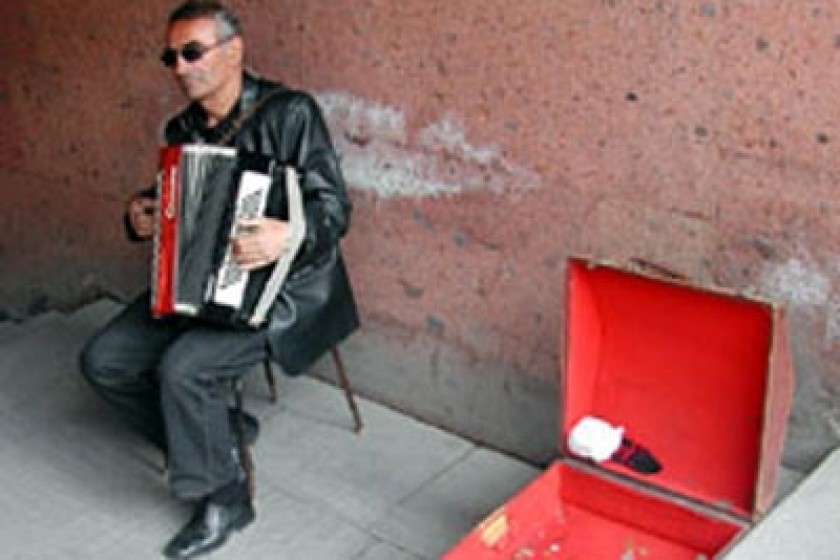
"Would you like me to sing?"
Lusine Balyan
"I'm not a beggar, to be treated badly. Nobody looks at me like that; I wouldn't even want to think that someone might take my work the wrong way. I'll give you an example: two plants are growing in the same conditions. They get equal warmth, light, humidity, and so on, but there is one difference: one of them is growing accompanied by music. Experiments show that that plant is much more luxuriant and grows much more quickly. The animal world likes music too. Everything reaches toward music; there is something divine in it. Just imagine how depraved someone would be if he didn't like music."
Fifty-five year old Kajik Hayrapetyan is one our city's wandering musicians. He is easy to distinguish from the others, with his repertoire of strictly Armenian folk songs and troubadour ballads.
"My intention is not to make money. I want Armenian songs to be heard the way they should sound. My heart just cries when our young people are so far away from literature and books. I feel bad when our young people listen to Persian, Arabic, and Turkish music instead of our own. In contrast, foreigners go crazy when they listen to our Sayat-Nova. They don't mind taking money out of their pockets; they give it to me and ask me to sing again and again. Yesterday a young man came up. I was singing Sheram; he stood there listening for more than an hour. Then he came up to me and asked if it was a new composition, and I joked saying it was one of the latest songs. Then I saw his curiosity was sincere, and I told him it was Sheram."
Kajik Hayrapetyan is from Kapan. He lives alone in Yerevan , though he thinks about bringing his family here. "My son died when he was thirteen. He was a very talented boy. After him, the world became all the same to me, everything lost its sense. I couldn't have my child reach his goal. I want to do something myself, to spread Armenian songs so that the national music doesn't sound foreign to the Armenian youth. They might not go to concerts, but they can somehow become listeners on the street."
The work he has done is very important to Kajik Hayrapetyan. Though he is his own boss, he has a clear time schedule and does not work outside of its limits. "You should not sing early in the morning: it is not good for your voice, nor is it pleasant for the passers-by. The best time is in the afternoon from 2 to 5. I meet people with different moods and tempers, but mostly the people of our city are very kind. They all value my art; I have a big audience. Maybe some people think it's an easy job but I think it's a responsible one. I work and my job has an aim, and some people appreciate the work I do with money."
We were not the first ones to ask Kajik Hayrapetyan whether he had a musical education. He plays a couple of instruments and can even orchestrate compositions, but he has no formal training, and cannot read music."I was schoolboy when my father bought my sister an accordion. When the instrument appeared in the house I was captivated by it. I would secretly open it, look at it and study it. My mother saw me once and told me it wasn't mine, it was Larissa's. But I couldn't get the instrument out of my mind. They kept telling me I couldn't play because I hadn't learned how and that I'd harm it. Once they saw me playing in secret and they saw that I was playing well. But it was my ill fortune that I learned to play in secret and I kept it a secret. My desire to get a musical education and my dream of becoming a musician remained a secret to everybody. I can't work in the field of music because of not having the proper education."
Like every artist, Kajik Hayrapetyan has his favorite venues. He says the choice is connected with some professional issues. "I like singing at the Vernissage. Diasporans and foreigners listen with great interest, but now they don't let me sing there, either. When I need to save my voice I sing in the passageways of the metro; there is a resonance there: your voice can be heard even if you're not singing loudly."
As we spoke, the wandering musician mentioned several times that he had put together a choir to sing troubadour ballads in Yerevan, and that they were getting ready to give concerts. When we tried to learn a little bit more about the choir we realized that it was a product Kajik Hayrapetyan's grieving mind, his unreal life.
Write a comment