 Videos
 Photos


Obliteration of Historical Memory
Metakse Petrosyan
“Presenting sites of interest in Yerevan means presenting Armenian architecture at the same time, which we try to do in our tours of the city. Unfortunately, not much of old Yerevan exists anymore. There are only a few buildings left along Abovyan and Alaverdyan Streets which are worth stopping by and talking about to tourists,” said Davit Khachiyan, head of Levon Travel’s department of tourism. “The new buildings don’t really impress tourists. Yerevan is a unique city, with 19 th and 20 th century architecture, and that’s what’s fascinating for tourists. They are more interested in what they can’t see at home.”
For a decade now, our government has declared tourism to be one of the main branches of development. With the same goal in mind, other countries make major budget appropriations for the maintenance, restoration and renovation of their historical and cultural monuments and the areas surrounding them. Not only do they protect and promote their own treasures, they also enrich their collections by purchasing valuable and unique objects from other countries that depict their own history and culture. Internationally, there is much evidence to suggest that the investment pays off - it stimulates tourists’ interest and encourages repeat visits, benefiting both investors and the government in the process.
 “The primary component of each and every people’s identity is its memory, particularly its historical memory. Especially today, on the 90 th anniversary of the Genocide, we remember our elders' stories of the apples of Artamet, of Lake Van , of the monuments of Ani - essentially, the memory of our lost homeland. That is part of our identity. Today, the term Armenian is synonymous with a people who have survived genocide as well as a people who have lost the tangible wealth of their memory. Currently, our leaders are eradicating the tangible components of our identity - the architecture of downtown Yerevan,” said ethnographer and expert in historical memory, Harutyun Marutyan, of the construction fever that has gripped the center of the city over the last few years.
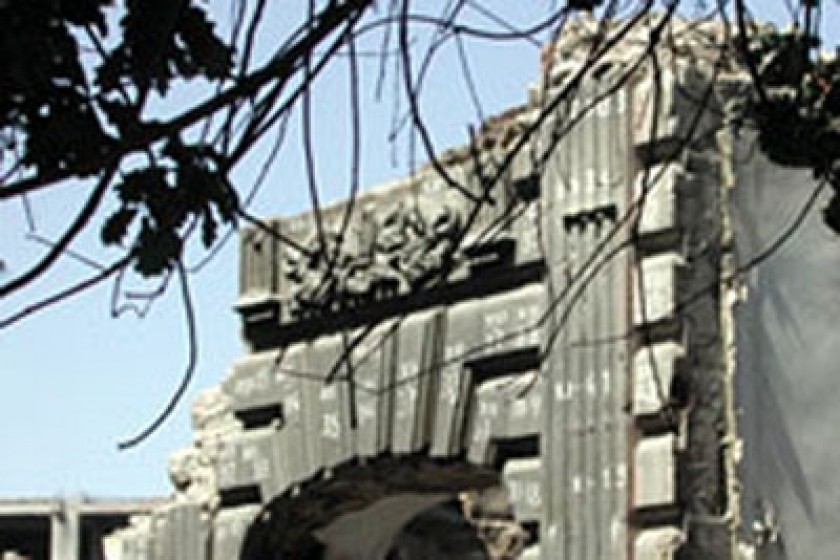
What began under the auspices of creating Hyusisayin Poghota ( Northern Avenue ) in 2000 turned into a construction craze that has reduced Yerevan 's historical and cultural monuments to ruins. Some of the preliminary documentation needed to authorize this demolition, however, had been initiated far in advance. In 1991, a mayoral order launched a new plan identifying Yerevan ’s historical and cultural monuments. Until then, the nation had been operating under the premises of the 1983 resolution passed during the Soviet regime, according to which there were 197 structures on the list of Yerevan monuments. The new plan increased this number greatly. In 2000, Mayor Albert Bazeyan, declared this plan to be ineffective and brought the 1983 decision back into force. And so began the “aggressive construction”, as described by Karen Ayvazyan, Head of the Yerevan Regional Department of the Agency for the Protection of Historical and Cultural Monuments, which works within the Ministry of Culture and Youth Affairs, immediately adding, “I do not mean that in a bad way.” The list of monuments established during the Soviet regime was designed to predominantly include churches and their surrounding areas, khachkars or cross-stones, and other various important structures like the Academic Theater of the Opera and Ballet with its adjacent territories, Republic Square and so on. Thus, their number was more limited compared to the new plan, which is why the previous order was preferred in order to work more freely.
In the city's Pokr Kentron (small center), more specifically when construction of Northern Avenue began, the municipality started to sign contracts for the sale of lots; however, there was no mention of historical buildings within the contract because at the time there had yet to be a governmental decision recognizing those buildings as monuments. It was only in 2004, after the controversy surrounding the issue - the complaints of inhabitants, various declarations by intellectuals, and the coverage of the press - that a committee was formed to determine the fate of the few remaining monuments. The expert committee formed by the Ministry of Culture included employees of both the agency and the office of the mayor - architects, historians, archeologists and ethnographers.
“The committee had the right to an advisory role; the decisions it adopted needed to be ratified by the agency and then the government,” noted Marutyan, who was also a member of the committee. Ultimately, the decision was adopted to preserve 14 historical buildings in the area; however, due to the fact that votes by government architects in the committee formed a majority, it was decided that they would be taken apart and relocated. Thus, they ignored the opinion of those independent experts, who found that a monument as such is perceived along with its historical surroundings and preserving it by taking it apart and relocating it makes it lose its value and significance, the characteristics of the technology of its period of construction, and even its architectural design. Government officials stuck to their justification - the city needs to grow and develop and a new capital is being built for a new country.
Buildings suddenly disappear
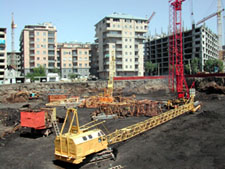 “Tamanyan’s concept of Northern Avenue has been defiled. They only pursued a profit, and wanted to make money immediately,” said Marutyan. The construction of Northern Avenue aimed at creating an administrative center complete with every modern convenience, as well as a commercial and business area which would be yet another way to attract the interest of foreign and Diasporan investors to Armenia. However, among similar European commercial centers, we are hard pressed to find one with such large-scale residential construction, or whose construction comes at the price of wiping out the city’s history. Furthermore, similar centers are usually built in empty landmasses, and lead to new commercial and business structures developing around them - thus stimulating the city’s growth.
“During the time period between 2000 and 2004,” continued Ayvazyan, “we were unable to properly protect them, but we have always urged that the historical buildings in the area form a part of the future avenue.”
The search for a solution involved the government, the office of the mayor as well as the municipality. The agency employee noted that the old buildings that were on the territory of the avenue would not directly interfere with its construction and so, it would have been possible to take them apart and relocate them along the avenue. However, citing extra cost, neither the office of the mayor nor the architects chose this path. They kept justifying themselves saying that the historical buildings do not correspond to the scale of those on Northern Avenue, they are out of place, better locations can be found for them and so on.
As a result, buildings, which had been standing undisturbed for a century, suddenly disappeared from their historical locations. And our most able state officials decided to “put them in their proper place, ” wherever they deemed a “familiar and fascinating” surrounding to be. An earlier plan had these 14 buildings being relocated to a section from Aram Street to Koghbatsi Street , where it intersects Northern Avenue . This is how our contemporary architects, claiming to follow the footsteps of greats such as Tumanyan, Bunyatyan and Mehrabyan seek to establish themselves in the history of Armenian architecture. History, indeed, is not fickle - it speaks of both Davit the Builder and Nero's fiery destruction of Rome.
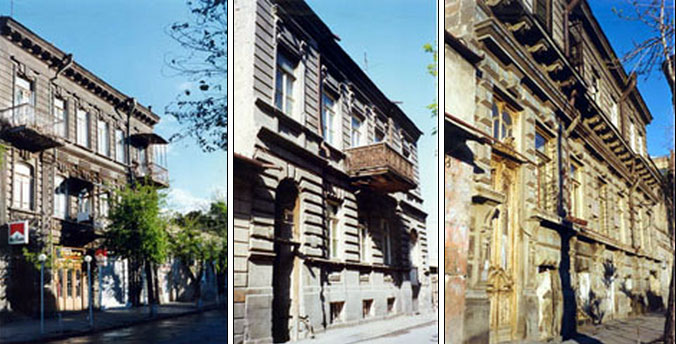
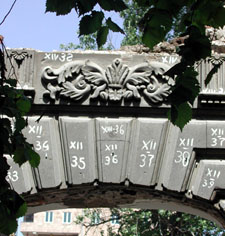
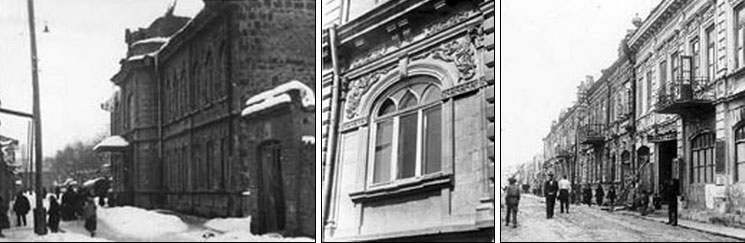
But how can one make sense what is being done with Abovyan Street ’s building 1/4? This building did not impede the avenue's construction neither through its location nor for any other reason, yet it has fallen to the same fate as the buildings found on Koghbatsi, Byuzand, Pushkin, Amiryan, Aram and Teryan Streets. The expert committee had decided to accept the preservation of this building on its current site, which Ayvazyan also confirmed. He said that the December 7, 2004 government decision number 16/16 ordered the inclusion of this building in the updated list of recognized monuments. But when it had been excluded for “technical” reasons, he emphasized that he brought up the oversight within a week of the list's publication, and it was reinstated. But, for some reason, its interior walls were brought down almost a month ago, and now its exterior wall is being taken apart (probably before relocation, although it might be undergoing final demolition). Even government decreed decisions are ignored by the builders. Or what explanation can be given to the section on Aram Street that runs from the Charents House Museum to Saryan Street ? It is not related to the construction of the avenue either. Yet, the “Eurohome” builders have not spared it. Someone has already managed to erect an unattractive high-rise building there, whose architectural and structural design does not correspond to the historical environment which the poet lived in, on what was once a charming section of a historically significant street. Until recently, one could still see single or double-story houses from the beginning of the previous century here, with wooden fences linked by arches, which had become a favorite promenade for both locals and tourists. But what has the modern architect done? He has constructed a building in contrast to the street, without taking into consideration either the construction material or the color combination of the surrounding region. The original structures had been built with black tufa, yet this newcomer stands awkwardly like a white crow, as if using its height to establish its place in the neighborhood.
According to Ayvazyan’s assertions, the only historical building in that region was number 62, which in fact is not included in the list of monuments to be relocated and has already been demolished. The list includes number 74, but this building is yet to be numbered, while this should have been carried out a long time ago. Meanwhile, a 2004 general preservation list recognized the buildings numbered 62, 64, 68, 70, 72, 74, 80 and 86 - essentially the street’s entirety - as monuments. The law stipulates that the area adjacent to a monument, which constitutes its historical environment, is also part of the zone of preservation. “Recently, when we were wandering around Aram Street , we came across a newly-constructed building and searched for its entrance, but could not find it for the longest time. We later discovered that it was going to be in place of the neighboring house,” said Marutyan, adding, “This is the politics of the day - to give little notice and eliminate the neighbor as well."
The section between the Charents House Museum and the high-rise building is already being demolished. The historical buildings found on Byuzand Street are also in the same situation. Of 16 buildings included in the list through a 1987 decision, only 10 remained after a review in 2004, and, of these, only 6 have been included in the list of buildings to be relocated. The fate of the rest is more than clear. The committee’s independent experts informed us that even though the subcommittee managing the newly recognized monuments in the area decided in January this year to include them in their protection list, the government has not ratified this measure to this day.
Laws which are never enforced
According to article 21 of the law “regarding the protection and use of the immobile historical and cultural monuments and historical surroundings in the Republic of Armenia ,” the demolition of a monument is prohibited, and relocation is allowed only in rare circumstances, with the permission of the central government, regardless of whether the monument is of national or local significance. What are the rare circumstances that could allow for such exceptional treatment of a monument? Ayvazyan answered this question as follows, “An issue of vital importance for the city, for example, installing a water-pipe or something like that.” Do any of these constructions pretend to be the solution to such vital issues? No. In general, the impression left by the employees of the agency is that they are acting as intermediaries rather than dealing with the protection of monuments. Ayvazyan had non-specific answers to all the questions put forth - “We’ve raised those issues with the government,” “we have tried to come to an agreement,” “the list has yet to be finalized,” “we were not authorized to hold the construction workers responsible,” and so on.
Even if the law did not allow for a solution through a judiciary process, did that mean that the government body was unable to temporarily suspend construction work until the issue was discussed, and an expert conclusion drawn, to decide a particular building’s fate? Faced with this question, Ayvazyan simply replied, “Please understand, I am a government official.”
Certainly, the expert committee discussed the issue of the historical buildings in the area. But first of all, the list was comprised very late, when the demolition work had been largely completed, and secondly, it was all done in a manner convenient to the builders. Only one or two meetings were convened. During the first of these, the independent experts' disagreement with the plan of obliterating the city’s historical appearance was immediately sensed, and during subsequent meetings their participation was minimized. Thus, the political machinery (both the government and the office of the mayor) succeeded in reaching a convenient decision. It is obvious that rather than resisting their colleagues, the agency has preferred to advocate reconciliation. After all, there is no need for justification; there are no legal grounds to demand it.
Write a comment