 Videos
 Photos


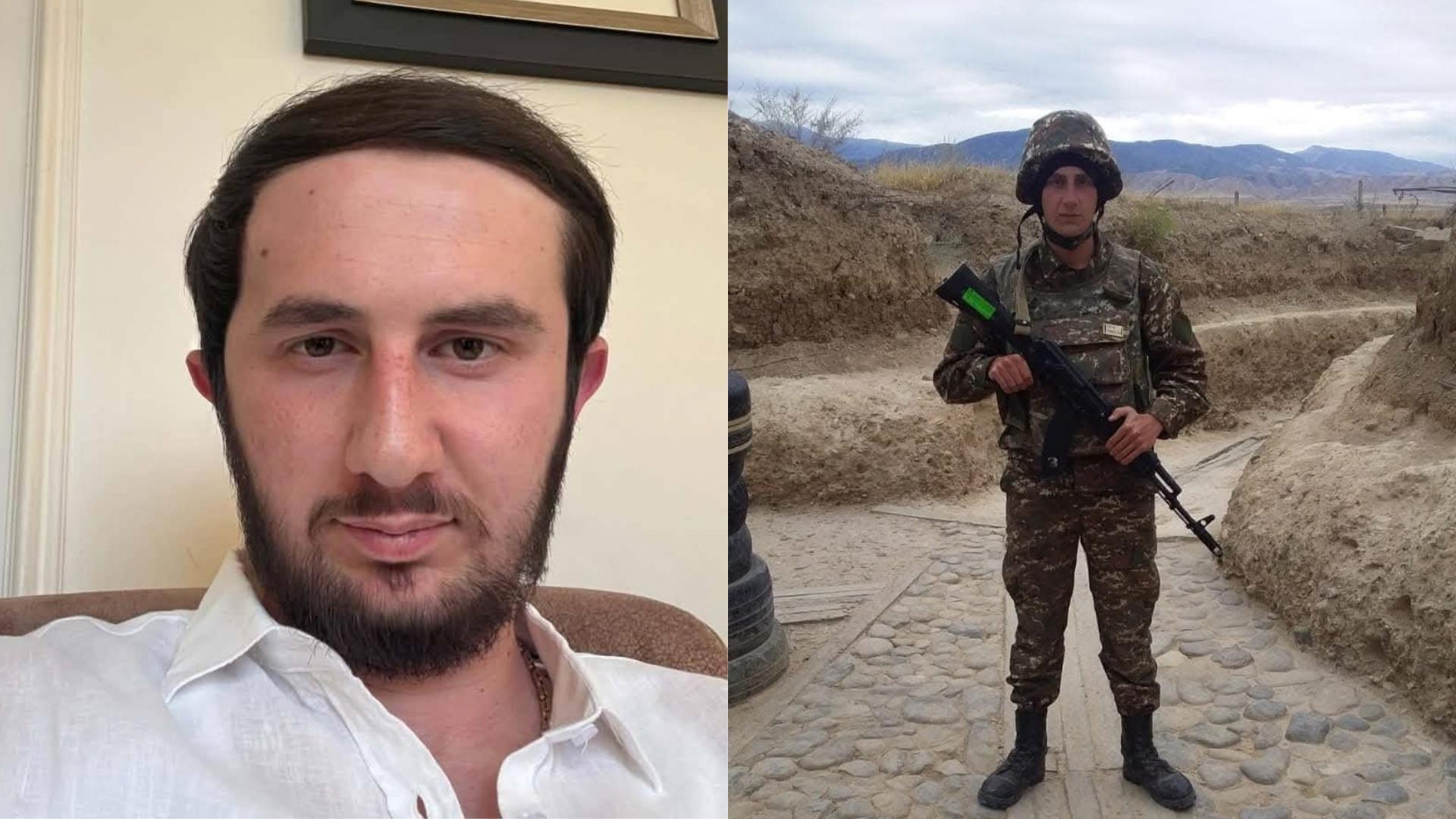
From Coma to College Graduate: 2020 Artsakh Vet Describes Chaos at Mataghis
This is the third in a series of stories told by 2020 Artsakh War vets now being treated at Yerevan’s Soldier's Home Rehabilitation Center (also known as Zinvori Tun). Narek Vardanyan, a vet himself at the center, is gathering and recording their recollections of the war. (Part 2)
On the first day of the 2020 Artsakh War, conscript Grigor Adoyan sustained a devastating craniocerebral injury in the frontline village of Mataghis. The blast left him in a coma for eleven days, completely paralyzed the right side of his body, and stripped away his ability to speak. After surviving the trauma, he faced the arduous journey of relearning how to live from scratch.
Below is his firsthand account of the chaos that erupted at the Mataghis military unit on the morning of September 27, 2020.
Convoy Under Fire: Mobilizing the AGL Platoon
On January 13, 2020, I was conscripted for mandatory military service at military unit No. 33656, stationed in the village of Mataghis within the Martakert district of Artsakh. The unit was under the command of Colonel Samvel Karapetyan, and I served as a gunner in the Automatic Grenade Launcher (AGL) platoon.
The morning of September 27 began like any ordinary day at the unit. Suddenly, the surrounding mountains came under intense artillery fire, and fires ignited across the slopes. Even as the smoke rose, we initially assumed it was just a regular military exercise. It took us some time to grasp the reality that war had begun.
By 07:40, under the command of the unit’s lieutenant colonel, the deputy commander for combat operations, we mobilized and rushed to the vehicle depot. We set off for our deployment area in two transport vehicles: one Ural and one Sadko truck. Enemy artillery was targeting our direction heavily. Along the route, shrapnel from the shelling punctured one of the Sadko’s tires, forcing us to abandon it and squeeze into the Ural.
Inside the Ural, there were eighteen soldiers and the deputy commander. As we advanced, we dropped off four men from our platoon at a position whose name I cannot recall. The remaining fourteen soldiers, alongside the deputy commander, proceeded toward combat position 126 on the second line, reaching it by 08:20. Three of our automatic grenade launchers were left behind on the road inside the damaged Sadko, but we managed to bring the remaining three with us. Stationed just 200 meters ahead of us on the first line were the forces of our military unit’s 4th Battalion.
Deployed to the Frontlines: Relocation to Goris Command Post
That same day, at 09:00, the deputy commander for armament arrived at our trench with a stark warning: 'Get ready; we are going to a serious and dangerous place—the Goris Command and Observation Post (GCOP). Anyone who doesn't want to come can stay here, but for those who do come, know that we are going to conduct an important mission.'
Three men chose to stay behind at Position 126. The remaining eleven of us in the platoon mobilized and headed toward Position 136, located along the route connecting Mataghis to the village of Talish. Upon arriving, I learned from the troops stationed there that the GCOP was the military designation for position 136, situated directly adjacent to the notorious 'Bozi Kalgotka' position.
The situation at the GCOP was already catastrophic. There were five officers and thirty soldiers on site, ten of whom were already wounded. We hastily set up two of our grenade launchers and tried to return fire. However, between our intense disorientation and the relentless, deafening bursts of enemy shelling, our hands were trembling uncontrollably. Out of sheer fear and anxiety, we struggled to remember the proper mechanics to load, aim, and fire—and the heavy weaponry simply wouldn't function. We couldn't manage to fire a single shot."
The Blast and the Eleven-Day Coma
By 10:30 AM, my comrade-in-arms Norayr and I left the safety of the trench, stepping out into the open area adjacent to our position to scout a suitable spot to deploy our third grenade launcher. At that exact moment, an artillery shell detonated right next to us.
The blast convulsed Norayr and inflicted a severe, catastrophic traumatic brain injury on me, knocking me instantly unconscious. My comrades later told me that Norayr desperately called out for help. Two fellow soldiers, Habet and Avo, rushed into the line of fire and carried my body back into the shelter.
Roughly half an hour later, a UAZ military ambulance evacuated me from the GCOP shelter to the city of Goris. From there, I was airlifted by helicopter to the Astghik Medical Center in Yerevan. I plunged into a coma that lasted for eleven days.
When I finally regained consciousness, I could neither speak nor walk. I was incredibly weak and only semi-conscious. The shrapnel and blast impact had severely damaged the left hemisphere of my brain, destroyed my speech center, and completely paralyzed the right side of my body, leaving my right arm and leg entirely useless.
Relearning to Walk at the Soldier's Home
On November 30, 2020, I was transferred to the Soldier's Home Rehabilitation Center in Yerevan to begin the grueling process of recovery. I arrived in a wheelchair, completely dependent on others, and capable of uttering only a few fragmented words.
I spent the next two months confined to that wheelchair. However, through the truly superhuman efforts, patience, and dedication of the rehabilitation specialists, I slowly began to reclaim my body. Step by step, I relearned how to walk and how to speak.
Months later, I defied the initial prognosis. I walked out of the center and returned home on my own two feet, with my speech significantly restored."
P.S. For five years following his injury, Grigor Adoyan has returned to the Soldier's Home Rehabilitation Center twice a year to sustain his recovery. Refusing to let his physical limitations define his future, he balanced his medical treatments with professional development, completing specialized courses in Advanced Excel, digital media marketing, and English.
In 2022, having recovered sufficiently to manage academic workloads, Adoyan resumed his studies in Business Administration at the Russian-Armenian University (RAU)—returning to the classrooms he had left behind for his military service. His resilience culminated in 2026, when he successfully graduated with his bachelor’s degree. Equipped with a university diploma and a strong technical skill set, Grigor is currently seeking employment opportunities to launch his corporate career.
Write a comment