 Videos
 Photos


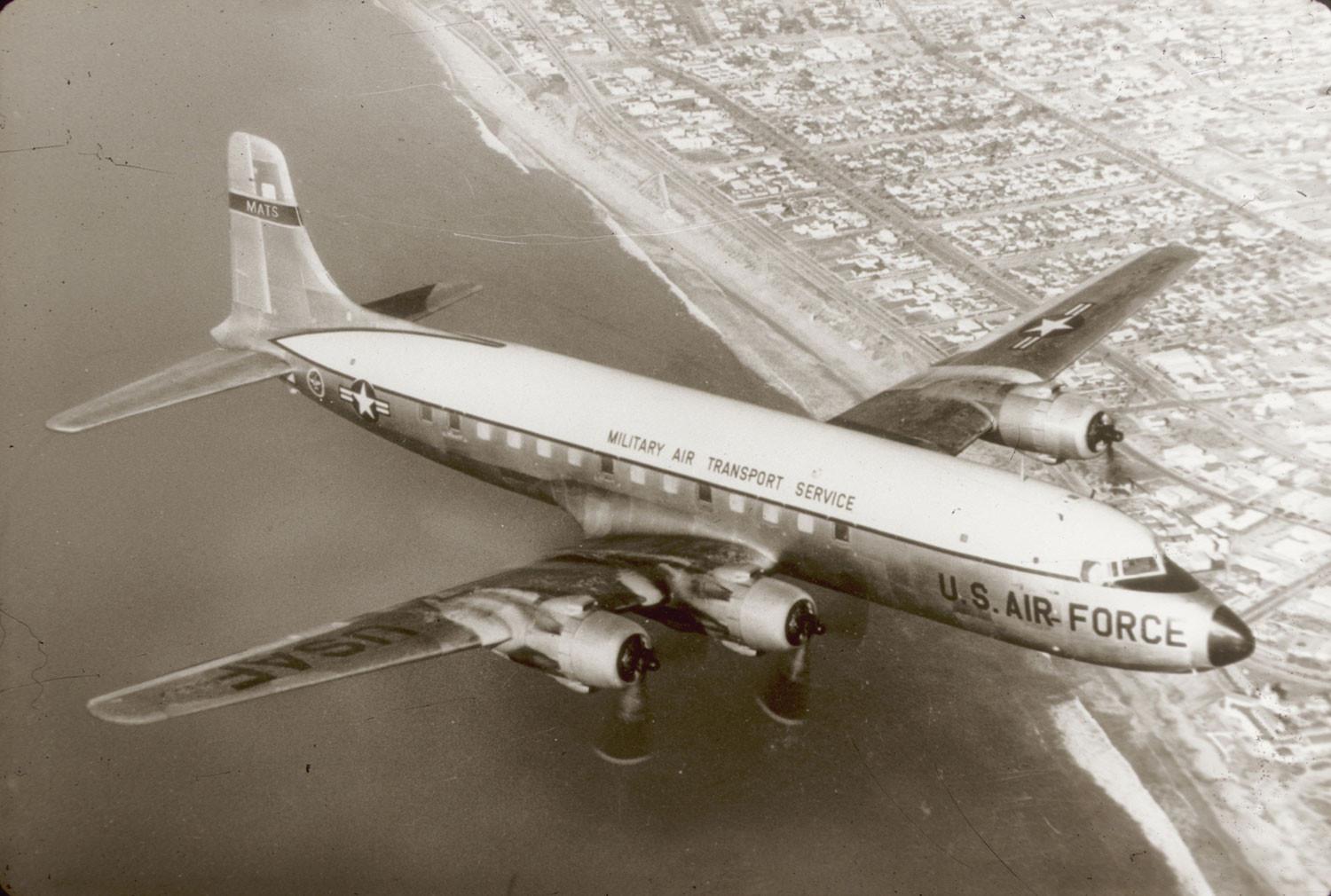
1958: Soviet Fighter Jets Clash with U.S. Aircraft Over Armenia
In 2022, one of the documents declassified by the administration of U․S․ President Joe Biden sheds light on a plane crash that occurred in 1958, about which little was known until then. At its core were American and Soviet military and intelligence representatives, and the scene of the accident was Armenia and Nagorno-Karabakh.
Hetq continues to present accidents that occurred in the territory of Armenia, as well as accidents related to Armenian aviation, during which not only aircraft were destroyed, but also in many cases people died.
In aviation, an accident is when a person receives fatal or serious bodily injury, or when the structure of the aircraft is destroyed, which usually requires major repairs or replacement of a damaged part. Accidents are also considered cases when an aircraft disappears without a trace or appears in a place where it is impossible to approach it. An accident that results in a human casualty is classified as a disaster, while an accident without a casualty is classified as an accident.
In 1958, two major accidents occurred in Armenia, involving Soviet and American military aircraft. During the Soviet era, such accidents were typically kept secret from the public, and details of many of them only became known following the collapse of the USSR.
An American Plane That Entered Armenia’s Airspace Made an Emergency Landing in Nagorno-Karabakh
The first case occurred on June 27, 1958, when a U.S. Air Force (USAF) C-118A Liftmaster transport plane (registration number 51-3822) was flying from Nicosia, the capital of Cyprus, to Tehran's Mehrabad Airport (Iran was then a secular state headed by the Shah and had good relations with the West).
Details of the accident are presented in a document published by the U.S. National Archives and Records Administration (NARA), which was compiled some four months after it occurred on November 1, 1958, and was declassified only in 2022. The document was allegedly compiled by the U.S CIA (Central Intelligence Agency).
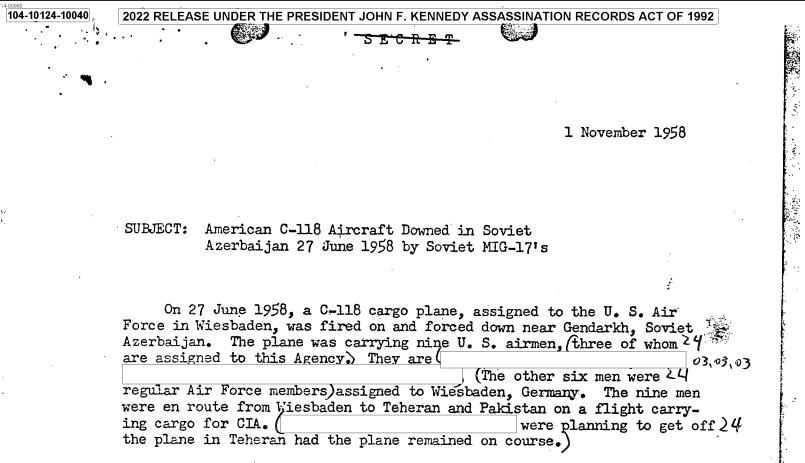
Document Excerpt from the 2022 declassified document
The plane was transporting cargo for the CIA from the West German city of Wiesbaden, where it was based, to Tehran and Pakistan. The crew of the plane consisted of nine Americans, three of whom were CIA agents. The other six were U.S. Air Force military personnel serving in Wiesbaden.
At the time of the accident, the plane was flying along the Nicosia-Tehran route. Some of those on board were supposed to disembark in Tehran, and the C-118 was supposed to continue its flight to Pakistan. According to the declassified American document, on the way to Iran, the plane deviated from its route due to bad weather and a navigation error and entered Armenia’s airspace from Turkey. According to the document, the USSR border was not intentionally violated.
According to another source, the C-118 was supposed to leave Tehran for Peshawar, Pakistan. The flight, which took off from Wiesbaden, was carried out in support of the activities of the American U-2 reconnaissance aircraft, which made a name for itself in the Cold War. According to the same source, the commander of the C-118 was Major Luther W. Lyles, and CIA agents accompanied the cargo. The aircraft violated the Armenian-Turkish border at 18:30 and appeared in the territory of Soviet Armenia, 30 km south of Yerevan.
To intercept the C-118 flying east, two Soviet MiG-17PF fighters (pilots: Major Svetlichnikov, Senior Lieutenant Zakharov) of the 976th Fighter Aviation Regiment took to the sky from the Kurdamir airport in Azerbaijan. According to available information, at 18:44, 20 km from Lake Sevan and at an altitude of 5,000 m, they discovered the trespassing American plane. At first, the C-118 did not want to obey the orders of the Soviet fighters, but after a short burst of fire, a fire broke out on the left wing of the reconnaissance aircraft, and it had to make an emergency landing. After the aircraft was damaged, 5 of the 9 crew members parachuted from the plane, while the other 4 managed to make an emergency landing near the village of Levonarkh in the Martakert region of the Nagorno-Karabakh Autonomous Oblast (NKAO), which was part of Soviet Azerbaijan, where, according to an American document, there was a small runway.
Locals Wanted to Hang One of the CIA Agents
The plane, which had been manufactured six years before the accident, had caught fire and was destroyed. The four crew members somehow managed to exit the plane.
The five who had previously parachuted out of the downed plane, were surrounded on the ground by local residents, some of whom beat them. The crowd took one of the five Americans, a CIA agent, to a telephone pole to hang him, but the Soviet military arrived at the scene and prevented this.
Interrogations in Baku
All the Americans were handed over to the Soviet military. The captured, according to the declassified American document, spent the night in a garrison near Stepanakert, and then were allegedly transferred to Yevlakh, and from there to Baku. Here, the Americans were interrogated by Soviet intelligence officers, at least one of whom, Vladimir Bourdin, had previously served in the United States and then in the USSR embassy in Canada. Bourdin interrogated one CIA agent for several days, while the other Americans were held at the Soviet Azerbaijan’s Ministry of Internal Affairs.
After the individual interrogations, the Americans were also interrogated separately at the Ministry of Internal Affairs by a commission of Soviet officials. They queried the Americans about violating the USSR border and gave them statements to sign stating that they had been treated well and provided with medical assistance. According to the declassified American document, the inquiry conducted by this commission was perfunctory and did not involve an interrogation in the intelligence sense. On July 7, 1958, the crew of the C-118 was transferred to Astara, near the USSR-Iran border, and handed over to the U.S. air attaché.
Soviets Release Americans, Investigation in Washington
The released Americans were immediately sent to Wiesbaden, West Germany, where CIA and Air Force officers jointly debriefed them. They gave a press conference after having been thoroughly briefed on the text and limitations as to what they could say.
The entire crew was then transferred to Washington, where an extended debriefing was conducted into what had happened. It turned out that the CIA officers had briefcases containing secret documents and address books with the names, addresses, and phone numbers of CIA officers and units. Presumably, both briefcases were burned because of the fire on the plane, but the address book of one of the CIA officers was taken by the villagers who captured them. The book was later returned to them by members of the Soviet commission who interrogated the crew in Baku. Although Soviet intelligence officers did not question the Americans about the briefcases or their contents, the CIA assumed that the USSR had or would have the information in the address book in its Moscow files. It was also revealed that some of those on the plane had personal notes in their wallets about several other CIA employees.
There was no evidence that Soviet authorities drugged or otherwise tampered the Americans during the interrogation. It has been recorded that some of the Americans received shots after being arrested to treat wounds and burns.
In the United States, the crew was questioned in detail about their treatment and the interrogation techniques used by the Soviet intelligence officers. The conclusion was that the Soviets had superficially interrogated the Americans, and that there was apparently no close coordination or communication with Moscow for intelligence research purposes. According to the declassified document, the fact that the USSR Foreign Ministry quickly confirmed the information about the C-118 landing on its territory probably prevented the Soviet Interior Ministry from “fully exploiting” the crew members. However, two of the Americans were separated from the group and given preferential treatment, apparently “with the intention of developing them for information purposes.” However, in the United States, it was concluded that the two had behaved very well and had not revealed any information about the CIA or its activities.
The Americans did not obtained evidence that the Soviet authorities learned about the C-118 flight and the CIA connection during the interrogation of the crew, or that three of the crew were CIA agents. However, the Americans were confident that the Soviet special services would find the CIA connection of the address book's owner and perhaps others through the address book, which lists the open CIA telephone mumber below his name on the first page. And since that employee was interrogated about the military units in Wiesbaden, the Soviets presumably would see a connection between them and the CIA.
Thus, the Americans concluded that the C-118 crew was released prematurely, because the Soviet investigators did not use the means at their disposal, particularly the CIA agent's address book, did not check the data in it with the information through their files prior to release of the crew, and were unable to "break" the crew through interrogation.
In addition, no compromising material was found on the burned aircraft, and several of the crew destroyed incriminating building passes and notations in their wallets while on their way down in their parachutes, or immediately after landing in their chutes. It was also recorded that the CIA, the U.S. Air Force, and the executive branch exerted sufficient pressure on the USSR to release the American crew as soon as possible. Also important in this matter was the fact that the USSR Foreign Ministry rushed to present what had happened as a deliberate violation of Soviet airspace, thereby confirming that the American plane’s crew was under Soviet control.
According to the declassified American document, safeguards taken by the CIA and the USAF were such that there was no leak to the press during the crew's internment of the fact that there was an intelligence connection of the flight and crew of the C-118. And the recommendations section of the document states that publicity about what happened should be prohibited in the future to minimize the possibility of the press learning about the connection between C-118 and the CIA. In fact, the details of the accident were declassified only sixty-four years later.
While the June 27 accident ended positively for the Americans, just two months later, on September 2, another odd accident occurred in the territory of Armenia. Again, the Soviet authorities did not speak out about it. Only after Armenia gained independence did details emerge that shed light on the unprecedented air clash between the two superpowers, the USSR and the USA, over Armenia. Unlike the June accident, this time the American side suffered casualties.
More on this in our next article.
28.06.2026 - Changes and additions have been made to the article.
Top photo: US Air Force C-118A Liftmaster transport aircraft, 1960s, source: commons.wikimedia.org
Write a comment